
Space-Saving Weider 2980 Home Gym & Starter Kit Guide
Maximize small spaces with our Weider 2980 home gym layout guide. Discover the ultimate beginner starter kit, clearances, and space-saving flooring tips.

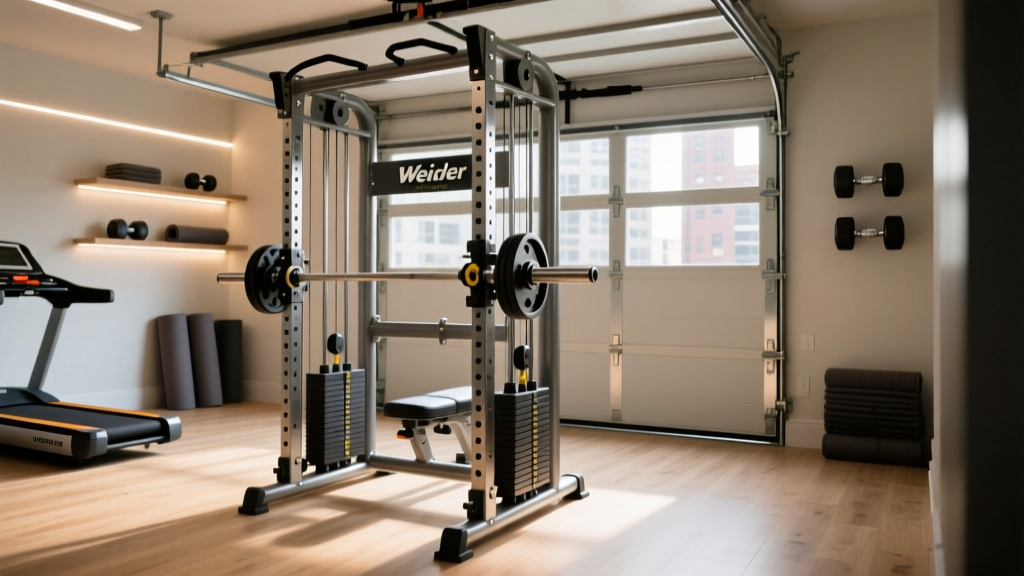
Designing a functional home gym in a limited footprint is one of the most common challenges for beginners. You want the versatility of a commercial facility, but you are constrained by the square footage of a spare bedroom, basement corner, or single-car garage. The Weider 2980 home gym has long been a popular anchor piece for budget-conscious beginners due to its relatively compact all-in-one design. However, relying solely on a single cable-and-pulley machine leaves critical gaps in a beginner's progressive overload journey.
This guide approaches the Weider 2980 not just as a piece of equipment, but as the spatial anchor for a comprehensive, space-optimized beginner starter kit. We will break down exact operational clearances, supplemental gear that solves the machine's inherent weight limitations, and layout matrices that keep your 'active zone' uncluttered.
Deconstructing the Weider 2980 Footprint & Operational Halo
Before purchasing supplemental gear, you must map the physical and operational reality of the Weider 2980. The machine's static footprint is approximately 50 inches long by 42 inches wide, with a height of 75 inches. However, static dimensions are useless for layout planning; you must calculate the 'Operational Halo'—the dynamic space required for human movement and cable travel.
💡 The 24/36 Clearance Rule:According to safety guidelines outlined by the American Council on Exercise (ACE), all-in-one cable machines require specific dynamic clearances to prevent joint impingement and cable snagging. For the Weider 2980, you need a minimum of 24 inches of lateral clearance on the lat-pulldown side for full shoulder abduction, and 36 inches of frontal clearance to accommodate the leg extension/curl lever arm and the user's seated knee trajectory.
If you are placing the unit in a corner, never push it flush against both walls. Position the 50-inch side against the back wall, and leave the 42-inch side exposed with the 24-inch lateral gap. This specific orientation allows the lat pulldown bar to clear the wall during wide-grip pulldowns, preventing the dreaded 'cable rub' that frays vinyl-coated aircraft cables over time.
The Beginner Supplemental Kit: Solving the 130-lb Ceiling
The most significant failure mode of the Weider 2980 for beginners is its 130-pound weight stack. While sufficient for the first 3 to 6 months of isolation movements (like tricep pushdowns or leg extensions), a novice will quickly outgrow this limit on compound movements like chest presses and lat pulldowns. To build a true 'starter kit' without buying a second, larger machine, we must integrate space-saving free weights.
1. Adjustable Dumbbells (The Overload Solution)
Instead of a sprawling dumbbell rack that consumes 15 square feet of floor space, invest in a pair of high-quality adjustable dumbbells. Models like the Nuobell 552 or Bowflex SelectTech 552 offer 5 to 52.5 lbs per hand, replacing 15 sets of fixed dumbbells. When combined, they provide 105 lbs of resistance for goblet squats, Bulgarian split squats, and heavy dumbbell floor presses, entirely bypassing the Weider's 130-lb stack ceiling for lower-body and unilateral work.
2. The Folding FID Bench
The Weider 2980 includes a basic vinyl seat pad, but it lacks an adjustable backrest for independent dumbbell work. Purchase a foldable Flat/Incline/Decline (FID) bench (such as the Flybird Adjustable Bench). Crucially, ensure the bench has a 'fold-and-store' footprint of less than 12 inches thick. When not in use, this bench slides directly under the overhang of the Weider's weight stack housing, reclaiming 8 square feet of floor space.
3. High-Density Flooring Over EVA Foam
Beginners often make the critical error of buying cheap, interlocking EVA foam puzzle mats. Under the concentrated point-load of a 200-lb Weider 2980 frame plus a 200-lb user, EVA foam compresses, causing the machine to list to one side and throwing the pulley alignment out of plumb. Instead, use 3/4-inch thick vulcanized rubber mats (commonly sold as 4x6 ft horse stall mats from agricultural suppliers like Tractor Supply Co., typically costing around $50-$60 each). You only need two mats (covering an 8x6 ft area) to create a stable, shock-absorbing 'Active Zone' that protects your subfloor and keeps the machine perfectly level.
Layout Blueprint: The 8x10 'Active Zone' Matrix
Assuming you have a standard 8x10 foot spare room or garage corner, here is the optimal spatial matrix to integrate the Weider 2980 and your supplemental starter kit without creating a claustrophobic environment.
| Zone Designation | Dimensions | Equipment Placement & Function |
|---|---|---|
| Zone A: The Anchor | 50' x 42' | Weider 2980 placed in the rear-left corner. 24' right-side gap maintained for lat pulldowns. |
| Zone B: The Free Weight Corridor | 72' x 36' | Center-right floor space. Folding FID bench deployed here for dumbbell presses. Clear path for walking lunges. |
| Zone C: The Dead Space | Under Machine | The 12' gap beneath the Weider's weight stack housing. Stores the folded FID bench and resistance bands. |
| Zone D: Transition & Storage | Wall-mounted | Over-the-door or wall-mounted peg rack for adjustable dumbbell handles (if separated) and lifting belts. |
Environmental Optimization: Mirrors, Airflow, and Lighting
Space optimization is as much psychological as it is physical. Small home gyms can quickly feel oppressive, which negatively impacts workout consistency—a factor heavily emphasized in Mayo Clinic's fitness guidelines regarding environment and habit formation.
- Mirror Placement: Install a large, shatterproof acrylic gym mirror on the wall directly opposite the Weider 2980. This serves a dual purpose: it allows you to monitor your spinal alignment during lat pulldowns and chest presses, and it optically doubles the perceived depth of the room, reducing the 'closet effect'.
- Targeted Airflow: All-in-one machines generate localized heat due to the friction of the weight stack plates and cable pulleys. In a small 8x10 room, this raises ambient temperature rapidly. Mount an oscillating wall fan at a 45-degree downward angle, aimed at the intersection of Zone A and Zone B. Do not place fans on the floor where they will blow dust into the Weider's weight stack guide rods.
- Lighting: Avoid single, harsh overhead bulbs. Use 4000K (neutral white) LED strip lighting mounted along the upper perimeter molding to eliminate deep shadows in the corners, making the space feel wider and safer during floor exercises.
Common Layout Failure Modes & Troubleshooting
Even with a perfect blueprint, beginners frequently encounter edge cases that disrupt their home gym ecosystem. Anticipate these three specific failure modes:
- Door Swing Interference: If your gym is in a spare bedroom, the inward-swinging door often collides with the 36-inch frontal clearance zone of the Weider 2980. Fix: Replace standard door hinges with 180-degree swing-clear hinges, or install a simple sliding barn door track to reclaim the 9 square feet of door-swing arc.
- Humidity and Guide Rod Corrosion: Basements and garages experience humidity fluctuations. The exposed steel guide rods on the Weider 2980 will develop micro-rust within 60 days in environments above 60% relative humidity, causing the 130-lb stack to 'stick' during the eccentric phase of a lift. Fix: Keep a small dehumidifier in Zone D, and wipe the guide rods with a silicone-based lubricant (never WD-40, which attracts dust) every 30 days.
- Cable Snagging on the Weight Stack Cover: Beginners often route the low-pulley cable incorrectly when switching from leg extensions to seated rows. If the cable rubs against the plastic weight stack cover, it will strip the vinyl coating. Fix: Apply a strip of high-density UHMW (Ultra-High Molecular Weight) polyethylene tape to the inside edge of the plastic cover where the cable makes contact.
'The most effective home gym isn't the one with the most equipment; it's the one where the friction between deciding to work out and actually starting is reduced to zero. A well-laid-out 8x10 space with a Weider 2980 and adjustable dumbbells removes the clutter barrier and keeps the focus entirely on the training.'
Final Investment Breakdown
Building this space-optimized starter kit is highly cost-effective compared to commercial gym memberships or sprawling power racks. Here is the realistic 2026 budget breakdown for this exact layout:
- Weider 2980 (Refurbished/Secondary Market): $250 - $400
- Adjustable Dumbbells (5-52.5 lbs pair): $300 - $400
- Foldable FID Bench: $130 - $180
- Vulcanized Rubber Flooring (2x 4x6 mats): $110 - $130
- Total Estimated Investment: $790 - $1,110
By treating the Weider 2980 as a spatial anchor rather than a standalone solution, and by strictly enforcing the 24/36 clearance rule, you can build a highly capable, progressive, and uncluttered home gym that will support your fitness journey from novice to intermediate without requiring a dedicated 400-square-foot room.
More gear to consider
All reviews
Trump Home Gym Trend: 2026 Electrical & Safety Requirements

Centr 1 Home Gym Reviews: Best Compact & Foldable Alternatives

Marcy Club Home Gym: Strength Setup & Longevity Tips
Weider 8630 Home Gym: 2026 Market Trends & Garage Setup Guide

Marcy Stack Home Gym Setup: Mirror Placement & Lighting Kits Compared
