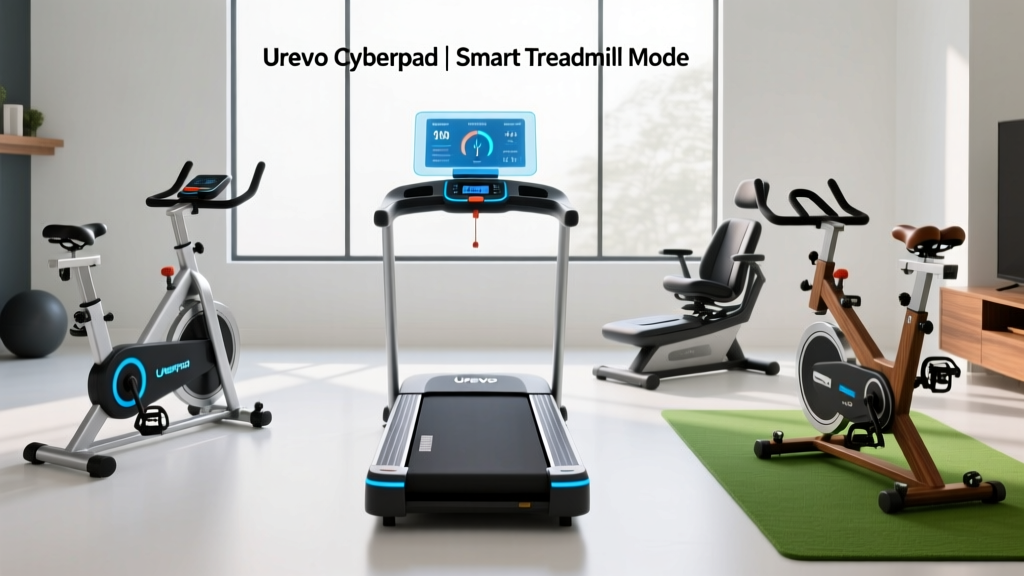
Urevo Cyberpad for Home Smart Treadmill vs. Stationary Bike Types
We compare the Urevo Cyberpad for home smart treadmill setups against upright, recumbent, and spin bikes to help you build the ultimate 2026 cardio gym.

The Home Cardio Dilemma: Walking Pads vs. Traditional Cycling
When designing a compact home gym in 2026, space constraints and joint health are the primary limiting factors. The debate frequently narrows down to low-impact walking pads versus traditional cycling. Specifically, fitness enthusiasts are weighing the urevo cyberpad for home smart treadmill workflows against the three main stationary bike types: upright, recumbent, and spin. Each modality offers distinct biomechanical advantages, price points, and long-term failure modes that dictate its place in your home.
Deep Dive: Urevo Cyberpad for Home Smart Treadmill Setups
The Urevo CyberPad has dominated the under-desk and walking pad market. Retailing between $169 and $229 in 2026, it features a 2.5 HP peak motor and a 47-inch by 20-inch running deck. However, as hands-on reviewers, we must look past the marketing peak horsepower. The continuous duty motor is rated at approximately 0.85 HP.
Expert Warning: Running the Urevo CyberPad at its maximum 4.0 mph speed for more than 90 consecutive minutes will trigger a thermal shutdown. This machine is engineered strictly for Low-Intensity Steady State (LISS) walking, not sustained jogging or running.From a biomechanical standpoint, walking on a flat, un-inclined pad generates a tibiofemoral joint load of roughly 1.2 times your body weight. While significantly lower than outdoor running, it still requires adequate ankle dorsiflexion and hip extension, which may aggravate users with severe lumbar radiculopathy or acute plantar fasciitis.
Stationary Bike Types: Upright, Recumbent, and Spin
1. Upright Bikes (The Versatile All-Rounder)
Upright bikes mimic the geometry of a traditional road bicycle but with a slightly more relaxed torso angle. The Schwinn IC4 (approx. $799) remains a benchmark in this category. It utilizes a magnetic resistance system with 100 micro-levels, ensuring silent operation. The primary drawback of upright bikes is saddle pressure; users often experience perineal numbness after 45 minutes unless they invest in a high-density gel seat cover or wear padded cycling shorts.
2. Recumbent Bikes (The Rehabilitation Standard)
If joint preservation is your ultimate goal, recumbent bikes are unmatched. The Nautilus R618 ($1,199) features a ventilated, contoured backrest that completely unloads the lumbar spine. According to research published by the American College of Sports Medicine, recumbent cycling minimizes shear forces on the knee joint while maintaining high cardiovascular output. The step-through design makes it the only viable option for users with limited hip mobility or those recovering from total knee arthroplasty.
3. Spin / Indoor Cycling Bikes (The Performance Choice)
Spin bikes are built for high-cadence intervals and aggressive riding postures. The Keiser M3i ($2,295) is the gold standard, featuring a rear-mounted V-frame flywheel that prevents sweat corrosion—a common failure point in cheaper front-flywheel models. Spin bikes demand significant core engagement and hamstring flexibility. They are not recommended for users with chronic lower back pain, as the aggressive forward flexion can exacerbate disc herniations.
Biomechanical & Spatial Comparison Matrix
| Modality | Peak Knee Flexion | Joint Load (x Body Weight) | Footprint (L x W) | 2026 Price Range |
|---|---|---|---|---|
| Urevo CyberPad | ~60° (Walking) | 1.2x | 57" x 22" | $169 - $229 |
| Upright Bike | ~105° | 0.8x | 45" x 21" | $400 - $900 |
| Recumbent Bike | ~90° | 0.5x | 65" x 28" | $800 - $1,500 |
| Spin Bike | ~115° | 1.0x (Standing) | 48" x 22" | $900 - $2,300 |
Caloric Expenditure and Heart Rate Zone Targeting
When evaluating cardio machines, users frequently ask which modality burns the most calories. The answer relies on the law of thermodynamics and your ability to sustain effort in specific heart rate zones. A 180-pound individual walking at 3.5 mph on the Urevo CyberPad will burn approximately 280 to 310 calories per hour. Because the upper body is largely disengaged, the systemic oxygen demand remains relatively low.
Conversely, a spin bike allows for simultaneous upper and lower body engagement when riding out of the saddle. That same 180-pound individual performing 30-second sprint intervals on a Keiser M3i can easily exceed 700 calories per hour, pushing their heart rate into Zone 4 (80-90% of max HR). Upright and recumbent bikes fall in the middle, typically yielding 400 to 550 calories per hour during steady-state Zone 2 cardio. If your primary 2026 fitness goal is rapid lipid oxidation and cardiovascular conditioning, the walking pad will serve as a supplementary tool, while the bikes will act as the primary metabolic driver.
Real-World Maintenance and Failure Modes
Cardio equipment degrades based on usage patterns and environmental factors. Here is what you need to know about maintaining these machines in a home environment:
- Walking Pad Belt Drift: The Urevo CyberPad belt will naturally drift to the left or right after approximately 80 to 100 miles of use. You must manually adjust the rear roller bolts using the included hex key. Furthermore, the deck requires 100% silicone lubricant every 40 hours of use; neglecting this will cause the motor to overheat and draw excess amperage, eventually frying the control board.
- Magnetic Upright Potentiometer Failure: On mid-tier upright bikes, the tension cable connecting the resistance knob to the magnetic brake can stretch or snap after 2-3 years of heavy use. Replacing this cable requires partial disassembly of the shroud.
- Spin Bike Sweat Corrosion: Human sweat is highly saline and corrosive. If you use a spin bike without a sweat guard and fail to wipe down the handlebars and flywheel housing with a pH-neutral cleaner after every session, the structural integrity of the steel frame will compromise within 24 months.
The Final Verdict: Choosing Your Modality
Choosing between the urevo cyberpad for home smart treadmill routines and a dedicated stationary bike depends entirely on your orthopedic profile and spatial constraints.
If you work from home and want to seamlessly integrate 10,000 daily steps into your workday without dedicating a massive footprint to a gym, the Urevo CyberPad is the undisputed champion of convenience.
However, if your goal is high-intensity interval training (HIIT), VO2 max improvement, or you require zero-impact rehabilitation, a recumbent or spin bike is non-negotiable. The American Heart Association recommends at least 150 minutes of moderate-intensity aerobic activity per week. A recumbent bike allows you to hit this target safely, even with severe joint limitations, while a spin bike will push your cardiovascular ceiling far beyond what a 4.0 mph walking pad can achieve.
More gear to consider
All reviews
NordicTrack C2150 Treadmill Motor Guide: HP & Size Explained

How Much Walking on a Treadmill to Lose Weight: Under-Desk Review

Space Layouts: Rove Concepts Camino Treadmill vs Stationary Bikes

Massage Equip Recovery Essentials: Science-Backed Tools for Athletes, Drivers, and Daily Commuters

Echelon Stride Folding Treadmill vs Rowing Machine: 2026 Guide
