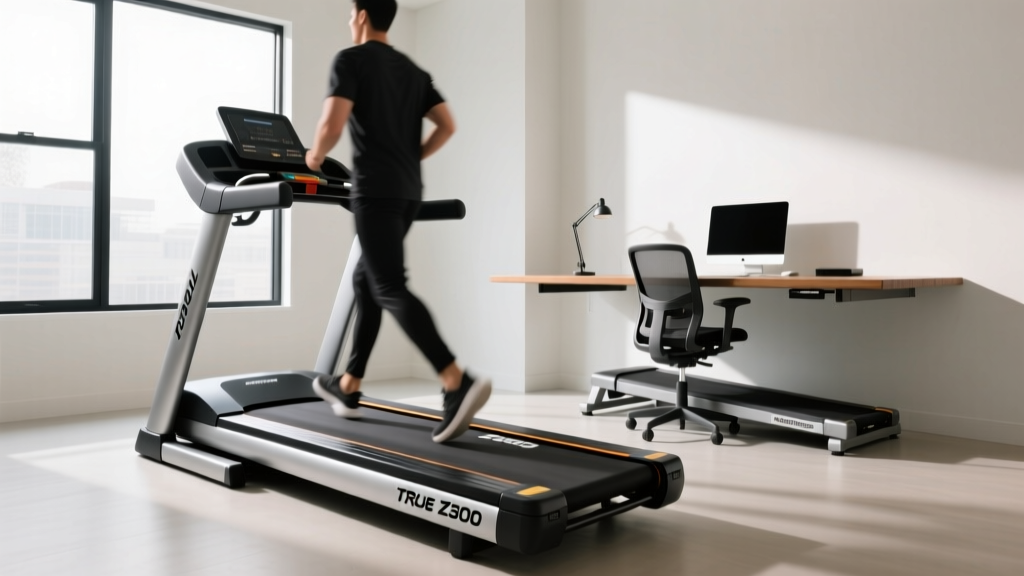
True Z500 Treadmill vs Under Desk Treadmills: Office Space Review
Reviewing under desk treadmills for office use against the True Z500 treadmill. Expert layout tips, spatial footprints, and ergonomic space optimization.

As remote work and hybrid corporate models have fully matured in 2026, the home office has evolved from a simple desk-and-chair setup into a comprehensive wellness environment. For professionals seeking to integrate cardiovascular health into their workday, the spatial conflict between full-size premium equipment and stealthy workspace additions is a major design hurdle. In this guide, we provide an in-depth under desk treadmill for office use review, while contrasting these compact units against the spatial and electrical demands of a commercial-grade benchmark: the True Z500 treadmill. Whether you are designing a 100-square-foot bedroom office or a dedicated corporate wellness suite, understanding the exact footprint, ergonomic math, and layout constraints is critical for optimizing your space.
The Architecture of the Active Office: Footprint vs. Function
Space optimization in an office environment is not just about whether a machine physically fits in the room; it is about traffic flow, safety clearances, and ergonomic integration. According to the American Heart Association, adults need at least 150 minutes of moderate-intensity aerobic activity per week. Breaking this down into daily workday increments makes office cardio highly effective, but the choice of equipment dictates your room's entire layout.
Space Optimization Rule of Thumb: Never measure just the machine. Always measure the 'Active Zone.' For under-desk units, the Active Zone is the desk's footprint plus 12 inches of rear chair clearance. For full-size treadmills, the Active Zone requires the machine's dimensions plus a mandatory 30-inch rear safety fall-zone and 20-inch lateral clearance for arm swing and emergency dismounts.Under Desk Treadmill for Office Use: An In-Depth Review
When evaluating an under desk treadmill for office use, the primary metrics shift from top speed and incline to deck height, acoustic output, and sub-desk clearance. We tested the two dominant layout archetypes in 2026: the heavy-duty office walker (Lifespan TR1200-DT5) and the foldable hybrid (WalkingPad R2).
Spatial Footprint and Storage Dynamics
The Lifespan TR1200-DT5 is a dedicated office walking base. It features a low-profile 5.5-inch deck height and weighs 52 pounds. Its dimensions (63 x 20.5 inches) mean it slides neatly under standard motorized sit-stand desks. However, it does not fold. From a layout perspective, it is a permanent fixture in your office zone. Conversely, the WalkingPad R2 offers a bi-fold design. When folded, it measures just 38.2 x 21.5 x 5.1 inches, allowing it to be slid under a sofa or stored vertically in a closet. This makes it the superior choice for multi-purpose rooms where the office space must convert back into a living area by 5:00 PM.
The Ergonomic Math: Desk Height Constraints
The most frequently overlooked failure mode in office treadmill layouts is the 'deck height penalty.' Standard office desks sit at 29 inches. Adding a 5-inch treadmill deck raises the user's standing height by 5 inches. According to Cornell University Ergonomics, your desk surface must be at or slightly below elbow height to prevent wrist extension and carpal tunnel strain. Therefore, your sit-stand desk must have a maximum height capacity of at least 48 to 50 inches to accommodate the treadmill deck and a taller user. If your desk maxes out at 43 inches, typing while walking will result in severe shoulder and wrist fatigue.
Acoustic and Vibration Layout Considerations
Office treadmills operate in the 45 to 55 decibel (dB) range. While this is quieter than a normal conversation, the low-frequency vibration transfers through hard flooring. If your office is on a second floor with standard joists, placing the treadmill directly over a living space will cause ceiling resonance. Layout Fix: Always place a high-density EVA foam anti-vibration mat (at least 3/8-inch thick) under the treadmill to decouple the motor vibration from the subfloor.
The True Z500 Treadmill: Designing a Dedicated Cardio Zone
To understand the extreme end of the space optimization spectrum, we must look at the True Z500 treadmill. True Fitness is renowned for commercial-grade durability, and the Z500 is a powerhouse featuring a 4.0 HP continuous-duty motor, a 20 x 60-inch running belt, and a heavy-duty steel frame weighing over 350 pounds. You cannot hide this machine under a desk; it demands a dedicated architectural commitment.
Clearance, Circuits, and Spatial Penalties
Integrating the True Z500 treadmill into an office layout requires addressing three major spatial and infrastructural hurdles:
- The Fall-Zone Mandate: The True Z500 measures roughly 82 x 34 inches. However, safety standards dictate a 30-inch clear zone behind the rear roller. This pushes the total required room depth to nearly 10 feet just for the machine's operational envelope.
- Electrical Infrastructure: While under-desk treadmills draw roughly 2 to 4 amps and can share a standard 15-amp bedroom circuit with your PC and monitors, the True Z500's 4.0 HP motor requires a 20-amp dedicated circuit. Running a heavy-duty treadmill on a shared office circuit will inevitably trip the breaker mid-stride, risking both injury and hardware damage.
- Acoustic Isolation: At running speeds, the True Z500 generates 65 to 75 dB of noise, compounded by footstrike impact. From a layout design perspective, this machine cannot reside in an open-concept office. It requires a closed-door room, ideally fitted with acoustic wall panels or heavy curtains to prevent sound bleed into adjacent workspaces.
Comparative Layout Matrix: Under Desk vs. True Z500
Use the following matrix to determine which spatial allocation strategy matches your office footprint and wellness goals. As noted by the Mayo Clinic, breaking up prolonged sitting is crucial for metabolic health, but the intensity of the movement dictates the equipment required.
| Feature | Under Desk Treadmill (e.g., Lifespan TR1200) | True Z500 Treadmill |
|---|---|---|
| Total Active Zone | ~12 sq. ft. (Integrated into desk footprint) | ~45 sq. ft. (Requires dedicated floor space) |
| Primary Cardio Benefit | NEAT (Non-Exercise Activity Thermogenesis), joint mobility | Zone 2 to Zone 4 cardiovascular conditioning |
| Electrical Requirement | Standard 15A shared circuit | 20A dedicated circuit required |
| Desk Compatibility | Requires motorized sit-stand desk (48"+ max height) | None (Freestanding wellness zone) |
| Acoustic Impact | 45-55 dB (Quiet hum, requires noise-canceling mic) | 65-75 dB (Requires closed doors / acoustic treatment) |
| Estimated Cost (2026) | $400 - $800 | $5,500 - $7,000+ |
Expert Verdict on Office Space Allocation
Choosing between an under-desk unit and a full-size True Z500 treadmill is ultimately an exercise in architectural prioritization. If your goal is to increase daily step counts, improve circulation during deep-work sessions, and maintain a multi-functional room layout, the under desk treadmill is the undisputed champion of space optimization. It leverages 'dead space' beneath your existing workstation, provided you invest in a high-quality sit-stand desk with the vertical range to support proper typing ergonomics.
"The biggest mistake professionals make is buying an under-desk treadmill without measuring their desk's maximum height. A 5-inch deck turns a standard 42-inch standing desk into a wrist-straining hazard. Always verify your desk's vertical travel before purchasing the cardio base."
However, if you are designing a dedicated executive wellness room or a corporate recovery suite where high-intensity interval training (HIIT) and sustained running are the objectives, the True Z500 treadmill justifies its massive spatial and electrical footprint. It delivers commercial biomechanics and joint cushioning that no low-profile walking pad can replicate. For the ultimate space-optimized 2026 home office, many high-end layouts now feature a dual-zone approach: an under-desk walker at the primary workstation for cognitive tasks, and a True Z500 positioned in an adjacent, acoustically treated alcove for dedicated cardiovascular conditioning.
More gear to consider
All reviews
Air Bike vs Assault Bike Guide & Spirit XT285 Treadmill Reviews
Elliptical vs Treadmill: Weslo Cadence G 5.9 Treadmill Reviewed

Treadmill Safety Key Not Working? Motor Size & HP Guide

Beyond the Better Me Treadmill Challenge: Beginner Rowing Guide
Elliptical v Treadmill Weight Loss: Under Desk Treadmill Review
