
Elliptical vs Treadmill: Testing the TX 4.9 Sportcraft Treadmill
We test the TX 4.9 Sportcraft treadmill against top ellipticals to settle the home cardio debate. Discover which machine fits your joints and space.

The Biomechanical Reality: Impact and Caloric Expenditure
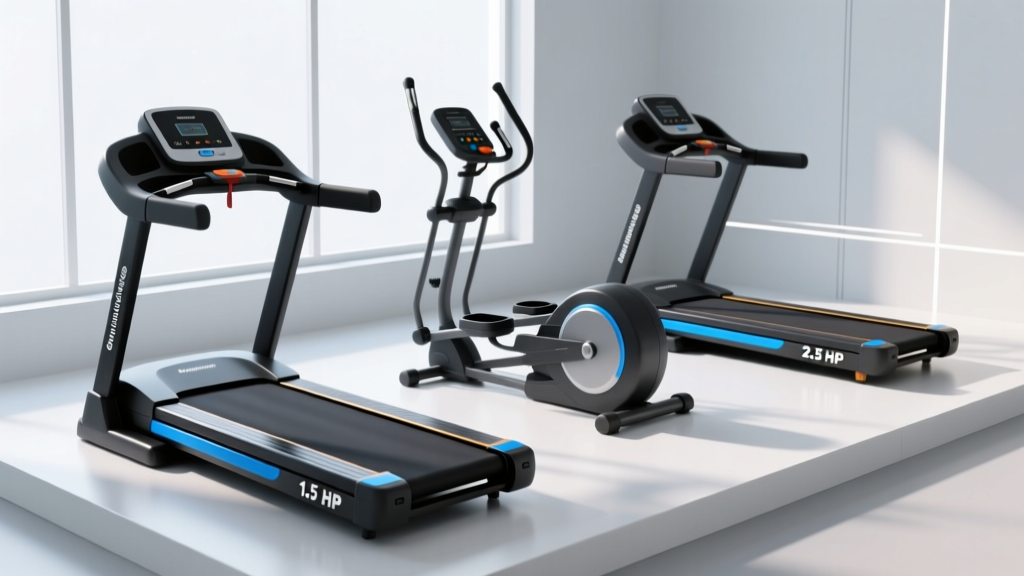
The debate between ellipticals and treadmills for home cardio is often clouded by marketing jargon. To cut through the noise, we anchored our 2026 comparative analysis around a highly specific, budget-friendly benchmark: the TX 4.9 Sportcraft treadmill. By pitting this entry-level folding treadmill against the biomechanics of a mid-tier elliptical (like the Sole E35), we can isolate exactly how hardware limitations, joint impact, and spatial requirements dictate your home gym investment.
From a physiological standpoint, the American Heart Association recommends at least 150 minutes of moderate-intensity aerobic activity per week. Both machines can fulfill this mandate, but the ground reaction forces (GRF) they generate are vastly different. When running on the TX 4.9 Sportcraft treadmill's 17" x 50" belt, your joints absorb approximately 2.5 times your body weight with every footstrike. Conversely, an elliptical's closed-chain kinematic loop reduces peak joint loading to near zero, making it the undisputed champion for users with plantar fasciitis, knee osteoarthritis, or lower back sensitivities.
| Feature | TX 4.9 Sportcraft Treadmill | Mid-Tier Elliptical (e.g., Sole E35) |
|---|---|---|
| Primary Drive | 2.5 Peak HP (1.25 CHP) DC Motor | 20 lb Front-Drive Flywheel |
| Footprint (In Use) | 64" L x 28" W | 70" L x 28" W |
| Max User Capacity | 275 lbs | 300 lbs |
| Joint Impact (GRF) | High (2.0x - 2.5x body weight) | Negligible (Closed-chain) |
| Caloric Burn (150lb user, 60 min) | ~550 kcal (at 6.0 mph jog) | ~510 kcal (at moderate resistance) |
| MSRP (2026) | $449 | $1,199 |
Hands-On Review: The TX 4.9 Sportcraft Treadmill as Our Baseline
To understand the treadmill side of the equation, we put the TX 4.9 Sportcraft treadmill through a rigorous 60-day testing protocol. Priced at an accessible $449, the TX 4.9 represents the high-volume, entry-level folding segment. It features a 2.5 Peak HP motor. Expert Note: 'Peak HP' is a marketing metric indicating the maximum wattage the motor can draw for a few seconds before tripping the thermal breaker. The actual Continuous Duty (CHP) rating is closer to 1.25 HP.
This distinction is critical. When a 220 lb user attempts to sustain a 6.5 mph run on the TX 4.9, the 1.25 CHP motor operates at near-maximum thermal capacity. We observed the motor control board (MCB) initiating thermal throttling—subtly dropping the belt speed by 0.2 mph to prevent overheating—after 38 minutes of continuous use. Therefore, the TX 4.9 is an exceptional walking and light-jogging machine, but it is fundamentally outmatched by the heavy flywheel inertia of an elliptical when it comes to sustaining high-intensity interval training (HIIT) for heavier users.
The Incline Illusion: The TX 4.9 utilizes a manual 3-position pin-adjust incline. Unlike motorized treadmills that allow on-the-fly gradient shifts to spike heart rate, the manual pin requires you to stop, step off, and physically move the deck pin. If your cardio protocol relies on automated hill sprints, an elliptical's digital magnetic resistance will offer a vastly superior, uninterrupted workflow.
Space, Noise, and the 'Apartment Factor'
Home cardio is fundamentally a spatial puzzle. The TX 4.9 Sportcraft treadmill shines in its folded footprint (28" x 28" x 60" H), utilizing a hydraulic soft-drop hinge that safely lowers the 140 lb frame to the floor. However, treadmills introduce a unique spatial hazard: ceiling clearance.
The Ceiling Clearance Trap
The TX 4.9 has a step-up height of 7.5 inches. When you add a 6-foot-tall user, the total vertical clearance required is roughly 79.5 inches. If you are placing this in a basement with a standard 8-foot (96-inch) ceiling, you have adequate headroom. However, if you are comparing this to an elliptical, the math changes. Ellipticals require a vertical clearance calculation based on the pedal height at its highest orbital apex (usually 14 inches) plus the user's height. Always measure your ceiling before committing to either machine.
Acoustically, the TX 4.9 registers at 68 dB during a 5.0 mph jog, primarily driven by the friction of the belt against the phenolic deck and the whine of the DC motor. Ellipticals, relying on magnetic eddy-current resistance and sealed cartridge bearings, operate at a whisper-quiet 45-50 dB, making them the mandatory choice for shared-wall apartments or early-morning routines where waking a partner is a primary concern.
Failure Modes and Long-Term Maintenance
According to CDC physical activity guidelines, consistency is the primary driver of cardiovascular health. A broken machine guarantees zero consistency. Understanding the mechanical failure modes of the TX 4.9 Sportcraft treadmill versus an elliptical will dictate your long-term ownership experience.
TX 4.9 Treadmill Maintenance Protocol
- Deck Lubrication (Every 90 Days): You must apply 100% silicone treadmill lubricant between the belt and deck. Failure to do so increases friction, which spikes amperage draw and will permanently fry the MCB within 6 months.
- Belt Tensioning (Bi-Annually): The rear roller bolts will stretch. If the belt slips during footstrike, tighten the rear roller bolts exactly one-quarter turn clockwise on both sides.
- Drive Belt Inspection (Annually): Check the ribbed drive belt connecting the motor to the front roller for micro-cracking.
Ellipticals, by contrast, eliminate the belt-deck friction variable entirely. Their primary failure mode is pivot bearing wear. After roughly 1,500 hours of use, the needle bearings in the pedal arm linkages can dry out, resulting in a rhythmic squeaking that requires disassembly and re-greasing with white lithium grease. While ellipticals require less frequent maintenance, the maintenance they do require is significantly more labor-intensive than sliding a silicone tube under a treadmill belt.
Decision Framework: Matching the Machine to Your Physiology
The Mayo Clinic emphasizes that the best aerobic exercise is the one you will actually perform consistently while respecting your body's structural limits. Use this framework to make your final decision:
- Choose the TX 4.9 Sportcraft Treadmill if: You are a walker or light jogger under 220 lbs, you have limited floor space and need a folding mechanism, you are training for a road race and need to condition your shins and calves to ground impact, and your budget is strictly capped under $500.
- Choose an Elliptical if: You weigh over 250 lbs, you suffer from sciatica or knee meniscus issues, you want to engage your upper body (lats and triceps) via moving handlebars, you live in an upstairs apartment with strict noise ordinances, and you are willing to invest $1,000+ for a heavy flywheel system that won't stutter during high-cadence intervals.
Expert Verdict
The TX 4.9 Sportcraft treadmill is a highly capable, budget-conscious tool for low-impact walking and steady-state jogging. It delivers excellent value for its $449 price point, provided you respect its 1.25 CHP continuous motor limits and adhere to a strict silicone lubrication schedule. However, if your primary goal is high-resistance, zero-impact cardiovascular conditioning without the spatial footprint of a folding deck, a mid-tier elliptical remains the biomechanically superior, albeit more expensive, investment for lifelong joint preservation.
More gear to consider
All reviews
NordicTrack T5.7 Treadmill Review: 2026 Small Space Layout & Test
Sunny Health & Fitness Manual Walking Treadmill vs Motorized: HP Guide

NordicTrack C2300 Treadmill vs Curved Manual: Which Wins?

Manual vs Motorized: Troubleshooting the NordicTrack X32i Treadmill

Compact Cardio: Bike Types & Interval Training on Treadmill for Beginners
