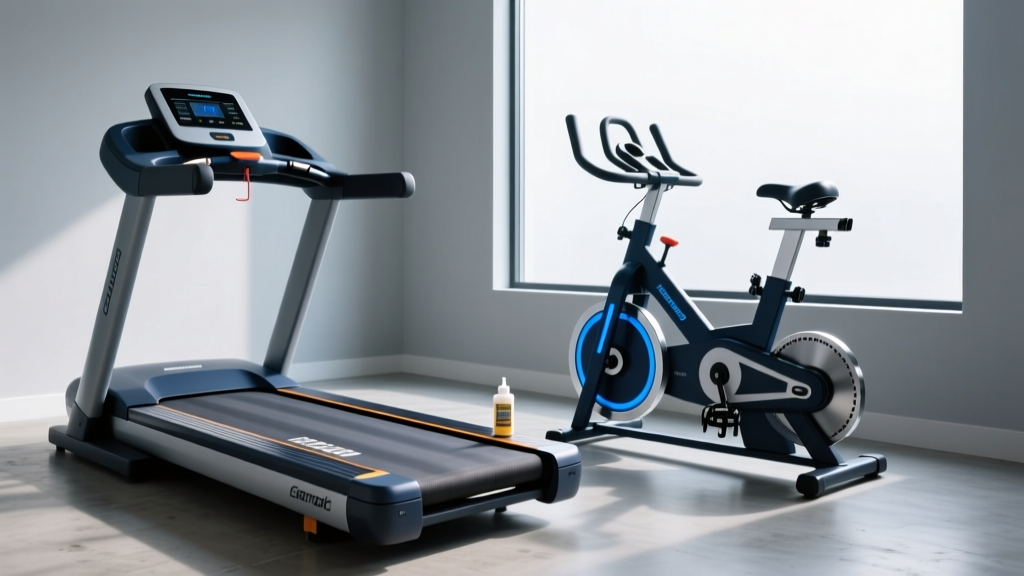
Treadmill Versus Bike: Belt Maintenance Costs & Value Analysis
Choosing a treadmill versus bike? We break down the hidden costs of treadmill belt maintenance and lubrication to help you maximize long-term value.

The Hidden Cost of Cardio: Treadmill Versus Bike Upkeep
When fitness enthusiasts debate the merits of a treadmill versus bike for their home gym, the conversation almost exclusively revolves around joint impact, calorie expenditure, and spatial footprint. However, from a strict budget breakdown and value analysis perspective, the most critical differentiator is often ignored: long-term mechanical maintenance. While stationary bikes operate on sealed magnetic resistance systems requiring virtually zero ongoing upkeep, treadmills rely on high-friction moving parts that demand rigorous, scheduled care.
According to the American Heart Association, consistency is the key to cardiovascular health, but your equipment's reliability dictates that consistency. If a treadmill breaks down due to neglected belt care, your fitness routine halts, and your wallet takes a massive hit. In this comprehensive value analysis, we dissect the exact financial implications of treadmill belt maintenance and lubrication, contrasting it against the near-zero maintenance costs of modern stationary bikes to help you make a financially sound investment in 2026.
Treadmill Belt Maintenance: The Real Dollar Breakdown
The treadmill belt and deck interface is a high-friction zone. As you walk or run, the belt glides over the wooden or composite deck. Without proper lubrication, the coefficient of friction increases dramatically. This doesn't just wear out the belt; it creates a cascading failure effect that targets the most expensive components of the machine.
When a belt is dry, the drive motor must work significantly harder to maintain speed. A standard 3.0 Continuous Horsepower (CHP) motor—like the one found in the popular Sole F80—might draw 8 to 10 amps under normal, lubricated conditions at 6 MPH. On a dry belt, that amp draw can spike to 15 amps or higher. This excess heat and electrical strain degrade the motor windings and frequently fry the Motor Control Board (MCB).
| Component | Maintenance/Repair Action | Estimated 2026 Cost | Frequency |
|---|---|---|---|
| 100% Silicone Lubricant | Routine preventative application | $12 - $18 per bottle | Every 130 miles or 3 months |
| Treadmill Belt & Deck | Replacement due to dry friction wear | $150 - $300 (Parts) | Every 3-5 years (if maintained) |
| Motor Control Board (MCB) | Replacement due to amp-spike burnout | $180 - $250 (Parts) | Unplanned (Failure event) |
| Drive Motor | Full motor replacement | $350 - $600+ | Unplanned (Catastrophic failure) |
As highlighted by Consumer Reports, treadmills consistently rank as the most repair-prone cardio equipment in home gyms, largely due to user neglect regarding deck lubrication. Spending $15 a year on silicone spray protects you from a potential $600 motor replacement.
Step-by-Step Lubrication Guide for Modern Treadmills
Proper lubrication is not a complex engineering task, but it requires precision. Most modern manufacturers, including Horizon and NordicTrack, specify the use of 100% pure silicone in either liquid or aerosol form. Here is the exact procedure to maintain your machine's warranty and operational efficiency:
- Preparation: Unplug the treadmill from the wall outlet. Never perform maintenance on a live machine.
- Access the Deck: Using a 6mm Allen wrench (standard for most Sole and NordicTrack models), loosen the rear roller adjustment bolts on both sides. Count the exact number of turns so you can re-tighten them to the same tension later.
- Application: Lift the edge of the treadmill belt. Insert the applicator tube of your 100% silicone lubricant and apply exactly 1/2 ounce (about 15 ml) in a zig-zag pattern across the center of the deck. Repeat on the opposite side.
- Re-tension: Pull the belt back into place and re-tighten the rear roller bolts using the exact number of turns you counted in Step 2.
- Distribution: Plug the machine back in. Turn it on and set the speed to 2 MPH. Walk on the treadmill for 3 to 5 minutes to evenly distribute the silicone across the entire deck surface.
Never use standard WD-40, petroleum-based oils, or household grease on a treadmill belt. These substances will chemically react with the PVC and urethane materials of the belt, causing it to stretch, delaminate, and permanently ruin the deck. Always verify the bottle explicitly states '100% Silicone'.
The Stationary Bike: A Zero-Lubrication Financial Baseline
To truly understand the value proposition of the treadmill versus bike debate, we must look at the stationary bike as a financial baseline. Modern indoor cycling bikes—such as the Schwinn IC4 or the Peloton Bike+—utilize magnetic resistance and sealed poly-V ribbed belts (or direct-drive systems).
Unlike a treadmill, there is no deck friction. The magnetic flywheel operates without physical contact, meaning there is zero friction-based wear and tear. According to Sole Fitness and other major manufacturers, the drivetrain on a quality magnetic bike is considered 'maintenance-free' for the lifespan of the machine. Your only ongoing costs are wiping down the frame to prevent sweat-induced corrosion and occasionally tightening the pedals with a 15mm wrench.
'When advising clients on home gym investments, I always factor in the 'sweat equity' of maintenance. A treadmill demands a strict lubrication schedule; if you are the type of user who will ignore maintenance alerts, a magnetic resistance bike will save you hundreds of dollars in voided warranties and burnt-out motors over a five-year period.'
— Home Gym Equipment Analyst, FitGearPulse
5-Year Total Cost of Ownership (TCO) Matrix
When evaluating the budget breakdown of a treadmill versus bike, the initial purchase price is only half the equation. Below is a 5-year Total Cost of Ownership (TCO) matrix comparing a mid-range treadmill (e.g., Horizon 7.0 AT) and a mid-range smart bike (e.g., Schwinn IC4), assuming 4 hours of use per week.
| Cost Category | Mid-Range Treadmill (5 Years) | Magnetic Smart Bike (5 Years) |
|---|---|---|
| Initial Hardware Cost | $1,199.00 | $999.00 |
| Routine Lubrication (Silicone) | $75.00 ($15/year) | $0.00 |
| Belt/Drive Replacement | $220.00 (Year 4 belt swap) | $0.00 (Sealed Poly-V belt) |
| Electronic/Motor Repairs | $180.00 (Average MCB risk) | $0.00 |
| Subscription Services (Optional) | $468 ($39/mo x 12, if used) | $468 ($39/mo x 12, if used) |
| Total 5-Year Hardware TCO | $1,674.00 | $999.00 |
Even with meticulous maintenance, the treadmill's mechanical nature guarantees a higher baseline TCO. If you neglect the belt lubrication, that $220 belt replacement quickly escalates into a $600 motor failure, pushing the treadmill's TCO well over $2,000.
How to Choose Based on Your Maintenance Budget
Your decision in the treadmill versus bike showdown should heavily weigh your personal tolerance for equipment upkeep.
- Choose the Treadmill if: You prioritize bone-density building (weight-bearing exercise), prefer walking/running mechanics, and are disciplined enough to set calendar reminders for quarterly silicone applications and belt tension checks.
- Choose the Bike if: You want a 'buy it and forget it' asset. If your budget is strictly capped and you cannot afford surprise $300 repair bills in year three, the sealed magnetic drivetrain of a stationary bike offers vastly superior long-term financial predictability.
Frequently Asked Questions
How do I know if my new treadmill needs lubrication right out of the box?
Many premium 2026 models feature 'factory-sealed' or 'pre-lubricated' decks that claim to require no maintenance for the first year. However, you should always consult your specific owner's manual. If the manual states it is pre-lubricated, do not add silicone, as over-lubrication can cause the belt to slip and the silicone to leak onto the motor housing, attracting dust and creating a sludge that damages internal electronics.
Can I use a treadmill without lubricating it if I only walk?
No. While running generates more heat and friction, walking still creates continuous drag between the belt and the deck. The motor will still experience elevated amp draw. Even if you only walk at 2.5 MPH, you must adhere to the manufacturer's time-based lubrication schedule (usually every 3 to 6 months) rather than the mileage-based schedule.
What happens if I over-lubricate the treadmill belt?
Applying too much silicone is almost as detrimental as applying too little. Excess lubricant will be pushed out the sides of the belt during use, coating the treadmill frame, your floor, and potentially the drive roller. If it reaches the motor compartment, it can coat the cooling fan and motor brushes, leading to overheating. Always stick to the recommended 1/2 ounce per side.
More gear to consider
All reviews
Treadmill or Exercise Bike? Motor Size & Setup Guide
Nordic Track Treadmill Not Working? A Motor Size & HP Guide
Pro-Form Treadmill Manual: 2026 Belt Maintenance Trends
Why the 'Fat Guy on a Treadmill' Should Switch to Rowing: 2026 Guide

Treadmill Cord Death & Rower Cable Care: Buying and Technique Guide
