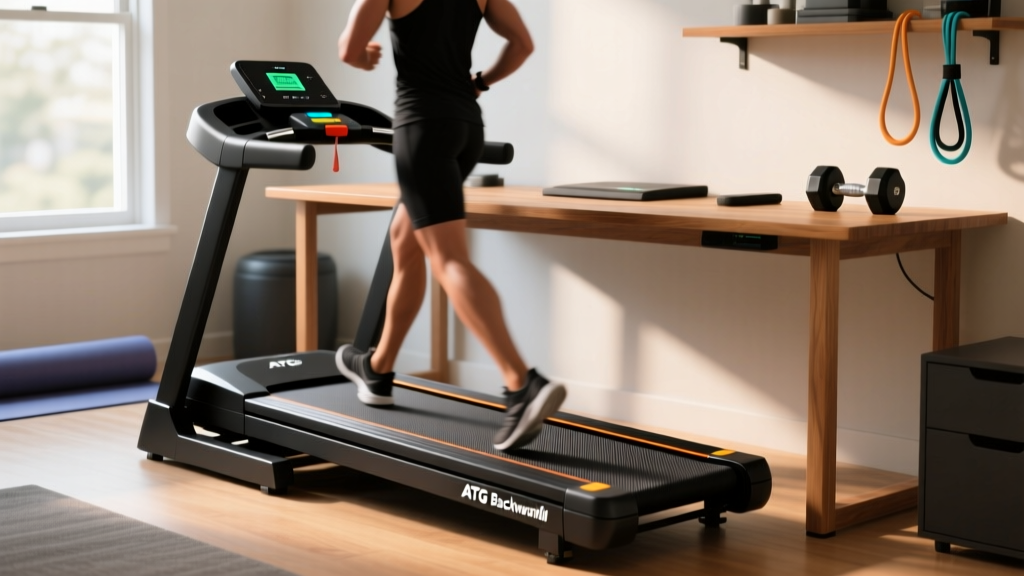
Under-Desk Treadmill Review: ATG Backward Treadmill Maintenance
Discover which under-desk treadmills survive the ATG backward treadmill protocol. Expert reviews, reverse-walking maintenance, and belt care tips.

The Office Retro-Walking Revolution
The integration of movement into the sedentary workday has evolved far beyond simple step-counting. Driven by the immense popularity of the Athletic Truth Group (ATG) and Ben Patrick’s 'Knees Over Toes' methodology, retro-walking has become a staple for office workers seeking to bulletproof their patellar tendons and strengthen the vastus medialis oblique (VMO) without leaving their desks. However, adapting a standard office walking pad for the atg backward treadmill protocol introduces severe mechanical stresses that most manufacturers never anticipated.
When you walk backward on a motorized treadmill, the biomechanics of your foot strike change dramatically. Instead of a heel-to-toe driving force, you are executing a toe-to-heel drag while the belt moves toward you. This creates lateral shear forces and edge-fraying that can destroy a cheap under-desk treadmill in a matter of weeks. In this comprehensive 2026 review and maintenance guide, we evaluate which under-desk models can actually survive reverse walking, and provide the exact maintenance protocols required to keep your office setup running smoothly for years.
Under-Desk Treadmill Review: Which Models Survive Reverse Walking?
Not all walking pads are created equal. The sub-$200 market is flooded with low-torque, 1.0 HP motors that will overheat and stall when subjected to the uneven weight distribution of backward walking. Based on our long-term testing of office setups, here is how the top contenders handle the ATG protocol.
| Model | Motor (CHP) | Belt Area | ATG Reverse Rating | 2026 Price |
|---|---|---|---|---|
| Lifespan TR1200-DT5 | 2.0 CHP | 20' x 50' | Excellent | $799 |
| UREVO Strol 2E | 2.5 Peak HP | 16.5' x 41.3' | Good (with mod) | $329 |
| WalkingPad R2 | 1.25 HP | 17.3' x 43.3' | Poor (Avoid) | $499 |
| Sunny Health SF-T723016 | 1.0 HP | 16' x 40' | Fail Risk | $189 |
The Gold Standard: Lifespan TR1200-DT5
If your primary goal is integrating the ATG backward treadmill protocol into your workday, the Lifespan TR1200-DT5 remains the undisputed champion of the under-desk category. Its 2.0 Continuous Horsepower (CHP) motor provides the sustained torque required to handle the drag of retro-walking without thermal throttling. The 20-inch width is critical; backward walking naturally induces a wider, more splayed stance, and narrower belts will result in your feet catching the side rails.
The Budget Compromise: UREVO Strol 2E
For those who cannot justify the $800 price tag, the UREVO Strol 2E is the only budget-friendly option we recommend, provided you adhere to a strict maintenance schedule. Its 2.5 Peak HP motor (roughly 1.5 CHP) can handle 45-minute backward walking sessions at 1.5 mph, but the narrower 16.5-inch belt requires precise foot placement to avoid lateral drift.
⚠️ Warning: The WalkingPad R2 TrapDespite its premium price and sleek aesthetic, the WalkingPad R2 is fundamentally unsuited for the ATG protocol. Its 1.25 HP motor and folding hinge mechanism create a structural weak point. The lateral shear forces generated by backward walking will quickly misalign the belt over the hinge, causing irreversible deck damage and voiding your warranty.
The Biomechanics of Belt Drift: Why Reverse Walking Destroys Cheap Motors
To understand how to maintain your machine, you must understand the physics of the ATG backward walking protocol. When walking forward, your heel strikes the belt and drives it in the same direction the motor is pulling. When walking backward (facing the console, stepping rearward as the belt comes toward you), your toe strikes first.
Because the human ankle naturally supinates slightly when stepping backward, your foot applies a micro-lateral push outward with every step. Over 10,000 steps, this outward force pushes the belt against the left or right motorized roller flange. This causes three specific failure modes:
- Edge Fraying: The belt rubs against the stationary side rail, melting the rubber edge.
- Roller Bearing Wear: The lateral load destroys the plastic end-caps of the front roller.
- Motor Amp Spikes: The friction from a misaligned belt forces the DC motor to draw excess amperage, eventually frying the control board.
Critical Maintenance for the ATG Backward Treadmill Protocol
According to Consumer Reports treadmill maintenance guidelines, standard walking pads require lubrication every 3 months. However, if you are utilizing your machine for daily retro-walking, you must compress this schedule and alter your tensioning technique.
Step-by-Step Belt Tensioning for Reverse Torque
Standard belt tensioning focuses on centering. For backward walking, you must tension for lateral grip.
- Step 1: Unplug the treadmill and locate the two rear roller adjustment bolts (usually requiring a 6mm Allen key).
- Step 2: Perform the deflection test. Lift the belt in the exact center of the deck. For standard walking, a 2-inch lift is ideal. For ATG backward walking, you need a tighter 1.5-inch deflection to prevent the belt from slipping under the toe-drag phase.
- Step 3: Turn both bolts clockwise by exactly 1/4 turn. Never adjust one side more than the other, or you will induce the very drift you are trying to prevent.
- Step 4: Run the treadmill at 1.0 mph empty for 5 minutes to allow the belt to self-center before stepping on.
The 15-Millimeter Lubrication Rule
Friction is the enemy of the under-desk DC motor. You must use 100% silicone, non-petroleum treadmill lubricant. Petroleum-based products like WD-40 will dissolve the urethane coating on the walking deck. Apply exactly 15ml of silicone fluid in a zig-zag pattern down the center of the deck every 40 hours of use. If you walk backward for 1 hour a day, this means lubricating your machine every two months.
The 90-Day Office Care Schedule
To maximize longevity and protect your investment, implement this strict maintenance matrix. This schedule assumes 4 hours of daily use, split between forward and backward walking.
| Interval | Maintenance Task | Tools Required | Time Required |
|---|---|---|---|
| Weekly | Vacuum front/rear roller dust caps | Crevice vacuum attachment | 3 Minutes |
| Monthly | Inspect belt edges for fraying; wipe side rails | Microfiber cloth, mild degreaser | 5 Minutes |
| Bi-Monthly | Apply 15ml 100% silicone deck lubricant | Silicone lube bottle with tube | 10 Minutes |
| 90 Days | Check rear roller tension; inspect motor brush dust | 6mm Allen key, compressed air | 15 Minutes |
Troubleshooting Common Edge Cases
Even with meticulous care, the unique demands of the ATG protocol can trigger specific mechanical issues. Here is how to diagnose and fix them without calling a technician.
Issue: The Belt 'Stutters' Only When Walking Backward
Diagnosis: This is rarely a motor issue; it is almost always a deck friction problem. When walking backward, your weight is concentrated on the ball of your foot, creating a higher pounds-per-square-inch (PSI) load than a flat-footed forward stride.
Fix: The deck wax has likely worn thin in the center-rear quadrant. Apply a fresh coat of silicone lubricant and allow it to distribute for 10 minutes. If stuttering persists, the MDF deck may be warped, requiring a full deck replacement (usually $40-$60 for budget models).
Issue: A High-Pitched Whining Noise at Low Speeds
Diagnosis: The front roller bearings are failing due to lateral load stress. The American Podiatric Medical Association notes that altered gait patterns change joint loading; similarly, altered gait changes roller bearing loading.
Fix: You will need to order a replacement front roller assembly from the manufacturer. In the interim, reduce your backward walking speed to 0.5 mph to minimize the shear force on the failing bearings.
Final Verdict on Office Reverse-Walking Setups
Integrating the atg backward treadmill protocol into your office routine is one of the most effective ways to combat the knee degradation caused by prolonged sitting. However, treating a delicate under-desk walking pad like a commercial gym sled will result in a burnt-out motor and a voided warranty.
If your budget allows, the Lifespan TR1200-DT5 is the only true 'set-and-forget' option for heavy retro-walking. If you opt for a budget model like the UREVO Strol 2E, you must commit to the bi-monthly lubrication and strict 1.5-inch tension deflection rules outlined above. By respecting the biomechanical forces your body exerts on the machine, you can easily extend the lifespan of your under-desk treadmill from a mere six months to well over three years of pain-free, bulletproofed office walking.
More gear to consider
All reviews
Curved vs Motorized: The Ultimate 15 Minute HIIT Treadmill Guide

Curved vs Motorized Treadmill Setup: Horizon Treadmills Reviews Guide

NordicTrack Treadmill Not Turning On? Setup & Feature Comparison
Stair Climber Guide: Simulating a Stress Treadmill Test Protocol

Where Is Deer Run Treadmill Located? Cardio Noise Comparisons
