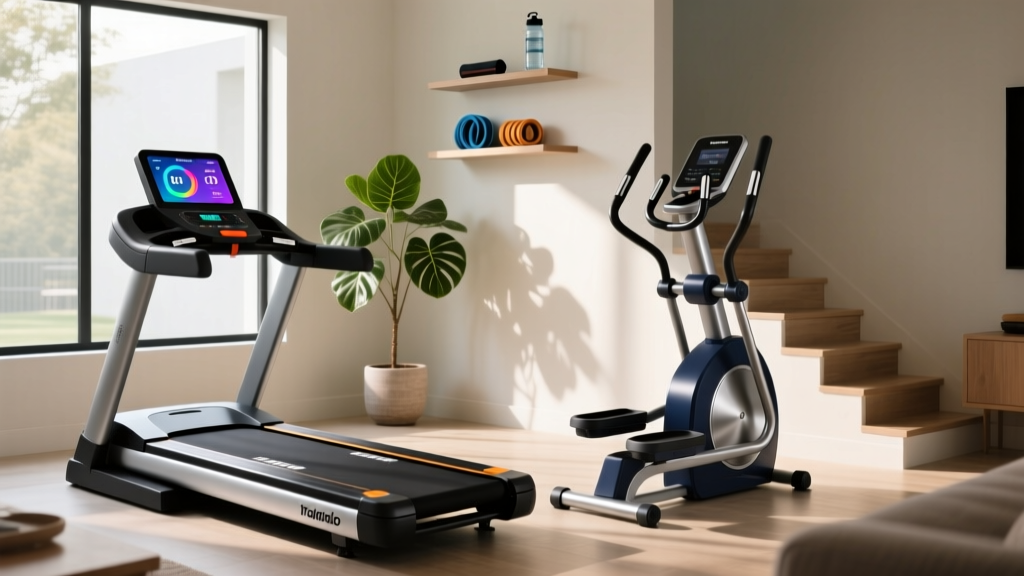
How Long Do Treadmills Last vs. Stair Climbers? Home Guide
Discover how long treadmills last compared to stair climbers. We compare top 2026 home models, lifespan, maintenance costs, and joint impact.

When homeowners ask us, 'how long do treadmills last?', the answer is rarely a simple number. The lifespan of your cardio equipment dictates your long-term fitness ROI, yet most buyers focus solely on upfront costs and digital features. In 2026, the home gym landscape has shifted dramatically. While treadmills remain the undisputed kings of accessible cardio, stair climbers have emerged as the ultimate longevity challengers, offering superior joint preservation and mechanical endurance. This comprehensive guide serves as your definitive stair climber machine for home use guide, pitted head-to-head against traditional treadmills to help you decide which machine deserves a permanent spot on your floor mat.
The Core Question: How Long Do Treadmills Last?
On average, a mid-tier home treadmill ($800 to $1,500) will last between 7 to 10 years with regular use (3-4 hours per week). Premium commercial-grade treadmills ($2,000 to $3,500) can push that lifespan to 12 to 15 years. However, these numbers assume strict adherence to maintenance schedules. Treadmills are inherently high-friction machines. The continuous sliding of a woven belt over a wooden deck, combined with the dynamic impact of a 150-250 lb user, creates immense mechanical and thermal stress.
The primary culprits that shorten a treadmill's life include:
- Deck Delamination: Friction heat melts the phenolic coating on the deck, causing the belt to grab and overwork the drive motor.
- Motor Burnout: Sub-3.0 CHP (Continuous Horsepower) motors in budget models overheat when tasked with incline walking or running.
- PCB Corrosion: Sweat contains chloride, which drips onto the console and eats through the conformal coating on the control boards, causing electrical shorts.
Stair Climbers: The Longevity Challenger
When evaluating a stair climber machine for home use, you are looking at a fundamentally different mechanical architecture. High-quality home stair climbers and step-mills typically boast a lifespan of 10 to 15+ years, frequently outlasting treadmills in the same price bracket. Why? Because they eliminate the highest-wear component in home cardio: the friction belt.
Modern stair climbers, such as those utilizing magnetic resistance or heavy-duty alternator systems, operate on closed-loop kinetics. There is no impact shock reverberating through a deck, and no continuous friction generating destructive heat. The wear is distributed across heavy-gauge steel chains, precision bearings, and magnetic flywheels—components that are vastly more resistant to the daily grind of home fitness routines.
Lifespan & Maintenance Matrix (2026 Data)
| Feature | Mid-Tier Treadmill ($1,200) | Premium Stair Climber ($1,800) |
|---|---|---|
| Expected Lifespan | 7 - 10 Years | 12 - 15+ Years |
| Primary Failure Point | Deck/Belt Friction, Incline Motor | Step Chain Elongation, Potentiometer |
| Routine Maintenance | Silicone lubrication every 3 months | Chain tensioning annually |
| Power Draw (Under Load) | 1,200W - 1,800W | 150W - 300W (or Self-Powered) |
Head-to-Head: Top 2026 Home Models
To understand how long do treadmills last in the real world versus their stair-climbing counterparts, we must look at specific 2026 market leaders. We've selected two flagship models from each category that dominate the home gym space.
Treadmill Contender: NordicTrack Commercial 1750
Price: ~$1,799 | Motor: 3.5 CHP | Footprint: 81" x 39"
The 1750 is a staple for a reason. Its 3.5 CHP motor is robust enough to handle daily running without thermal throttling, and the -3% to 15% incline/decline motor is geared with metal cogs rather than the plastic gears found in budget units. However, the massive 14-inch HD touchscreen and complex incline mechanics introduce multiple points of electronic failure over a 10-year horizon.
Stair Climber Contender: StairMaster SM3 Stepper
Price: ~$1,499 | Resistance: 12-Level Magnetic | Footprint: 53" x 32"
The SM3 brings commercial DNA to the home. It uses independent pedal action (unlike connected ellipticals) and a heavy-duty steel frame that weighs over 130 lbs. Because it relies on magnetic resistance and a simple alternator to power the console, the mechanical wear is practically negligible. The SM3 easily surpasses the 10-year mark with nothing more than occasional dusting and pedal strap replacements.
Failure Modes & Edge Cases: What Actually Breaks?
As equipment reviewers, we see the machines after the warranty expires. Here is the unvarnished truth about how these cardio giants fail when pushed to their limits.
Treadmill Edge Cases
The most common catastrophic failure we see in treadmills is incline motor stripping. When a 220 lb user stands still on the belt and commands a 15% incline, the static load on the incline lift gear is immense. Over time, this shears the teeth off the gear. Furthermore, treadmills require a dedicated 20-amp circuit; plugging a 3.5 CHP treadmill into a shared 15-amp bedroom circuit will degrade the motor's capacitor over time, leading to premature burnout.
Stair Climber Edge Cases
Stair climbers are not invincible. The primary maintenance issue is chain elongation. Just like a bicycle, the steel chains connecting the pedals to the internal flywheel stretch slightly over thousands of hours of use. If ignored, the chain will skip teeth on the sprocket, causing a jarring, unsafe step. Additionally, the potentiometer—the sensor that translates your step speed to the console—can become clogged with dust and pet hair, resulting in erratic resistance jumps.
Biomechanics and Joint Longevity
It is not just about how long the machine lasts; it is about how long your joints last. The repetitive eccentric loading of treadmill running places up to 2.5 times your body weight of force on the patellar tendon and Achilles. While modern treadmills feature elastomer deck cushioning, it cannot entirely negate ground reaction forces.
According to the Arthritis Foundation, low-impact cardiovascular exercises are critical for preserving joint cartilage and managing osteoarthritis. Stair climbers provide a closed-chain kinetic movement, meaning your foot never leaves the pedal, effectively reducing the peak impact forces to near zero while maintaining a high metabolic demand.
Furthermore, the American Heart Association recommends 150 minutes of moderate-intensity aerobic activity per week. Achieving this on a stair climber yields a higher caloric burn per minute compared to flat treadmill walking, allowing users to meet AHA guidelines in less time, thereby reducing cumulative repetitive joint cycles.
The 5-Year Cost of Ownership Framework
To truly answer the value proposition, we must calculate the hidden costs of ownership over a standard 5-year period.
| Cost Factor (5 Years) | Premium Treadmill | Home Stair Climber |
|---|---|---|
| Upfront Hardware Cost | $1,799 | $1,499 |
| Electricity (Est. 4hrs/wk) | $180 | $35 |
| Maintenance / Parts | $75 (Lube/Belts) | $40 (Pedal Straps) |
| Expected Repair (Yr 4-5) | $250 (Deck Replacement) | $0 |
| Total 5-Year Cost | $2,304 | $1,574 |
Final Verdict: Choosing Your Home Gym Anchor
So, how long do treadmills last, and are they still the right choice for your home? If your primary goal is marathon training, sprint interval work, or you simply prefer the biomechanics of outdoor walking and running, a premium treadmill like the NordicTrack 1750 is a mandatory investment. Expect a solid decade of service, provided you religiously lubricate the deck and keep sweat off the console.
However, if your goal is maximum cardiovascular output, lower-body hypertrophy, and joint preservation, the stair climber is the undisputed champion of longevity. Models like the StairMaster SM3 will quietly outlast almost any treadmill in their price class, drawing less power, requiring less maintenance, and saving your cartilage in the process. For the average home gym user in 2026 looking for a 'buy it for life' cardio solution, the stair climber is the smarter, more durable anchor.
More gear to consider
All reviews
Beyond a 30 Minute Incline Treadmill Workout: Stair Climber Setup
Under-Desk Treadmill Review & 15 3 30 Workout Care

Bowflex BXT116 Treadmill vs Under Desk Office Use: Value Breakdown

Instrumented Treadmill Buying Guide: Feature Comparison & Mistakes

Spirit 185 Treadmill Setup & Motor Horsepower Guide
