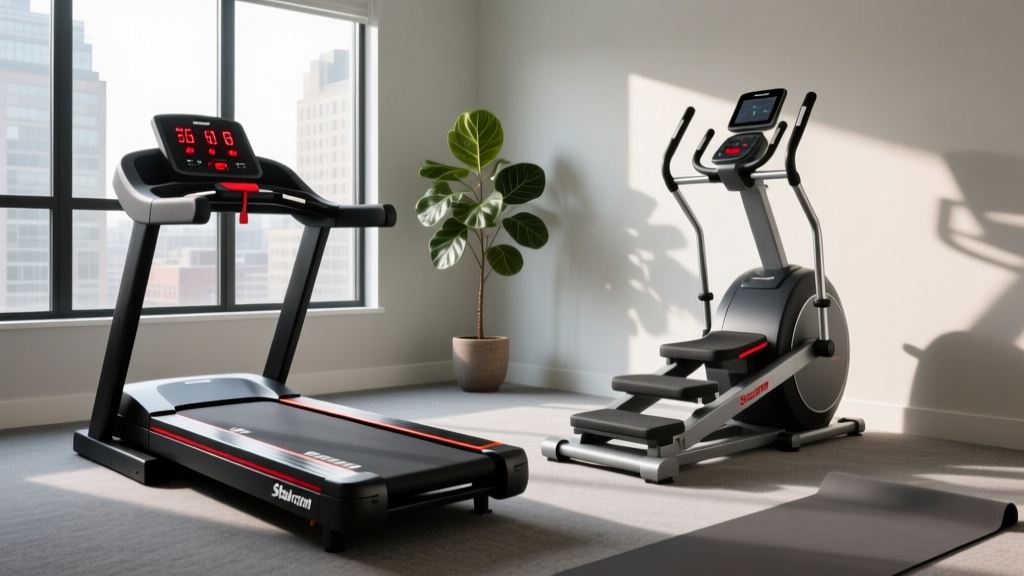
Buying a Treadmill for Your Treadmill and Stairmaster Workout Setup
Compare treadmill features for a dual-cardio gym and follow our complete setup and installation walkthrough for your treadmill and stairmaster workout.

The Synergy of the Treadmill and Stairmaster Workout
Designing a home gym around a combined treadmill and stairmaster workout is one of the most effective strategies for comprehensive cardiovascular conditioning in 2026. While the stair climber targets the posterior chain, glutes, and anaerobic threshold, the treadmill provides essential horizontal force production, eccentric loading (via decline), and active recovery zones. However, pairing these two heavy-duty machines requires meticulous feature selection and spatial engineering. According to the American Heart Association, varying your aerobic stimulus is key to preventing plateaus and reducing overuse injuries, making this dual-machine approach highly recommended for advanced home athletes.
This buying guide and installation walkthrough will help you select the right treadmill features to complement your stair climber, followed by a rigorous, step-by-step setup protocol to ensure both machines operate safely and efficiently in your space.
Expert Insight: When pairing these machines, your treadmill should act as the 'recovery and speed' module, while the StairMaster serves as the 'resistance and power' module. Prioritize treadmills with decline capabilities to flush lactic acid from the lower body between high-intensity stair intervals.Treadmill Feature Comparison Matrix for Dual-Cardio Homes
Not all treadmills are suited to share a room with a high-draw machine like a StairMaster StepMill. You must evaluate the continuous horsepower (CHP), footprint, and electrical requirements. Below is a comparison of the top 2026 models optimized for this specific setup.
| Model | Motor (CHP) | Incline/Decline | Footprint (L x W) | Est. Price (2026) |
|---|---|---|---|---|
| Sole F85 | 4.0 CHP | 0% to 15% | 66 x 35 inches | $1,999 |
| NordicTrack 1750 | 3.5 CHP | -3% to 15% | 81 x 39 inches | $2,299 |
| Bowflex Treadmill 22 | 4.0 CHP | -5% to 20% | 76 x 39 inches | $2,699 |
Why Decline and Footprint Matter Here
The Bowflex Treadmill 22 is our top pick for a treadmill and stairmaster workout setup because its -5% decline allows for eccentric calf and hamstring loading, which perfectly offsets the concentric-heavy, glute-dominant nature of the stair climber. Furthermore, its 4.0 CHP motor handles rapid speed transitions without overheating, a common failure mode in cheaper 2.5 CHP models when users alternate between sprinting and walking recovery.
Spatial Planning and Clearance Requirements
Before unboxing, you must map your room. The U.S. Consumer Product Safety Commission (CPSC) mandates strict clearance zones to prevent entrapment and injury in the event of a fall.
- Treadmill Rear Clearance: Minimum 30 inches of unobstructed space behind the belt. Never place a treadmill flush against a wall.
- Side Clearance: Minimum 20 inches on both sides for emergency dismounting.
- StairMaster Ceiling Clearance: The StepMill 7 stands 79 inches tall. You must add the height of the tallest user plus 5 inches for head bobbing. For a 6-foot user, you need a minimum ceiling height of 84 inches (7 feet). Standard 8-foot ceilings are usually sufficient, but beware of dropped soffits or ceiling fans.
Complete Setup and Installation Walkthrough
Installing heavy cardio equipment is not just about assembly; it is about electrical load balancing and floor stabilization. Follow this exact sequence to prepare your room for a treadmill and stairmaster workout.
Step 1: Electrical Circuit Verification
Both machines draw significant current. A commercial-grade StairMaster under heavy load can pull 12 to 15 amps, while a 4.0 CHP treadmill can spike to 18 amps during startup or steep inclines. Do not plug both machines into the same 15-amp household circuit. Doing so will trip the breaker mid-workout.
- Locate your electrical panel and identify two separate 20-amp dedicated circuits.
- Ensure the receptacles are non-GFCI if possible. Treadmill motors generate inductive voltage spikes during deceleration (especially models with regenerative braking), which can cause nuisance tripping on standard GFCI outlets.
- Never use extension cords. If an outlet is out of reach, hire a licensed electrician to install a new 12-AWG dedicated receptacle.
Step 2: Flooring and Vibration Dampening
Placing these machines directly on hardwood or laminate will cause micro-vibrations that degrade the treadmill's internal PCB board over time and create deafening noise transfer to floors below.
- Purchase two separate 3/8-inch thick vulcanized rubber mats (minimum 4x6 feet each).
- Do not use cheap PVC foam mats; they compress under the 300+ lb weight of the machines, causing the treadmill frame to twist and the belt to drift.
- Leave a 2-inch gap between the two mats to prevent them from riding up against each other during use.
Step 3: Assembly and Leveling
According to Mayo Clinic fitness guidelines, maintaining proper biomechanical alignment during aerobic exercise is crucial to preventing joint strain. An unlevel treadmill forces an asymmetrical gait.
- Assemble the uprights and console according to the manufacturer's torque specifications (usually 15-20 Nm for main frame bolts).
- Place a 48-inch machinist spirit level across the treadmill deck, both horizontally and vertically.
- If the floor is out of plumb by more than 1/4 inch, use heavy-duty composite shims under the rubber mat, not under the machine feet directly, to distribute the load.
- Repeat the leveling process for the StairMaster, ensuring the base plate is perfectly flush to prevent the stepping mechanism from binding.
Common Installation Failure Modes and Troubleshooting
Even with perfect planning, dual-cardio setups present unique edge cases. Here is how to troubleshoot the most common issues encountered in 2026 home gyms.
Warning: Belt Drift on TreadmillsIf your treadmill belt consistently drifts to the left during your treadmill and stairmaster workout transitions, do not immediately adjust the rear roller. First, verify that the machine is perfectly level. If the floor slopes, the belt will naturally track downhill. Only adjust the rear roller adjustment bolts (1/4 turn clockwise on the left side) if the machine is confirmed level and the drift persists.
Wi-Fi and Bluetooth Interference
Modern smart treadmills and stair climbers both rely on 2.4 GHz Wi-Fi and Bluetooth for app integration and firmware updates. Placing them within 3 feet of each other can cause signal degradation. If your treadmill console drops connection during auto-adjusting workouts, move your Wi-Fi router or install a dedicated mesh node in the gym room to ensure a strong, isolated signal for both machines.
Final Thoughts on Your Dual-Cardio Setup
Executing a high-performance treadmill and stairmaster workout at home requires treating your gym space like a professional facility. By selecting a treadmill with the correct decline features and motor capacity, respecting CPSC safety clearances, and installing dedicated 20-amp electrical circuits, you eliminate the friction between your training intent and your equipment's capabilities. Invest the time in this precise setup walkthrough, and your dual-cardio station will deliver years of uninterrupted, elite-level conditioning.
More gear to consider
All reviews
Taylor Swift Treadmill Strut: Motor Horsepower Guide & Troubleshooting

Manual Treadmill vs Electric Treadmill or Stationary Bikes?

TX400 Treadmill vs Elliptical: Expert Home Cardio Review

Curved Manual vs Motorized: ProForm Pro 9000 Smart Treadmill Guide

Treadmill Calibration: Curved Manual vs Motorized Setup Guide
