Taylor Swift Treadmill Strut: Motor Horsepower Guide & Troubleshooting
Is the viral Taylor Swift treadmill workout frying your motor? Learn the truth about CHP vs HP, troubleshoot burnout, and pick the right horsepower.

The 'Taylor Swift Treadmill' Phenomenon: Why Your Motor is Frying
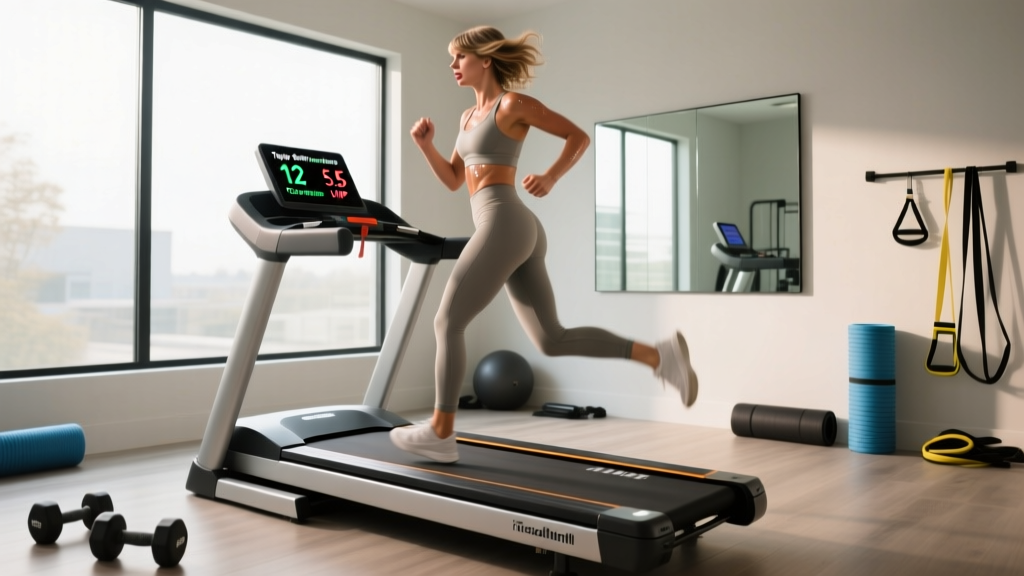
What started as a viral TikTok trend has evolved into a permanent staple of home cardio routines in 2026. The 'Taylor Swift Treadmill Strut'—walking, jogging, and sprinting through the 44-song, 3-hour-and-15-minute Eras Tour setlist—is an incredible cardiovascular challenge. However, it has also become the leading cause of catastrophic motor burnout in budget and mid-tier residential treadmills.
As fitness equipment technicians, we see the aftermath daily: melted Pulse Width Modulation (PWM) control boards, seized DC drive motors, and snapped drive belts. The root cause? A fundamental misunderstanding of treadmill motor sizing, specifically the deceptive marketing of 'Peak Horsepower' versus 'Continuous Horsepower' (CHP). If you are attempting a 3-hour mixed-tempo workout on a machine not engineered for sustained thermal loads, you are pushing your hardware past its mechanical limits.
⚠️ CRITICAL WARNING: The average Eras Tour setlist workout lasts over 195 minutes. Most residential treadmill manuals explicitly state a maximum continuous duty cycle of 60 to 90 minutes before requiring a 20-minute cool-down. Ignoring this voids your warranty and risks an electrical fire.Decoding the Specs: HP vs. CHP (The Hard Data)
The most common mistake consumers make when buying a treadmill for long-form walking or jogging is looking at the 'Peak HP' number. Peak HP only measures the maximum output the motor can hit for a fraction of a second before stalling. What actually matters for a 3-hour Taylor Swift treadmill workout is Continuous Horsepower (CHP)—the power the motor can sustain indefinitely without overheating.
According to Consumer Reports, a heavy user walking at a brisk pace on an incline requires significantly more sustained torque than a lighter user running on a flat deck. Below is the definitive 2026 sizing matrix for matching your motor to the Eras Tour workout intensity.
| Workout Phase (Setlist) | Speed & Incline | User Weight < 150 lbs | User Weight 150-200 lbs | User Weight 200+ lbs |
|---|---|---|---|---|
| Acoustic / Slow Walking | 2.5 mph / 2% Incline | 1.5 CHP | 2.0 CHP | 2.5 CHP |
| The Strut (Brisk Walk) | 3.5 mph / 5% Incline | 2.0 CHP | 2.5 CHP | 3.0 CHP |
| Upbeat / Jogging | 5.5 mph / 0% Incline | 2.5 CHP | 3.0 CHP | 3.5 CHP |
| High-Incline Power Walk | 3.0 mph / 12% Incline | 3.0 CHP | 3.5 CHP | 4.0 CHP |
4 Fatal Mistakes Ruining Your Treadmill Motor
If your machine is suddenly shutting off mid-concert or emitting a distinct 'burnt ozone' smell, you have likely committed one of the following hardware sins.
1. Buying a 'Peak HP' Walking Pad for a 3-Hour Setlist
Many budget under-desk walking pads (priced between $150 and $299) advertise '2.5 HP Motors.' In reality, these are 1.0 or 1.25 CHP DC motors. When subjected to 3 hours of continuous friction and heat, the internal copper windings melt, and the thermal fuse trips permanently. The Fix: For any workout exceeding 90 minutes, you must invest in a folding or commercial treadmill with a verified minimum of 2.75 CHP (e.g., the Horizon 7.4 or Sole F63).
2. Ignoring Belt Friction and Amp Draw
A dry treadmill deck increases the coefficient of friction between the belt and the phenolic deck. This forces the motor to draw excess amperage to maintain speed. A well-lubricated belt draws roughly 3 to 5 amps at 3 mph. A dry, neglected belt can spike the draw to 12+ amps, overwhelming the PWM control board. The Fix: Apply 100% pure silicone treadmill lubricant every 40 hours of use. You can test your belt tension by lifting it at the center of the deck; it should yield exactly 2 to 3 inches of lift.
3. Maxing Out the Incline on a Sub-3.0 CHP Motor
Biomechanical studies highlighted by the American Council on Exercise (ACE) show that walking on a 10% to 15% incline increases the mechanical load on the drive system by up to 45%. If your motor is rated below 3.0 CHP, combining high incline with the 'Cruel Summer' sprint intervals will cause immediate thermal shutoff. The Fix: Keep incline below 5% if your motor is under 3.0 CHP, or upgrade to a machine with a 4.0 CHP motor and an AC (Alternating Current) drive, which dissipates heat far better than residential DC motors.
4. Skipping the Duty-Cycle Rest Intervals
Residential treadmills are not commercial gym machines. They rely on passive air cooling via a small fan attached to the motor shaft. If you run a 195-minute setlist without stopping, the core temperature of the motor will exceed 212°F (100°C). The Fix: Program a mandatory 15-minute pause (perhaps during the acoustic surprise song set) to allow the internal fan to cool the copper windings and the PWM board.
Troubleshooting Flowchart: Is Your Motor Dead or Just Overheated?
Before spending $300 to $650 on a replacement motor, perform this step-by-step diagnostic sequence to identify the exact point of failure.
- The 'Push' Test (Belt vs. Motor): Unplug the machine. Stand on the belt and try to push it forward with your foot. If it is difficult to move or feels 'gritty,' your deck is worn or the belt is overtightened. The motor is likely fine, but it is working too hard. Replace the belt/deck kit ($60-$120).
- The Amp Draw Test (Control Board): If the belt moves freely by hand, plug the machine in and use a clamp multimeter on the motor's red power wire. Walk at 3 mph. If the amp draw exceeds 10 amps consistently, your motor windings are shorting out, or the deck is creating massive friction.
- The Ozone Smell (PWM Failure): If the treadmill stutters, drops speed randomly, or you smell burnt plastic near the front motor hood, your PWM motor controller has failed due to voltage spikes. You can often replace just the control board ($80-$150) without replacing the physical motor.
- The Dead Stop (Thermal Fuse): If the machine completely died mid-workout and won't turn back on hours later, the internal thermal fuse inside the motor housing has blown. This requires a full motor replacement.
Expert Verdict: Sizing Your Next Machine for Long-Form Cardio
The Taylor Swift treadmill workout is a phenomenal way to achieve the 10,000+ daily steps recommended by the Mayo Clinic for long-term cardiovascular health. However, treating a marathon-length playlist like a 20-minute gym warm-up is a fast track to the landfill.
'Consumers frequently confuse the physical footprint of a walking pad with its mechanical endurance. A 3-hour continuous stride requires commercial-grade heat dissipation, not a compact folding hinge and a 1.5 HP peak motor.' — FitGearPulse Engineering Team
If you are committed to the full Eras Tour setlist in 2026, stop compromising on horsepower. Demand a verified 3.0 CHP minimum (like the NordicTrack T Series 10 or Sole F80), maintain your deck lubrication religiously, and respect the thermal limits of residential electronics. Your joints—and your wallet—will thank you when your machine survives the final chord of 'Karma' without breaking a sweat.
More gear to consider
All reviews
Rowing Machine Setup vs Treadmill Belly Fat Workout

Best Treadmills After Abnormal Treadmill Stress Test Results

Curved vs Motorized: Assembling a NordicTrack Treadmill & Setup

Walking Pad Technogym Review: Myths, Alternatives & Fixes

Small Space Cardio: Elliptical vs Treadmill & Fat Burner on Treadmill