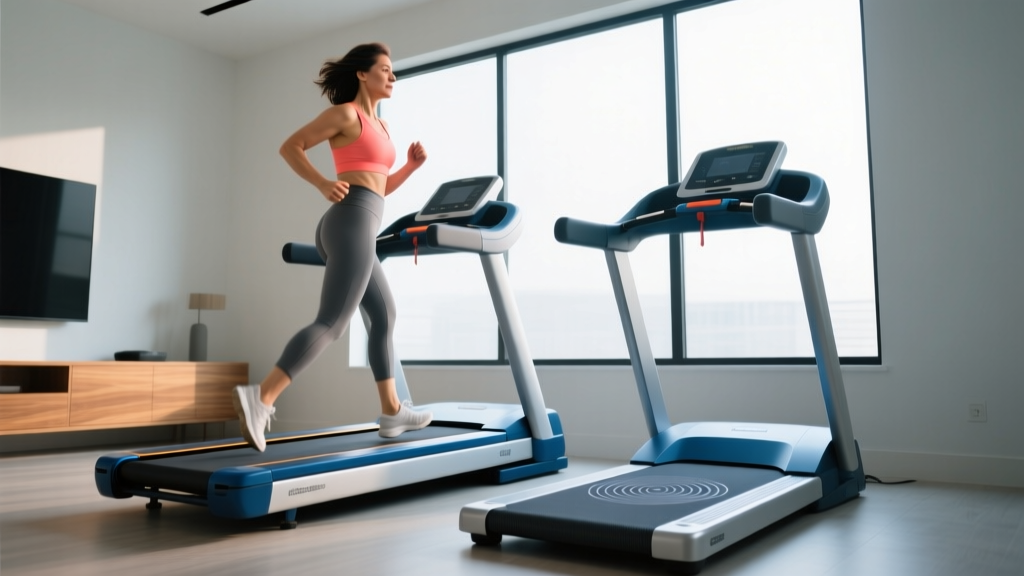
Curved Manual vs Motorized: ProForm Pro 9000 Smart Treadmill Guide
Compare curved manual treadmills with motorized models. We analyze biomechanics, costs, and how the ProForm Pro 9000 smart treadmill stacks up.

The Biomechanical Divide: Self-Powered vs. Belt-Driven Decks
In the 2026 home fitness landscape, the debate between curved manual treadmills and traditional motorized treadmills is more relevant than ever. Choosing between the two is not merely a matter of budget or aesthetics; it is a fundamental decision about biomechanics, muscle activation, and long-term training goals. Curved manual treadmills, characterized by their non-motorized, concave slat belts, require the user to generate 100% of the forward propulsion. Conversely, motorized treadmills utilize a motor to pull the belt beneath the user's feet, altering the natural running stride.
According to biomechanical analyses highlighted by the American Council on Exercise (ACE), running on a curved manual treadmill increases posterior chain activation—specifically the hamstrings and glutes—by up to 20% compared to motorized equivalents. Because there is no motorized belt to pull your foot backward, you must actively drive your foot into the deck and push off, mimicking outdoor overground running much more closely. Furthermore, studies indicate that curved treadmills can yield a 30% higher caloric expenditure at the same perceived exertion level, making them highly efficient for high-intensity interval training (HIIT).
However, motorized treadmills offer distinct advantages in pacing control, joint impact mitigation, and interactive programming. This brings us to the motorized benchmark for this guide: the ProForm Pro 9000 smart treadmill. As a premier motorized option, it provides a contrasting experience to the raw, self-powered nature of curved decks, relying on technological integration and precise speed regulation to drive workouts.
Expert Insight: If your primary goal is sprint mechanics and posterior chain development, a curved manual deck is superior. If your goal involves steady-state zone 2 cardio, marathon pacing, and interactive global route mapping, a high-end motorized model is the necessary choice.Benchmarking the Motorized Standard: ProForm Pro 9000 Smart Treadmill
To understand how motorized treadmills compete with curved manual models, we must look at a top-tier motorized contender. The ProForm Pro 9000 smart treadmill represents the modern apex of belt-driven home cardio. Priced typically around $1,299 to $1,499, it undercuts the $3,000+ price tag of premium curved treadmills (like the AssaultRunner Elite or TrueForm Runner) while offering a suite of technological features that manual treadmills simply cannot replicate.
Key Specifications and Performance Metrics
- Motor: 3.6 CHP Mach Z Commercial Plus Motor. Continuous Horsepower (CHP) is critical here; unlike 'Peak Horsepower' marketing gimmicks, 3.6 CHP ensures the motor can sustain 10 mph for an hour without overheating.
- Deck Dimensions: 20-inch width by 60-inch length. This provides ample lateral stability and stride clearance for runners up to 6'4".
- Incline/Decline: -3% to 12%. The decline feature is a massive advantage for motorized treadmills, as curved manual treadmills offer zero incline or decline capabilities due to their fixed gravity-based mechanics.
- Interactive Tech: 20-inch interactive HD touchscreen powered by iFIT. The software automatically adjusts speed and incline/decline based on the programmed route or trainer-led workout.
- Speed Range: 0 to 12 mph, adjustable in 0.1 mph increments.
The ProForm Pro 9000 smart treadmill excels in pacing enforcement. When following a marathon training plan, maintaining an exact 8:00/mile pace (7.5 mph) is effortless on a motorized belt. On a curved manual treadmill, maintaining an exact pace requires constant micro-adjustments and intense mental focus, as any lapse in effort immediately drops your speed.
Feature-by-Feature Comparison Matrix
Below is a detailed comparison matrix contrasting a premium curved manual treadmill with the ProForm Pro 9000 smart treadmill to highlight the functional divergences between the two categories.
| Feature / Metric | Curved Manual (e.g., AssaultRunner Elite) | ProForm Pro 9000 Smart Treadmill |
|---|---|---|
| Propulsion Type | 100% User-Powered (Self-Curving) | 3.6 CHP Motorized Belt |
| Pricing (MSRP) | $3,299 - $3,495 | $1,299 - $1,499 |
| Speed Limit | Unlimited (User-Dependent) | 12 MPH (Capped by Motor) |
| Incline / Decline | None (Fixed Curve) | -3% Decline to +12% Incline |
| Caloric Burn | Up to 30% higher at same RPE | Standard motorized baseline |
| Power Requirement | None (Zero Electricity) | 120V Dedicated Outlet Required |
| Interactive Screen | Basic LCD (Speed/Time/Distance) | 20-inch HD Touchscreen (iFIT) |
| Footprint | Compact (~67" L x 32" W) | Large (~76" L x 35" W) |
Long-Term Ownership: Maintenance and Failure Modes
A critical factor often ignored in buying guides is the 5-year cost of ownership, including maintenance and common failure modes. According to equipment repair data and insights from Runner's World treadmill maintenance guides, the mechanical stress points differ vastly between curved and motorized decks.
Curved Manual Treadmill Failure Modes
Curved treadmills rely on a series of rubber or urethane slats connected by a heavy-duty belt, gliding over ball-bearing rollers. The most common edge-case failure is slat belt stretching or roller bearing seizure. If a user consistently runs on the extreme edges of the belt, uneven wear can cause the slats to track improperly and grind against the side rails. Furthermore, while they require no electricity, the sheer mechanical friction means the urethane slats may need replacement after 5,000 to 7,000 miles, a service that can cost upwards of $400.
Motorized Treadmill (ProForm Pro 9000) Failure Modes
The ProForm Pro 9000 smart treadmill utilizes a traditional MDF deck coated in wax, with a continuous PVC belt. The most frequent point of failure in motorized treadmills is the Motor Controller Board (MCB). This usually happens not because the motor is weak, but due to user neglect. If the deck is not lubricated with 100% silicone every 3 months (or every 150 miles), friction between the belt and deck increases. This friction causes the motor to draw excess amperage, eventually frying the MCB or burning out the motor windings. Replacing an MCB typically costs between $150 and $250.
Pro-Tip for Motorized Owners: To test if your ProForm Pro 9000 needs lubrication, slide your hand under the belt. If it feels completely dry to the touch, it is time to apply the silicone. A slightly tacky or oily feel means the deck is properly protected.
Additionally, motorized treadmills require a dedicated 15-amp or 20-amp circuit. Plugging the ProForm Pro 9000 into a shared outlet with other appliances can lead to tripped breakers or voltage drops that degrade the motor over time, a non-issue for self-powered curved treadmills.
Decision Framework: Which Deck Belongs in Your Home Gym?
Choosing between a curved manual treadmill and the ProForm Pro 9000 smart treadmill ultimately comes down to your specific physiological goals, spatial constraints, and budget. Use the framework below to make your final decision.
Choose a Curved Manual Treadmill If:
- You are a Sprinter or CrossFit Athlete: The unlimited top speed and requirement for explosive posterior chain drive make curved decks ideal for HIIT and sprint intervals.
- You Have Strict Spatial or Electrical Constraints: Curved treadmills have a smaller footprint and can be placed anywhere, including basements or garages without dedicated 20-amp electrical circuits.
- You Want Zero Subscription Fees: Manual treadmills do not require Wi-Fi or monthly iFIT/app subscriptions to function at 100% capacity.
Choose the ProForm Pro 9000 Smart Treadmill If:
- You Train for Endurance Events: If you are training for a half-marathon or marathon, the ability to lock into an exact pace and utilize the -3% decline feature to condition your quads for downhill running is irreplaceable.
- You Rely on External Motivation: The 20-inch HD touchscreen and iFIT global workouts provide an immersive experience that distracts from the monotony of steady-state cardio.
- You Need Joint Impact Mitigation: The ProForm's ProShox cushioning system is engineered to reduce impact on the knees and lower back compared to the firmer, more rigid slat decks of manual treadmills, an important factor for aging runners or those recovering from minor joint issues, as supported by general joint health guidelines from the Mayo Clinic.
Frequently Asked Questions
Can you walk on a curved manual treadmill?
Yes, but it requires an adjustment period. Because the belt only moves when you push it, walking at very slow speeds (under 2.5 mph) can feel jerky or require a steeper leaning posture to keep the belt engaged. Motorized treadmills like the ProForm Pro 9000 are vastly superior for slow, steady walking and recovery sessions.
Is the ProForm Pro 9000 smart treadmill compatible with third-party apps?
While the ProForm ecosystem is heavily optimized for iFIT, many modern motorized treadmills feature Bluetooth FTMS connectivity. However, to get the most out of the auto-incline and HD screen features, an active iFIT subscription is highly recommended, which adds roughly $39/month to your long-term ownership cost.
Which treadmill is quieter for apartment living?
Curved manual treadmills are generally quieter regarding motor noise, but the heavy footstrike on the hard urethane slats can transmit significant impact vibration through the floor. The ProForm Pro 9000 has a quiet motor, but the mechanical whir of the belt and the impact of footfalls still require a high-density EVA foam equipment mat to dampen sound transfer to downstairs neighbors.
More gear to consider
All reviews
Treadmill Buying Guide: Belly Fat 30 Minute Treadmill Workout Features
Treadmill Belt Costs: What Is 12 Incline on Treadmill in Numbers?

Is It Better to Run on a Treadmill or Outside? Portable Cardio Costs

Elliptical vs Treadmill Care: Assault Fitness Curved Treadmill Tips

Famistar Treadmill T532A Setup and Walking Pad Review