Treadmill Slows Down When Running? Motor Size & HP Guide
Discover why your treadmill slows down when running. Our step-by-step guide covers motor size, CHP ratings, and troubleshooting belt stutter.

There are few things more jarring—and potentially dangerous—than hitting your target pace on a run, only to feel the belt hesitate, stutter, or decelerate beneath your feet. If your treadmill slows down when running, it is not just an annoyance; it is a mechanical red flag. While a worn deck or a loose drive belt can contribute to the problem, the root cause almost always traces back to a fundamental mismatch between the machine's motor capacity and the physical load you are placing on it.
As we navigate the fitness equipment market in 2026, manufacturers are pushing smarter screens and interactive inclines, but the raw physics of moving a human body at 8.0 mph remains unchanged. This beginner-friendly, step-by-step guide will demystify treadmill motor sizes, explain the critical difference between marketing jargon and actual horsepower, and give you a concrete troubleshooting framework to fix or upgrade your setup.
Step 1: Diagnose the 'Stutter' (Is It Really the Motor?)
Before we dive into horsepower charts, we must isolate the variable. When a treadmill belt bogs down underfoot, the motor is working overtime to overcome resistance. This resistance comes from two places: friction and user load.
- The Friction Factor: If your walking belt is dry, or the walking deck is warped, the motor has to pull significantly more amperage just to keep the belt moving. A dry belt can increase motor strain by up to 40%.
- The Load Factor: Every time your foot strikes the deck, you momentarily stop the belt's momentum. A motor with low torque (rotational force) will struggle to re-accelerate the belt between footfalls, resulting in that infamous 'stuttering' sensation.
Step 2: Decoding the Horsepower Myth (CHP vs. HP)
If you are shopping for a new machine or trying to understand your current one, you will see two acronyms: HP (Horsepower) and CHP (Continuous Duty Horsepower). Understanding this distinction is the most critical step in preventing the 'slow down' effect.
Peak HP (The Marketing Gimmick)
Peak HP measures the absolute maximum power the motor can generate for a fraction of a second before overheating or tripping a breaker. Budget brands often advertise '4.0 Peak HP' on the box, but the motor may only sustain 1.5 HP during a continuous 30-minute run. This is the primary reason budget treadmills fail when running.
Continuous Duty HP (The Reality)
CHP measures the power the motor can sustain indefinitely under normal operating temperatures. When evaluating top-tier brands like Sole, NordicTrack, or Horizon, always look for the CHP rating. According to comprehensive testing by Wirecutter's treadmill experts, a minimum of 2.5 CHP is required for basic jogging, while serious runners need 3.0 CHP or higher to maintain belt momentum without degrading the motor's internal components.
Step 3: The 2026 Motor Sizing Matrix
Use the table below to determine the exact Continuous Duty Horsepower (CHP) you need based on your primary activity and body weight. Undersizing your motor based on this matrix is the #1 reason your treadmill slows down when running.
| Activity Level | User Weight: Under 180 lbs | User Weight: 180 - 250 lbs | User Weight: 250+ lbs |
|---|---|---|---|
| Walking (Under 4.0 mph) | 2.0 CHP | 2.5 CHP | 2.75 CHP |
| Jogging (4.0 - 6.0 mph) | 2.5 CHP | 3.0 CHP | 3.5 CHP |
| Running (6.0+ mph) | 3.0 CHP | 3.5 CHP | 4.0+ CHP |
Step 4: Real-World Machine Breakdown
Let us apply this matrix to some of the most popular home treadmills on the market to see how motor size dictates performance under heavy loads.
The Heavy-Duty Standard: Sole F80 (3.5 CHP)
The Sole F80 features a 3.5 CHP motor paired with a heavy 17-pound flywheel. The flywheel is a crucial, often overlooked component; a heavier flywheel stores kinetic energy, helping the belt glide between foot strikes and reducing the immediate torque demand on the motor. For a 220-pound runner sprinting at 8.5 mph, the Sole F80 maintains perfect belt consistency because the 3.5 CHP motor operates well within its thermal limits.
The Budget Compromise: Horizon T101 (2.5 CHP)
Horizon makes excellent entry-level machines, but the T101's 2.5 CHP motor is strictly for walking and light jogging. If a 190-pound user attempts to run at 7.0 mph on this unit, the motor will draw excessive amperage, heat up, and the control board will intentionally limit power to prevent a fire hazard, resulting in the belt slowing down.
Step 5: Step-by-Step Troubleshooting Your Current Treadmill
If you already own a treadmill and it is bogging down, follow this sequential checklist before spending thousands on a replacement. Proper maintenance can restore up to 30% of a struggling motor's efficiency, as noted in Sole Fitness's official maintenance guidelines.
Phase 1: The Belt Tension & Friction Reset
- Test the Tension: With the machine off, reach under the walking belt at the center of the deck. You should be able to lift it exactly 2 to 3 inches. If it is tighter than this, the motor is fighting unnecessary mechanical drag.
- Lubricate: Use only 100% silicone treadmill lubricant. Apply 1 oz in a zig-zag pattern under the belt, run the machine at 2.0 mph for 3 minutes, and wipe away excess.
- Inspect the Deck: Run your hand under the belt. If the phenolic coating on the wooden deck feels rough, grooved, or bare, friction is destroying your motor's torque. You need a deck replacement (typically $150-$250).
Phase 2: The Drive Belt Inspection
The motor connects to the front roller via a small rubber drive belt (not to be confused with the large walking belt).
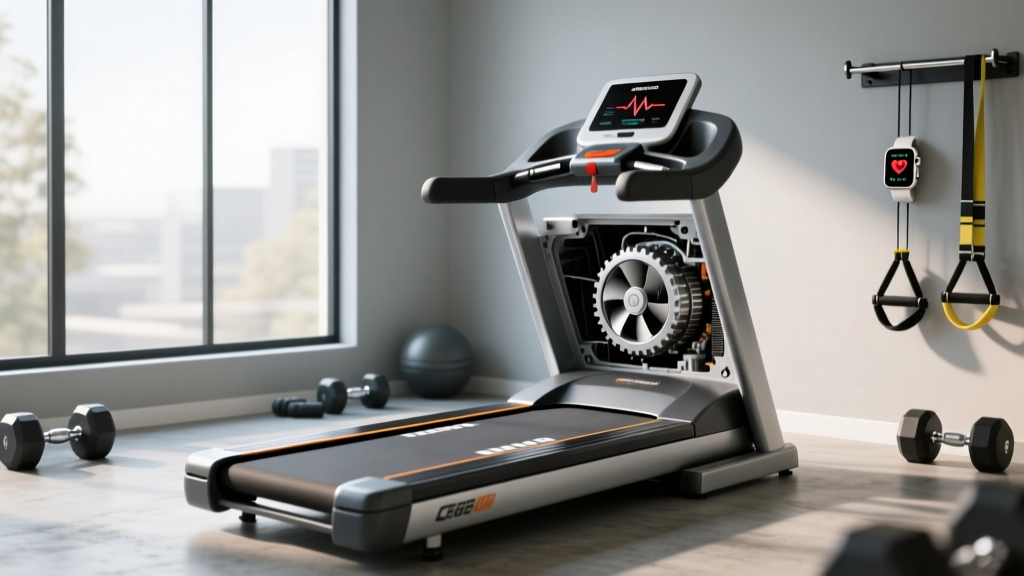
- Remove the motor hood (usually 4 to 6 Phillips screws).
- Check the drive belt for 'rubber dust' or glazing. A glazed drive belt will slip on the motor pulley when you step on the deck, mimicking a motor slow-down.
- The Fix: Drive belts cost under $20 and take 10 minutes to swap.
Phase 3: Evaluating Motor Brush Wear
Most home DC treadmill motors use carbon brushes to conduct electricity to the spinning armature. Over 5 to 7 years (or roughly 5,000 miles), these brushes wear down to the nub. When they lose solid contact, the motor loses torque and stutters under load. Replacing carbon brushes is a $30 repair, but it requires removing the motor and disassembling the end caps.
WARNING: The Control Board LimiterNever attempt to 'upgrade' your treadmill by swapping a 2.5 CHP motor for a 3.5 CHP motor. The machine's lower control board (the circuit board near the motor) is calibrated to the specific voltage and amperage limits of the factory motor. Installing a larger motor will instantly blow the board's capacitors or trip your home's breaker.
Frequently Asked Questions
Does running on an incline make the stuttering worse?
Absolutely. Running at a 10% to 15% incline increases the gravitational load and the torque required from the motor exponentially. If your treadmill only slows down when running on an incline, your motor is likely functioning fine for flat ground, but is simply undersized for your weight-to-incline ratio. You will need to either reduce the incline or upgrade to a machine with a minimum 3.5 CHP motor.
How do I know if the motor is completely dead versus just underpowered?
An underpowered motor will stutter, smell faintly of hot ozone, and eventually trigger an error code (like 'E1' or 'LS' for Loss of Signal) after 20 minutes of use. A dead motor will either not move at all, make a loud clicking noise (indicating a shorted commutator), or immediately trip your home's GFCI outlet the second you step on the belt.
Are commercial AC motors better for heavy runners?
Yes. Commercial gym treadmills (like the Life Fitness Integrity Series) use AC (Alternating Current) motors rated at 4.0 HP or higher. AC motors generate massive low-end torque and do not use carbon brushes, making them virtually immune to the stuttering issue. However, they require 220V outlets and cost upwards of $8,000 for home installation, making high-CHP DC motors the practical choice for 95% of home users.
Final Verdict: Sizing for Success
When your treadmill slows down when running, it is your machine's way of crying for help. By understanding the vital difference between Peak HP and Continuous Duty HP, properly maintaining your deck friction, and matching your motor size to your specific body weight and pace, you can ensure a smooth, safe, and uninterrupted workout. Always consult Consumer Reports' treadmill buying guides to verify the true CHP ratings of any machine before making your final investment.
More gear to consider
All reviews
How to Calibrate Garmin to Treadmill & Home Stair Climbers

WalkingPad P1 Foldable Walking Treadmill Setup & Feature Comparison

Air Bike vs Assault Bike: Converting 10,000 Treadmill Steps to Miles
Elliptical vs Treadmill: Space & NordicTrack Treadmill Problems
NordicTrack Commercial 1750 Treadmill NTL17125: Folding Small Space Review