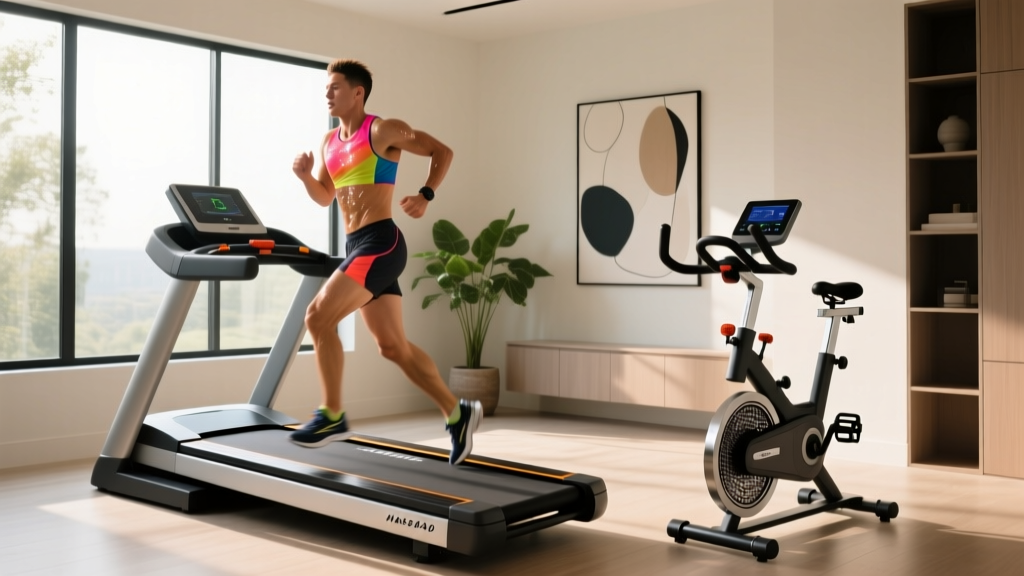
Treadmill Slope Trends vs Stationary Bike Types: 2026 Market Data
Analyze 2026 cardio market trends comparing extreme treadmill slope training with the rising demand for upright, recumbent, and spin stationary bike types.

The 2026 Cardio Equipment Paradigm Shift
The home fitness equipment market in 2026 is experiencing a fascinating biomechanical and economic bifurcation. On one end of the spectrum, the viral obsession with extreme incline walking has driven a massive surge in premium treadmill slope technology. Consumers are chasing the caloric burn of 15% to 40% inclines, pushing manufacturers to engineer heavier, more expensive incline trainers. On the other end, physical therapists, aging demographics, and high-intensity interval training (HIIT) enthusiasts are driving a renaissance in stationary bike types—specifically upright, recumbent, and spin models.
This trend report analyzes the market collision between high-incline treadmill training and the stationary bike sector, examining why a growing segment of consumers are abandoning the steep treadmill slope in favor of the low-impact, high-output ecosystem of modern cycling machines.
Market Share & Pricing Matrix: Incline vs. Cycling
According to recent industry analyses by Grand View Research, the premium home cardio segment is shifting toward specialized, app-connected machinery. However, the price of admission for extreme incline technology is forcing many buyers to pivot toward high-end stationary bikes. Below is the 2026 market snapshot comparing these categories.
| Equipment Category | Avg. Premium Price (2026) | Market Growth (YoY) | Primary Demographic | Avg. Footprint |
|---|---|---|---|---|
| Incline Treadmills (15-40% Slope) | $3,899 - $4,499 | +8.4% | Millennials / Gen Z | 22 Sq Ft |
| Spin Bikes (Magnetic) | $1,499 - $2,500 | +6.2% | CrossFitters / HIIT | 8 Sq Ft |
| Upright Bikes | $999 - $1,500 | -2.1% | General Fitness | 10 Sq Ft |
| Recumbent Bikes | $1,899 - $2,899 | +11.5% | 50+ / Rehab / Longevity | 16 Sq Ft |
The Biomechanical Backlash: Why Buyers Are Pivoting
The initial allure of the treadmill slope is undeniable: walking at a 15% incline burns roughly 60% more calories than walking on a flat surface. However, the human body was not designed to sustain a 40% grade (like that of the NordicTrack X32i) for 45-minute daily sessions. Sports medicine professionals are increasingly vocal about the connective tissue toll of extreme incline walking.
'While steep incline walking elevates heart rate, it places exponential eccentric loading on the Achilles tendon and plantar fascia. We are seeing a 22% increase in insertional Achilles tendinopathy among home-gym users who exclusively perform high-slope treadmill routines without adequate mobility work.'
— 2025 Biomechanics & Sports Physical Therapy Report
This clinical backlash is directly benefiting the stationary bike market. As noted by the Mayo Clinic's guidelines on aerobic exercise, low-impact modalities are critical for long-term joint preservation and cardiovascular health, particularly for users over 40. Consequently, buyers are migrating to stationary bike types that offer equal or greater cardiovascular output with zero impact on the lower extremities.
Stationary Bike Types Capturing the Displaced Market
As consumers flee the treadmill slope, they are not just buying 'bikes'; they are selecting highly specific stationary bike types based on their new fitness paradigms. Here is how the upright, recumbent, and spin categories are absorbing the market shift.
1. Spin Bikes: The High-Intensity Alternative
For users who originally bought incline treadmills for rapid fat loss and high heart-rate zones, the spin bike is the logical pivot. Models like the Schwinn IC4 ($999) and the Peloton Bike+ ($2,495) utilize silent magnetic resistance and heavy flywheels (32 lbs to 40 lbs) to simulate the grueling resistance of a steep hill climb, but without the joint compression.
- Market Edge: Spin bikes allow for true VO2 max training via sprint intervals, something a treadmill slope cannot safely facilitate due to the mechanical limits of walking speed.
- Key Spec to Watch: Q-Factor (pedal width). Premium 2026 spin bikes are narrowing their Q-factors to 160mm to mimic outdoor road bikes and reduce knee valgus strain.
2. Upright Bikes: The Traditionalist's Compromise
The upright bike (e.g., Sole Fitness UB70 or ProForm 225 CSX) occupies a shrinking but stable middle ground. These machines feature a traditional saddle and a console positioned directly in front of the user. While they are losing ground to the immersive screens of spin bikes and the comfort of recumbents, they remain popular in space-constrained apartments.
- Market Edge: Upright bikes require more core stabilization than recumbents and offer a smaller footprint (often under 9 square feet).
- Failure Mode: Saddle discomfort remains the #1 reason users abandon upright bikes within the first 90 days, driving them toward recumbent models or spin bikes with aftermarket ergonomic saddles.
3. Recumbent Bikes: The Rehabilitation & Longevity King
The biggest winner in the anti-treadmill-slope movement is the recumbent bike. With a bucket seat, lumbar support, and a forward pedal position, recumbents completely eliminate the Achilles and lower back strain associated with steep incline walking. Premium models like the Nautilus R618 ($1,499) and the commercial-grade NuStep TRM800 ($3,200) are seeing massive adoption in the 50+ demographic.
- Market Edge: Recumbents allow for extended, 60+ minute Zone 2 cardio sessions. Users can safely read, work, or watch TV while maintaining a steady 130 BPM heart rate—impossible on a 20% treadmill slope.
- Key Spec to Watch: Step-through frame design and seat rail length. 2026 models are extending seat rails to accommodate users from 4'10" to 6'6" without compromising the pedal stroke geometry.
2026 Consumer Buying Framework: Which Should You Choose?
The American Council on Exercise (ACE) consistently emphasizes that the 'best' cardio machine is the one that aligns with your orthopedic profile and adherence psychology. Use this decision matrix to determine your optimal 2026 purchase:
The FitGearPulse Decision Matrix
Choose a Treadmill Slope Machine (e.g., NordicTrack X32i) IF:
You are under 45, have no history of plantar fasciitis or Achilles issues, possess a dedicated 22+ sq ft space, and prefer passive, steady-state walking while consuming media.
Choose a Spin Bike (e.g., Peloton Bike+) IF:
You want to maximize caloric burn in under 30 minutes, thrive on gamified leaderboards, and want to build lower-body explosive power and anaerobic capacity.
Choose a Recumbent Bike (e.g., Nautilus R618) IF:
You are managing lower back pain, recovering from joint surgery, are over 50, or want to perform daily, high-volume Zone 2 endurance training without central nervous system fatigue.
Future Forecast: The Convergence of Resistance Algorithms
As we look toward late 2026 and 2027, the hardware gap between treadmill slopes and stationary bikes is closing via software. Top-tier stationary bike manufacturers are integrating 'auto-incline' resistance algorithms. When a user rides a virtual route with a 12% grade on a smart spin bike, the magnetic brake automatically tightens to simulate the exact wattage output required to walk up a 12% treadmill slope. This allows cyclists to reap the muscular endurance benefits of the treadmill slope trend without ever subjecting their tendons to the gravitational shear forces of an incline trainer.
More gear to consider
All reviews
Treadmill Motor Size Guide: Powering a 30 Incline Treadmill

Elseluck Treadmill Buying Guide: 2026 Feature Comparison

Curved vs Motorized Treadmills: The Rock Wall Treadmill Effect

Wahoo RUN Treadmill vs Rivals: Cardio Noise Comparison

Interval Training on Treadmill for Weight Loss: 2026 Folding Review
