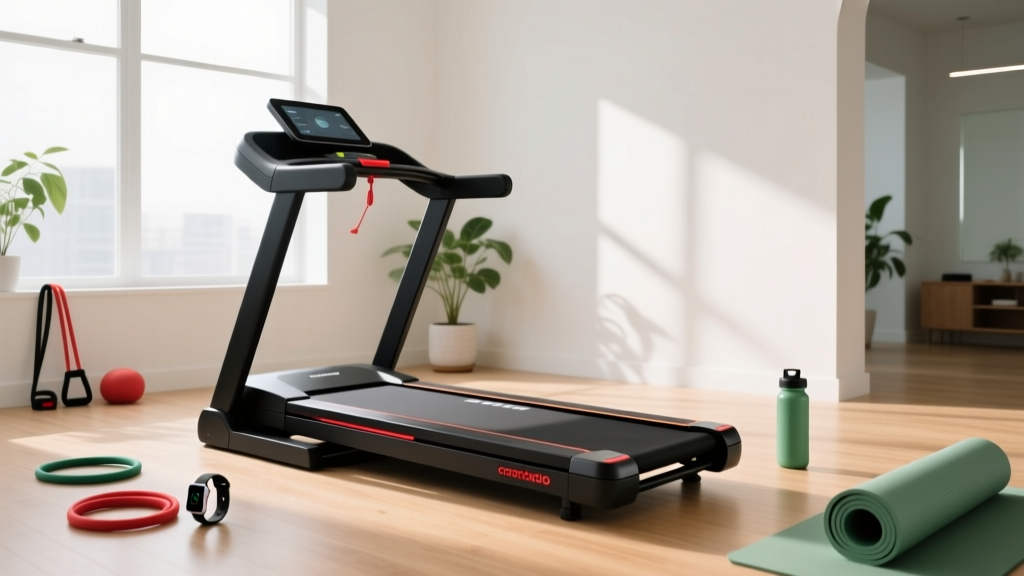
Treadmill Workout for Losing Weight: 2026 Portable Trends
Explore 2026 market trends for portable cardio. Discover if a compact treadmill workout for losing weight works, plus top models and caloric burn data.

The 2026 Market Shift: The Rise of Compact Cardio
The home fitness landscape in 2026 has undergone a radical transformation. Driven by the permanent normalization of hybrid work models and the premium on urban square footage, the demand for massive, 300-pound traditional treadmills has plateaued. In its place, the compact portable cardio equipment sector has exploded into a $4.2 billion sub-market. Consumers are no longer dedicating entire spare rooms to fitness; they are integrating equipment into living rooms, home offices, and micro-apartments.
But this spatial efficiency raises a critical physiological question for our readers: Can you actually execute an effective treadmill workout for losing weight on a machine that folds in half and slides under a sofa? The short answer is yes, but the biomechanics, hardware limitations, and workout protocols required for portable machines differ vastly from their commercial gym counterparts. Below, we break down the market data, hardware realities, and exact protocols needed to drive fat loss with compact cardio equipment in 2026.
Caloric Expenditure: Portable vs. Traditional Machines
According to the American Heart Association, consistent moderate-intensity walking is a cornerstone of cardiovascular health and weight management. However, the caloric yield of your workout is dictated by your stride mechanics and machine resistance.
Most budget walking pads feature a belt length of 40 to 43 inches. For users over 5'8", this forces a shortened stride, which inherently reduces glute and hamstring activation. Less muscle recruitment equates to a lower metabolic demand. To achieve a genuine treadmill workout for losing weight on a portable unit, you must artificially increase the metabolic equivalent of task (MET) through external loading or speed manipulation.
| Equipment Type | Avg. Speed / Resistance | Caloric Burn (160 lb user / 45 mins) | Primary Limitation |
|---|---|---|---|
| Commercial Treadmill (Incline) | 3.5 MPH @ 12% Incline | ~380 kcal | Footprint (70"+ length) |
| Heavy-Duty Folding Treadmill | 3.5 MPH @ 10% Incline | ~340 kcal | Weight (150+ lbs) |
| Standard Walking Pad (Flat) | 3.5 MPH @ 0% Incline | ~165 kcal | Short belt limits stride |
| Walking Pad + 20lb Weighted Vest | 3.5 MPH @ 0% Incline | ~210 kcal | Joint impact over time |
| Under-Desk Elliptical (High Res.) | Level 8 Magnetic Resistance | ~145 kcal | Seated posture limits core |
Note: Caloric estimates are based on standard MET calculations and Mayo Clinic metabolic guidelines. Individual results vary based on basal metabolic rate (BMR) and lean muscle mass.
Hardware Analysis: Top Portable Options for Fat Loss
Not all compact machines are engineered for the sustained friction and motor heat generated by weight-loss protocols (which typically require 45-60 minutes of continuous LISS—Low-Intensity Steady State cardio). Here is our market analysis of the top-performing portable units in 2026.
1. UREVO Strol 2E (Best Overall for Weight Loss)
Unlike flimsy under-desk pads, the Strol 2E bridges the gap between a walking pad and a traditional treadmill. It features a 1.5 CHP (Continuous Horsepower) motor, which is critical. Many competitors use 'Peak HP' ratings that mask underpowered motors prone to thermal throttling after 30 minutes.
- Max Speed: 7.6 MPH (Allows for light jogging and HIIT intervals)
- Belt Dimensions: 43.3" x 17.5" (Accommodates average strides comfortably)
- 2026 Street Price: $429 - $459
- Weight Loss Edge: The included handlebar and 3% fixed incline allow for a slightly higher caloric burn and safer use of weighted vests.
2. WalkingPad R2 (Best for Micro-Spaces)
KingSmith's WalkingPad R2 remains a market leader for ultra-compact storage, folding down to a mere 10 inches thick. However, it is strictly a walking machine.
- Max Speed: 6.2 MPH (Auto-adjusts via AI stride sensors)
- Belt Dimensions: 43.3" x 17.3"
- 2026 Street Price: $499
- Weight Loss Edge: The seamless belt design reduces friction, allowing the 1.25 HP motor to run cooler during 60-minute daily step challenges.
3. Cubii JR2 (Best Non-Treadmill Alternative)
If a treadmill workout for losing weight is causing joint fatigue, the under-desk elliptical market offers a zero-impact alternative. The Cubii JR2 utilizes magnetic resistance rather than friction, ensuring silent operation.
- Resistance Levels: 8 manual levels
- 2026 Street Price: $299
- Weight Loss Edge: Promotes non-exercise activity thermogenesis (NEAT). While the per-minute caloric burn is lower, users average 2+ hours of daily use while working, compounding total daily energy expenditure (TDEE).
When shopping for compact treadmills in 2026, ignore 'Peak Horsepower' claims. A 2.5 Peak HP motor may only sustain 0.75 Continuous Horsepower (CHP). For users over 180 lbs aiming for sustained fat-loss sessions, a minimum of 1.5 CHP is mandatory to prevent the motor's internal thermal switch from tripping and shutting the belt down mid-stride.
The 'Compact Treadmill' Weight Loss Protocol
Because portable treadmills lack the 15% motorized inclines of premium traditional models, you must manipulate other variables to trigger fat oxidation. We recommend the Weighted LISS Protocol for portable machine owners.
- Equip a 15-20 lb Weighted Vest: Distributing weight across the torso (rather than holding dumbbells, which alters gait and stresses the lower back) increases caloric expenditure by up to 15% without requiring a faster belt speed.
- Set Speed to 3.2 - 3.8 MPH: This keeps you in Zone 2 heart rate territory (60-70% of max HR), which optimizes fat utilization as a primary fuel source.
- Duration - 45 to 60 Minutes: Because the mechanical load is lower than an inclined commercial treadmill, you must extend the duration to achieve a 250+ calorie deficit per session.
- Cadence Focus: Actively focus on a heel-to-toe strike and forceful push-off to compensate for the lack of incline and maximize calf and glute engagement.
Market Forecast: What's Next for Portable Cardio?
According to recent equipment testing by The New York Times Wirecutter, the primary consumer complaint with portable cardio equipment remains belt durability and edge-tracking. In response, 2026 models are increasingly adopting multi-layer, pre-tensioned belts that require zero manual alignment.
Furthermore, we are seeing a surge in 'hybrid' portable machines—units that operate as flat under-desk walking pads but feature telescoping handlebars and manual incline pins to convert into traditional cardio trainers for evening weight-loss sessions. As urbanization continues to dictate consumer purchasing power, the compact treadmill market will only grow more sophisticated, blurring the line between spatial convenience and commercial-grade performance.
Frequently Asked Questions
Do walking pads consume a lot of electricity?
No. A standard 1.5 CHP walking pad drawing continuous load for an hour consumes roughly 0.8 to 1.2 kWh, costing less than $0.20 per session based on the 2026 national average electricity rate of $0.17/kWh.
Can I run on a folding portable treadmill?
Most true 'walking pads' cap out at 4.0 to 6.0 MPH and lack the shock absorption required for running. Attempting to run on them will degrade the deck rapidly and void the warranty. Look for 'folding treadmills' with 10+ MPH capabilities and elastomer cushioning if running is your primary weight-loss modality.
More gear to consider
All reviews
iFIT App for NordicTrack Treadmill & Home Stair Climber Setup

Horizon Fitness 7.4AT Treadmill vs Stationary Bikes: Space Layout
Home Stair Climber Guide: Is a Treadmill Good for Weight Loss?

Air Bike vs Assault Bike Guide: Translating Treadmill Speed to Pace KM

Portable Cardio Longevity: Maintenance Care & How to Burn the Most Calories on a Treadmill
