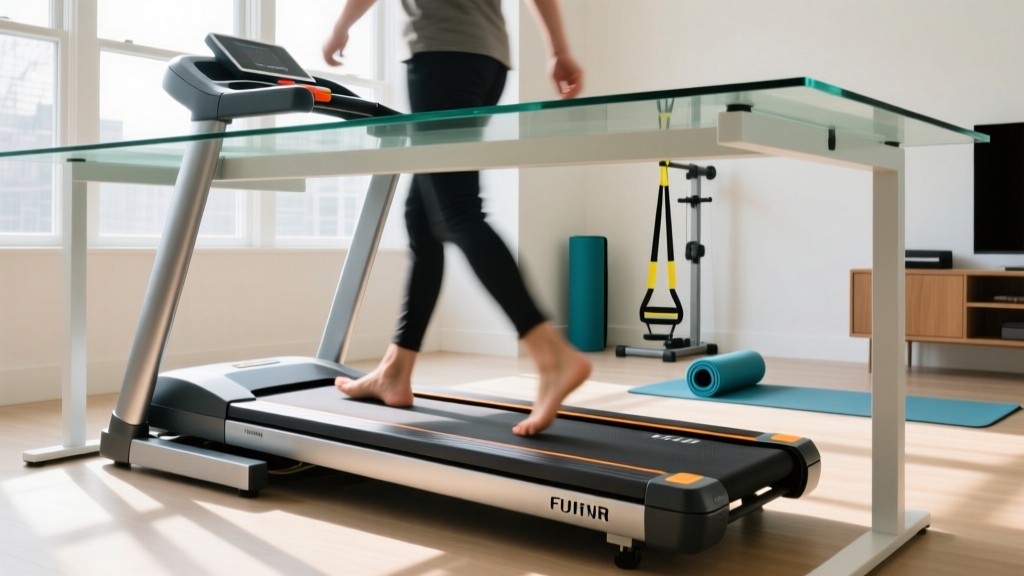
Under Desk Treadmill Review vs Average Treadmill Size: 2026 Trends
Discover how the 2026 under desk treadmill market solves spatial limits. We review top office models and compare them to the average treadmill size.

The permanent shift to hybrid and remote work models has fundamentally altered the home office landscape. As professionals seek to combat the sedentary nature of desk jobs, cardiovascular equipment has migrated from the garage gym to the workspace. However, spatial constraints remain the primary barrier to entry. In this 2026 market analysis and comprehensive under desk treadmill review, we examine how the latest low-profile walking pads are disrupting the industry by directly challenging the spatial dominance of the average treadmill size.
The Spatial Reality Check
The average treadmill size for a standard residential motorized model is approximately 77 inches long by 30 inches wide, consuming roughly 16 square feet of floor space. In a standard 10x10 foot home office, a traditional treadmill occupies over 15% of the total room area, often violating the 3-foot ergonomic clearance zone required behind and beside the machine. Under-desk treadmills, averaging 54 inches long by 22 inches wide, reduce this footprint by nearly 60%, allowing them to slide entirely beneath a standard 48-inch standing desk.
The 2026 Market Shift: Why Under-Desk Treadmills are Dominating
According to recent telecommuting trends tracked by Global Workplace Analytics, the hybrid work model has stabilized, with professionals spending an average of 3.2 days per week working from home. This permanence has driven a massive capital reallocation toward home office ergonomics. The under-desk treadmill market has responded by evolving from cheap, low-torque novelty items into robust, commercial-grade micro-mobility devices.
In 2026, the primary market differentiator is no longer just portability; it is continuous duty cycle. Early walking pads from 2020-2022 featured 1.0 HP motors that overheated after 45 minutes of use. Today's market leaders utilize 2.0 to 2.5 CHP (Continuous Horsepower) brushless DC motors, allowing users to walk at 2.0 MPH for four-hour blocks during deep-work sessions without triggering thermal shutoffs.
'The integration of low-impact movement into the cognitive workday is no longer a niche biohacking trend; it is a fundamental ergonomic standard. The reduction in musculoskeletal strain achieved by alternating between sitting, standing, and slow walking is profound.' — Mayo Clinic Research on Sedentary Behavior
Dimensional Breakdown: Under-Desk vs. Average Treadmill Size
To understand the value proposition of the under-desk category, we must look at the exact dimensional trade-offs. When you eliminate the incline motor, the massive steel uprights, and the heavy-duty console, you drastically alter the machine's physical and mechanical profile.
| Specification | Standard Residential Treadmill | 2026 Premium Under-Desk Treadmill | Impact on Office Use |
|---|---|---|---|
| Footprint (L x W) | 77' x 30' (16.0 sq ft) | 52' x 22' (7.9 sq ft) | Under-desk models fit within standard desk clearance zones. |
| Weight | 150 - 220 lbs | 55 - 85 lbs | Allows for single-person relocation and under-bed storage. |
| Belt Width | 20' - 22' | 16' - 18' | Narrower belts require better balance; not suitable for running. |
| Max Speed | 10 - 12 MPH | 3.5 - 4.0 MPH | Under-desk limits prevent high-impact jogging while typing. |
| Deck Height | 8' - 10' | 4' - 5.5' | Low profile prevents knee-strike against the desk crossbar. |
Top Under-Desk Treadmills for Office Use: 2026 Review & Analysis
We evaluated the top-performing models of 2026 based on motor thermal endurance, acoustic output (decibel levels during phone calls), and structural rigidity.
1. WalkingPad R2 (2026 Refresh)
Price: $499 | Motor: 1.25 HP (Peak 2.0) | Weight Capacity: 265 lbs
The WalkingPad R2 remains the benchmark for the foldable under-desk category. Its patented 180-degree fold mechanism allows the 59' x 21.5' frame to halve in length for closet storage. The 2026 refresh features an upgraded silent-drive belt that reduces acoustic output to 42 dB at 2.0 MPH—quiet enough to remain undetected by colleagues on Microsoft Teams calls. However, the 16.5' belt width demands strict lateral discipline; users who naturally sway while walking will frequently clip the side rails.
2. UREVO Strol 2E
Price: $359 | Motor: 2.0 HP | Weight Capacity: 300 lbs
UREVO has captured the mid-market by prioritizing raw power over portability. The Strol 2E abandons the folding mechanism in favor of a reinforced steel chassis and a wider 17.5' running surface. The 2.0 HP motor handles heavier users (up to 300 lbs) without the belt-stutter common in cheaper 1.0 HP models. It includes integrated desk-mount brackets, a massive advantage for users who want to physically tether the treadmill to their standing desk to prevent creeping.
3. King Smith R3 Pro
Price: $599 | Motor: 2.5 CHP | Weight Capacity: 330 lbs
For executives and heavier users, the King Smith R3 Pro is the undisputed heavyweight. The die-cast aluminum body eliminates the flex and creaking associated with plastic-shelled walking pads. The 2.5 CHP motor provides immense torque at low speeds (0.5 to 1.5 MPH), which is critical for maintaining a smooth walking cadence while reading complex documents. The trade-off is weight: at 88 lbs, it is not easily moved, making it a permanent fixture in the office.
Real-World Failure Modes & Edge Cases
- Control Board Frying: The most common catastrophic failure in sub-$250 walking pads occurs when users exceed the weight limit. The motor draws excessive amperage to pull the belt, overheating the MOSFETs on the control board. Always buy a machine with a 20% weight buffer above your actual body weight.
- Belt Delamination: Continuous walking at the exact same 1.5 MPH pace creates a localized heat band in the center of the PVC belt. Over 6-8 months, this can cause the top grip layer to separate from the cotton backing. We recommend shifting your walking speed by 0.2 MPH every 20 minutes to distribute thermal load.
- Static Shock: Low-humidity home offices combined with nylon-blend office wear create massive static buildup. Without a properly grounded outlet and an anti-static silicone belt lubricant applied every 90 days, users risk shocking themselves on the desk frame or damaging laptop motherboards via USB peripherals.
Ergonomic Framework: Pairing Treadmills with Standing Desks
Simply placing a treadmill under a desk is a recipe for cervical strain and wrist tendonitis. According to ergonomic guidelines established by ACE Fitness, the introduction of a moving surface radically alters your biomechanical alignment.
- Calculate True Desk Height: An under-desk treadmill adds 4.5 to 5.5 inches to your stance. If your seated desk height is 29 inches, your walking desk height must be raised to approximately 44-46 inches. Your elbows must remain at a 90-degree angle to prevent ulnar nerve compression.
- Stabilize the Visual Field: Walking introduces vertical oscillation (bounce). If your monitor rests on a standard desk stand, the screen will shake, causing eye fatigue and motion sickness. You must use a heavy-duty, gas-spring monitor arm clamped to the rear edge of the desk to isolate the screen from the treadmill's micro-vibrations.
- The 20-Minute Rule: Biomechanists recommend a 20-8-2 ratio (20 minutes sitting, 8 minutes standing, 2 minutes walking/stretching). When using an under-desk treadmill for deep work, cap continuous walking sessions at 45 minutes. Beyond this threshold, cognitive load sharing causes a measurable drop in typing accuracy and complex problem-solving speed.
Final Verdict: Reclaiming the Home Office
The era of sacrificing 20 square feet of your home office to a traditional, dust-collecting treadmill is over. By understanding the spatial limitations imposed by the average treadmill size, professionals are pivoting to high-torque, low-profile under-desk models that integrate seamlessly into the workday. Whether you opt for the ultra-quiet WalkingPad R2 for shared spaces or the heavy-duty King Smith R3 Pro for long-haul walking sessions, the 2026 market finally offers commercial-grade cardiovascular solutions that respect the geometry of the modern home office.
More gear to consider
All reviews
How to Run on a Treadmill Properly & Stationary Bike Maintenance

Yesoul Treadmill Reviews 2026: W3 Walking Pad vs KingSmith X21

Walking Pad Setup: Beating the Indoor Bike vs Treadmill Dilemma

NordicTrack C1650 Treadmill Belt Maintenance Trends
Rowing Machine Setup: Technique vs Weight Capacity for Treadmills
