Beyond the Basic Treadmill Definition: Curved vs Motorized Guide
Redefine your treadmill definition. We compare curved manual vs motorized treadmills with 2026 pricing, biomechanics, and expert buying advice.

When most people search for the standard treadmill definition, they are met with a rudimentary dictionary entry: an exercise machine featuring a continuous moving belt for walking or running in place. However, as we navigate the 2026 fitness equipment market, that basic treadmill definition is no longer sufficient. The industry has bifurcated into two fundamentally distinct biomechanical categories: the traditional motorized treadmill and the curved manual treadmill.
Understanding the mechanical, financial, and physiological differences between these two machine types is critical for home gym builders and commercial facility managers alike. This in-depth buying guide transcends the basic treadmill definition to provide a rigorous, data-driven comparison of curved manual versus motorized treadmills, complete with real-world pricing, failure modes, and expert decision frameworks.
The Biomechanical Divide: Redefining the Treadmill
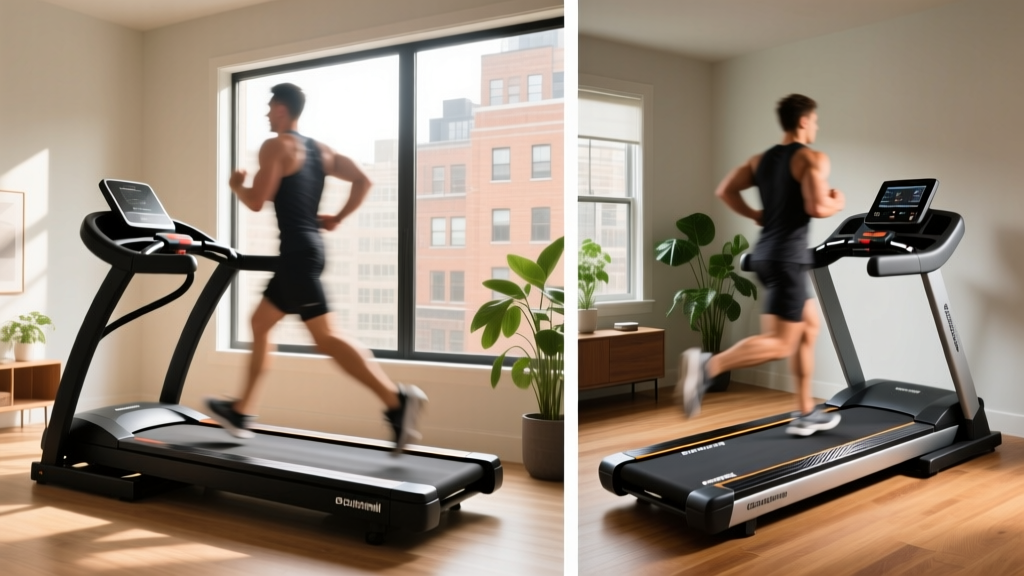
The core difference lies in the drive mechanism. A motorized treadmill relies on an electric motor (typically ranging from 2.5 to 4.0 Continuous Horsepower) to pull a PVC or polyurethane belt beneath the user's feet. The user must simply keep pace with the pre-set speed.
Conversely, a curved manual treadmill operates entirely on human kinetics. Featuring a concave, slatted running surface, the curved design uses gravity and friction to drive the belt. The user's foot strike pulls the belt backward, meaning the machine only moves when you move. This shifts the treadmill definition from a 'pacing tool' to a 'resistance engine,' fundamentally altering muscle recruitment patterns, specifically increasing activation in the posterior chain (glutes and hamstrings).
Motorized Treadmills: The Traditional Powerhouse
Motorized treadmills remain the gold standard for steady-state cardio, marathon pacing, and incline training. Because the motor dictates the pace, these machines are ideal for users who need external pacing cues or require precise, repeatable speed intervals.
Top 2026 Models & Real-World Pricing
- Sole F80: Priced at $1,199, this remains the benchmark for mid-tier home gyms. It features a 3.5 CHP motor and a 22-inch running deck, offering exceptional stability for runners up to 350 lbs.
- NordicTrack Commercial 1750: Retailing around $2,799, this model leans heavily into interactive programming with a 14-inch HD touchscreen and automatic incline/decline adjustments (-3% to 15%).
- Peloton Tread: At $3,495, it offers a seamless integration of live studio classes, though its 2.0 HP motor is better suited for walking and light jogging rather than heavy sprinting.
Curved Manual Treadmills: The Athletic Upgrade
Curved treadmills have redefined high-intensity interval training (HIIT) and sprint mechanics. Without a motor to enforce a top speed, the user's power output is the only limiting factor. According to biomechanical research published by the National Institutes of Health (NIH), running on a curved non-motorized treadmill increases energy expenditure and caloric burn by approximately 30% compared to a motorized treadmill at the same perceived exertion level.
Top 2026 Models & Real-World Pricing
- AssaultRunner Elite: Priced at $3,299, this model features a 1/8-inch thick vulcanized rubber slat belt and a reinforced steel frame, capable of withstanding extreme torque from elite sprinters.
- TrueForm Runner: Retailing at $4,895, the TrueForm utilizes a low-profile design and a proprietary rubber compound that offers superior shock absorption for joint health.
- Woodway Curve: The commercial titan at $6,800+. Woodway's patented slat belt technology is rated for 150,000+ miles, making it a staple in professional sports facilities.
Head-to-Head Comparison Matrix
| Feature | Motorized Treadmill | Curved Manual Treadmill |
|---|---|---|
| Drive Mechanism | Electric Motor (2.5 - 4.0 CHP) | User-Generated (Gravity & Friction) |
| Caloric Expenditure | Baseline (Standard METs) | +20% to +30% Higher |
| Max Speed Limit | 12 - 15 MPH (Motor restricted) | Unlimited (User restricted) |
| Incline Capability | 0% to 15% (Motorized deck lift) | Fixed Curve (Simulates 8-10% grade) |
| Average Price Range | $1,000 - $3,500 | $3,200 - $7,000+ |
| Power Requirement | 120V Dedicated Outlet | None (Self-powered) |
Real-World Failure Modes: What Actually Breaks?
As equipment reviewers, we look past the marketing brochures to identify how these machines actually fail in home and commercial environments. The failure modes for these two categories are entirely different.
Motorized Treadmill Edge Cases & Failures
- Static Electricity Arcing: In low-humidity environments, friction between the belt and deck generates static charge. If the machine is not properly grounded via a dedicated 120V outlet, this static can arc into the lower control board, instantly frying the MOSFETs and requiring a $300+ board replacement.
- Incline Motor Gear Stripping: Users who frequently run at maximum incline (15%) while weighing over 250 lbs place immense lateral torque on the incline lift actuator. Over time, the internal plastic gears can strip, causing the deck to get stuck at a fixed angle.
- Drive Belt Slippage: The ribbed poly-v belt connecting the motor to the front roller stretches over time. When it slips, users experience a sudden 'stutter' or hesitation in the belt during foot strike, which is a major fall hazard.
Curved Manual Treadmill Edge Cases & Failures
- Urethane Slat Degradation: While the slats themselves are tough, heavy heel-strikers can cause micro-fractures in the urethane over thousands of miles. More commonly, the rubber O-rings or screws securing the slats to the drive chain can loosen, creating a rhythmic clicking noise that requires manual tensioning.
- Guide Rail Friction Burn: The belt rides on low-friction UHMW (Ultra-High Molecular Weight) polyethylene guide rails. If dust and pet hair infiltrate the side panels, the friction coefficient increases, making the belt feel 'heavy' or 'sticky' until the rails are cleaned and re-waxed.
- Magnetic Resistance Band Snapping: On models with adjustable magnetic resistance (like the AssaultRunner), the Kevlar-reinforced drive bands connecting the magnetic brake to the flywheel can snap under extreme sprinting torque, requiring a specialized repair kit.
The 2026 Buyer's Decision Framework
To finalize your purchasing decision, map your primary training modality to the correct machine profile. The Mayo Clinic emphasizes matching aerobic equipment to your specific joint health and cardiovascular goals, which aligns perfectly with our framework below.
Choose a Motorized Treadmill If:
- You are training for a marathon and need to lock into precise, sustained paces (e.g., exactly 8.5 MPH for 12 miles) while zoning out or watching media.
- You require variable incline/decline programming to simulate specific outdoor topography.
- Your primary use case is walking, rehabilitation, or low-impact steady-state cardio (LISS).
- Your budget is strictly capped under $2,500.
Choose a Curved Manual Treadmill If:
- You are an athlete focused on HIIT, CrossFit, or sprint mechanics where instant acceleration and deceleration are required.
- You want to maximize caloric burn in shorter time windows (the 30% energy expenditure premium is highly valuable for time-crunched professionals).
- You want to eliminate the ongoing maintenance of motor lubrication, control board replacements, and power surges.
- You need to place the machine in a room without a dedicated 120V circuit or want to reduce your home's phantom energy draw.
Final Thoughts on the Modern Treadmill Definition
The literal treadmill definition may remain static in the dictionary, but the practical application of the machine has evolved dramatically. Motorized treadmills like the Sole F80 and NordicTrack 1750 continue to dominate the steady-state and interactive-training markets, offering unmatched convenience and pacing control. Meanwhile, curved manual treadmills like the AssaultRunner Elite and Woodway Curve have carved out an elite niche, offering superior biomechanical feedback, higher caloric yields, and virtually bulletproof mechanical longevity.
By understanding the deep mechanical differences, real-world pricing, and specific failure modes outlined in this guide, you can look beyond the basic marketing jargon and invest in the exact cardio engine your training demands in 2026 and beyond.
More gear to consider
All reviews
Curved vs Motorized Treadmill: How to Grease a Treadmill Belt

Stair Climber Home Guide: Mistakes & Lifetime Fitness T5 Treadmill Fixes

Stair Climber Troubleshooting: Beyond the Treadmill Wooden Board

Film an OK Go Video on Treadmill: Quiet Cardio Noise Guide
Maintaining Portable Cardio for a 10 Minute Mile on Treadmill
