NordicTrack Flex Select T6 5s Treadmill Noise: Troubleshooting & Fixes
Diagnose and fix NordicTrack Flex Select T6 5s treadmill noise. Compare decibel levels across cardio machines and learn expert maintenance tips.

Home gym acoustics are often an afterthought until the first early morning workout. Among the most popular entry-to-mid-level cardio machines, the NordicTrack Flex Select T6 5s treadmill offers an excellent balance of interactive programming and adjustable cushioning. However, like all motorized cardio equipment, it is subject to mechanical wear, structural resonance, and user-induced acoustic issues. When owners search for solutions to excessive noise, they often confuse normal operational hum with genuine mechanical failure. According to baseline acoustic guidelines from the CDC NIOSH, prolonged exposure to noise above 70 decibels (dB) can cause fatigue and hearing strain, making a quiet home gym not just a courtesy to housemates, but a health priority.
This comprehensive troubleshooting guide dissects the specific acoustic profile of the NordicTrack Flex Select T6 5s treadmill, compares it against other popular cardio machines, and provides exact, measurable solutions to eliminate squeaks, thumps, and motor whines. As of 2026, advancements in brushless motor technology and high-durometer vibration mats have changed how we approach home gym noise, and applying these modern standards to your equipment maintenance is critical.
Baseline Acoustic Footprint: Cardio Machine Noise Comparison
Before diagnosing a specific fault, you must understand what 'normal' sounds like. Every cardio machine generates noise through two primary vectors: airborne noise (motor hum, fan whir, foot strikes) and structure-borne noise (vibrations transferring through the floor joists). The World Health Organization (WHO) notes in their environmental noise guidelines that low-frequency, structure-borne noise is often the most disruptive in multi-family dwellings, even at lower decibel levels.
| Cardio Machine Type | Average Airborne Noise (dB) | Structure-Borne Vibration | Primary Noise Source |
|---|---|---|---|
| Motorized Treadmill (e.g., T6 5s) | 65 - 80 dB | High (Impact dependent) | Foot strike, belt friction, motor |
| Magnetic Rower (e.g., Concept2) | 50 - 65 dB | Low | Fan/magnetic drag, chain slap |
| Elliptical Cross-Trainer | 55 - 65 dB | Very Low | Drive wheel bearings, pivot joints |
| Air Resistance Bike | 75 - 90 dB | Low | Air displacement fan, chain drive |
As the data illustrates, treadmills inherently produce the highest combination of airborne and structure-borne noise due to the repetitive impact of human body weight against a moving, motorized belt. If your NordicTrack Flex Select T6 5s treadmill is consistently pushing past 80 dB during a moderate jog, you are likely dealing with a maintenance issue rather than normal operational acoustics.
Diagnosing the NordicTrack Flex Select T6 5s Treadmill
Troubleshooting treadmill noise requires isolating the sound by its pitch, rhythm, and location. Below are the three most common failure modes specific to this model and the broader NordicTrack T-Series lineup.
1. The FlexSelect Deck: Cushioning vs. Impact Noise
The defining feature of this model is the FlexSelect cushioning system, which allows users to rotate the elastomer cushions to switch between a 'soft' (shock-absorbing) and 'firm' (road-simulation) deck feel. A common mistake is leaving the deck on the 'firm' setting in an upstairs apartment. When the elastomers are rotated to the rigid position, the deck transfers up to 30% more kinetic energy directly into the floor joists, creating a low-frequency 'thud' that travels through walls. Conversely, if the deck is set to 'soft' but the elastomers have oxidized or flattened after 300+ miles of use, you will hear a sharp 'clack' as the deck bottoms out against the steel frame upon foot strike. The Fix: Inspect the rubber elastomers under the deck rails. If they show visible compression lines or dry rot, order replacement OEM isolators. For multi-story homes, always keep the FlexSelect dial on the 'soft' setting and pair it with a high-density mat.
2. Belt Friction and the High-Pitched Squeal
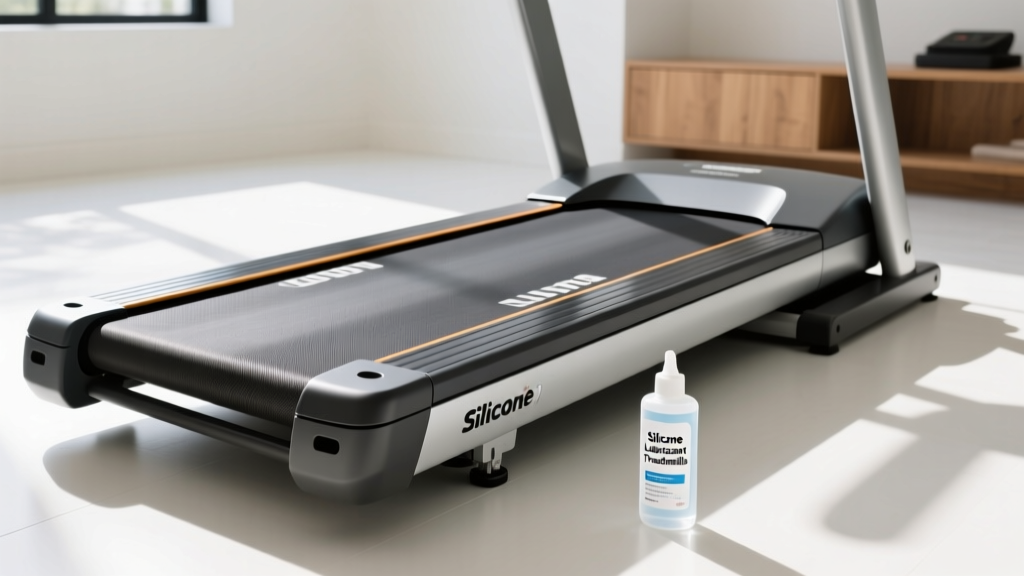
A high-pitched squealing or chirping noise that correlates with your foot strikes is almost always a symptom of belt-to-deck friction. Over time, the factory-applied silicone dries out. When friction increases, the motor must work harder to pull the belt, leading to a secondary symptom: a strained, whining motor hum. The Fix: Perform the 'Lift Test'. With the machine off, reach under the center of the walking belt and lift. You should achieve exactly 2 to 3 inches of clearance. If it is tighter, the belt is over-tensioned, which destroys roller bearings and increases friction. Loosen the rear roller bolts by a quarter-turn. Next, apply exactly 1 ounce of 100% pure silicone treadmill lubricant in a zig-zag pattern under the belt. Never use WD-40, lithium grease, or petroleum-based oils, as these will dissolve the PVC backing of the belt and void your warranty.
WARNING: Static ArcingIf you hear a faint 'popping' or 'ticking' sound near the motor hood, this is static electricity arcing from a dry belt to the metal chassis. In severe cases, this static can short out the lower control board. Ensure your treadmill is plugged directly into a grounded 15-amp wall outlet, never a power strip, and maintain a strict bi-annual silicone lubrication schedule.
3. Roller Bearing Degradation
If the noise is a rhythmic grinding or rumbling that speeds up and slows down with the belt speed—even when you are not standing on it—the sealed bearings inside the front or rear rollers are failing. To isolate the faulty roller, remove the motor hood and run the treadmill at 3 MPH. Use a mechanic's stethoscope (or a long screwdriver placed carefully against the roller axle and your ear) to listen to the bearing housings. A healthy bearing is silent; a failing one sounds like crushing gravel. Replacing a roller assembly is a straightforward DIY repair that typically costs between $60 and $90 for OEM parts.
Step-by-Step Troubleshooting Matrix
Use this quick-reference matrix to match the acoustic symptom to the required mechanical intervention.
| Sound Profile | When It Occurs | Probable Cause | Required Action |
|---|---|---|---|
| Rhythmic Thumping | Only when walking/running | Belt seam overlap or worn deck elastomers | Inspect belt seam; rotate FlexSelect to 'soft' |
| High-Pitched Squeal | Constant during belt movement | Dry walking belt / High friction | Apply 1 oz 100% silicone lubricant |
| Grinding / Rumbling | Scales with belt speed (unweighted) | Sealed roller bearing failure | Replace front or rear roller assembly |
| Faint Ticking / Popping | Randomly during use | Static electricity arcing | Lubricate belt; verify grounded outlet |
| Loud Motor Whine | Under heavy load (incline/sprinting) | Over-tensioned belt straining motor | Loosen rear roller bolts by 1/4 turn |
Structural Resonance and Apartment Mitigation
Even a perfectly maintained NordicTrack Flex Select T6 5s treadmill will generate impact noise. The kinetic energy of a 180-pound runner striking the deck at a 10-minute mile pace generates peak impact forces exceeding 2.5 times their body weight. This energy must go somewhere. If it isn't absorbed by the deck's cushioning, it travels into the subfloor.
The most common mistake home gym owners make is purchasing cheap, 1/4-inch thick PVC or foam mats from big-box stores. These materials compress entirely under the dynamic load of a treadmill, offering zero acoustic isolation. To properly decouple your treadmill from the floor structure in 2026, you must use a vulcanized rubber mat with a density rating of at least 80 to 90 Shore A durometer and a thickness of 3/8-inch to 1/2-inch. This specific density is stiff enough to prevent the treadmill from sinking and becoming unstable, yet porous enough to trap and dissipate low-frequency sound waves before they penetrate the concrete or wood joists below.
'Acoustic decoupling is not about making the machine softer; it is about creating a mechanical break between the vibration source and the structural receiver. High-durometer rubber acts as a low-pass filter, effectively neutralizing the sharp impact transients generated by foot strikes.'
Finally, ensure your treadmill is positioned at least two inches away from any walls. The motor's cooling fan and the acoustic reflection of the belt slap can create a resonant feedback loop in tight corners, artificially amplifying the perceived volume of the machine by up to 4 decibels. By combining rigorous mechanical maintenance with proper structural isolation, your cardio sessions will remain intense, while your home environment remains peacefully quiet.
More gear to consider
All reviews
Beginner Incline Treadmill Workout & Cardio Noise Guide

Walking Pad vs ProForm Crosstrainer Treadmill: 2026 Beginner Guide
How to Lose Stomach Fat on Treadmill vs. Stationary Bikes
Before Watching a Video on Treadmills Care: Belt Lubrication Guide

Sunny Health & Fitness WalkStation Slim Flat Treadmill Review (2026)