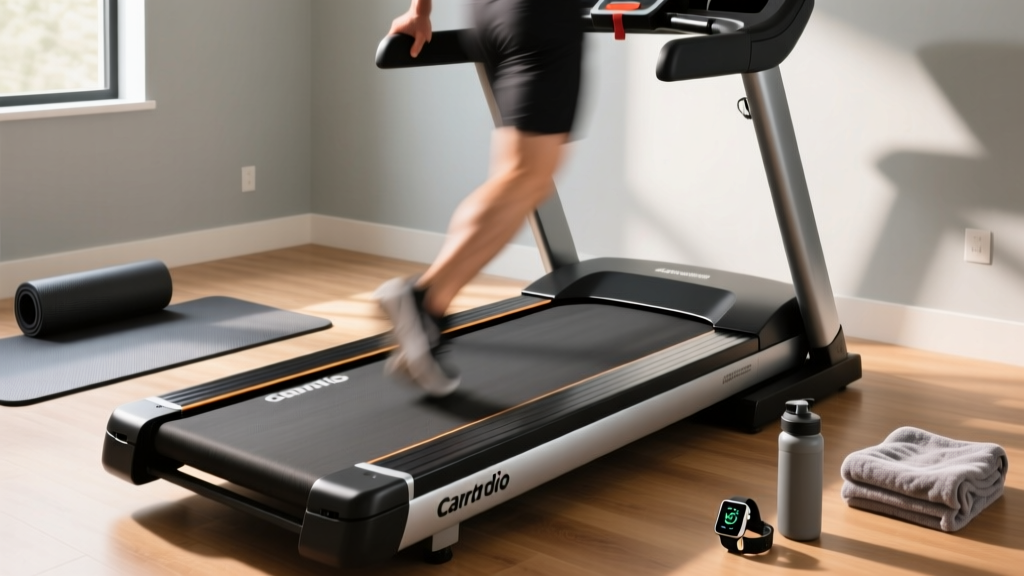
John Terry Treadmill Workout: Motor Size & Power Guide
Planning the John Terry treadmill workout? Learn how to choose the right treadmill motor size, CHP vs Peak HP, and prevent burnout.

The John Terry Treadmill Workout: Why Motor Size Matters
The famous John Terry treadmill workout—originally used by the Chelsea FC captain to build elite pre-season stamina—has become a viral benchmark for home athletes. The routine is deceptively simple but brutally demanding: a sustained 15% incline with alternating intervals of jogging and sprinting, typically lasting 20 minutes. According to the Mayo Clinic, high-intensity interval training (HIIT) on an incline maximizes cardiovascular efficiency and caloric burn, but it also places extreme mechanical stress on your equipment.
If you attempt the John Terry treadmill workout on an entry-level machine, you will likely experience a sudden belt stall, a tripped circuit breaker, or a permanently fried motor controller. To survive this routine, you need to understand treadmill motor sizing. This beginner-friendly, step-by-step guide will teach you how to decode horsepower ratings, calculate your exact torque needs, and select a machine built for high-incline interval abuse in the 2026 fitness market.
⚠️ Warning: The Incline Torque MultiplierRunning on a flat surface requires roughly 1.5 to 2.0 horsepower for an average user. However, pushing a 200 lb runner at a 15% incline increases the torque demand on the motor by up to 300%. A weak motor will draw excessive amperage to compensate, leading to thermal shutdown or permanent demagnetization of the motor's internal magnets.
Step 1: Decode the Horsepower Marketing Trap
When shopping for a treadmill, manufacturers often throw around terms like 'Peak Horsepower' and 'Continuous Horsepower.' Understanding the difference is the most critical step in protecting your investment.
Peak HP vs. Continuous HP (CHP)
- Peak Horsepower (HP): This is the absolute maximum power the motor can generate for a fraction of a second before it fails or trips a thermal sensor. It is a marketing gimmick. A treadmill boasting '4.0 Peak HP' might only sustain 1.5 CHP during your workout.
- Continuous Horsepower (CHP): This is the power the motor can deliver consistently, hour after hour, without overheating. You must only look at the CHP rating when evaluating a treadmill for the John Terry workout.
Step 2: Calculate Your Required CHP
The American Council on Exercise (ACE) notes that interval training requires rapid acceleration and deceleration, which demands high starting torque from a DC motor. To determine the minimum CHP you need for high-incline sprints, cross-reference your body weight with the workout intensity using the matrix below.
| User Weight | Flat Walking (0-3% Incline) | Steady Jogging (0-5% Incline) | John Terry Routine (15% Incline + Sprints) |
|---|---|---|---|
| Under 150 lbs | 2.0 CHP | 2.5 CHP | 3.0 CHP |
| 150 - 200 lbs | 2.5 CHP | 3.0 CHP | 3.5 CHP |
| 200 - 250 lbs | 3.0 CHP | 3.5 CHP | 4.0 CHP |
| 250+ lbs | 3.5 CHP | 4.0 CHP | 4.5+ CHP (Commercial Grade) |
Step 3: Choose Between DC and AC Motors
Not all Continuous Horsepower is created equal. The type of electrical current your motor uses dictates its lifespan, especially under the heavy load of a 15% incline.
Brushless DC Motors (BLDC)
Standard in 95% of home treadmills, DC motors are quieter and more cost-effective. However, they rely on internal permanent magnets and carbon brushes (or electronic commutation in brushless models). When subjected to the high amperage draw of the John Terry workout, cheap DC motors overheat, causing the magnets to lose their magnetic field (demagnetization). If you buy a DC treadmill for this workout, ensure it features a heavy-duty flywheel and an oversized cooling fan.
Alternating Current (AC) Motors
Found in commercial gym equipment and high-end residential models (typically starting around $3,500), AC motors do not use permanent magnets and are virtually immune to the thermal demagnetization that kills DC motors. An AC motor will easily handle daily 15% incline sprints for over a decade without breaking a sweat.
Step 4: Evaluate 2026 Treadmill Models for the Terry Workout
Based on current market testing and Runner's World treadmill evaluations, here are three machines with the motor architecture required to handle high-torque interval training without voiding the warranty.
- Sole F80 (Approx. $1,199): Features a 3.5 CHP brushless DC motor and a heavy 135 lb steel frame. Its oversized roller tubes reduce belt friction, easing the burden on the motor during steep inclines.
- NordicTrack Commercial 1750 (Approx. $1,999): Equipped with a 3.5 CHP self-cooling motor. The active cooling system forces air over the motor housing, which is critical for preventing thermal shutdowns during the 20-minute Terry test.
- Life Fitness Club Series Track Connect (Approx. $3,899): Utilizes a 3.0 HP AC motor. While the HP number looks lower than the Sole, AC horsepower is measured differently and delivers vastly superior continuous torque at low speeds and high inclines.
Step 5: Optimize Your Electrical and Mechanical Setup
Even a 4.0 CHP motor will fail if the supporting infrastructure is flawed. Follow these setup rules to protect your machine's Pulse Width Modulation (PWM) control board.
💡 Pro-Tip: The 20-Amp RuleNever plug a high-performance treadmill into a shared 15-amp bedroom circuit. When the motor demands maximum torque at a 15% incline, it can pull 15 to 18 amps momentarily. If the vacuum cleaner or AC unit kicks on, the voltage drop will fry the treadmill's lower control board. Always use a dedicated 20-amp circuit.
Mechanical Maintenance Checklist
- Belt Tension: A loose belt slips, causing the user to stumble. A belt that is too tight creates immense drag, forcing the motor to work 40% harder. You should be able to lift the belt 2 inches off the deck at the center.
- Deck Lubrication: Apply 100% pure silicone treadmill lubricant every 150 miles. Friction between the belt and the wooden deck is the number one cause of motor burnout during incline workouts.
- Post-Workout Cool Down: Do not turn the machine off immediately after the John Terry workout. Let the belt run flat at 2.0 mph for 3 minutes to allow the internal motor fan to dissipate the accumulated heat sink.
Summary: Your Buying Checklist
Before you attempt the John Terry treadmill workout, ensure your equipment meets these non-negotiable criteria: a minimum of 3.5 CHP (for users under 200 lbs), a 15% maximum incline capability verified by user reviews, a dedicated 20-amp electrical outlet, and a freshly lubricated deck. By prioritizing continuous torque over marketing gimmicks, you will build elite cardiovascular endurance without turning your treadmill into an expensive clothing rack.
More gear to consider
All reviews
ProForm Treadmill Parts List & Cardio Machine Noise Level Comparison
Sit Down Treadmill Setup: 2026 Walking Pad Comparison
XTERRA TRX3500 vs Stationary Bikes: Upright, Recumbent, or Spin?
Stair Climber Setup: Ending the Row Machine vs Treadmill Debate

WalkingPad C2 Treadmill Motor Guide: HP vs CHP Explained