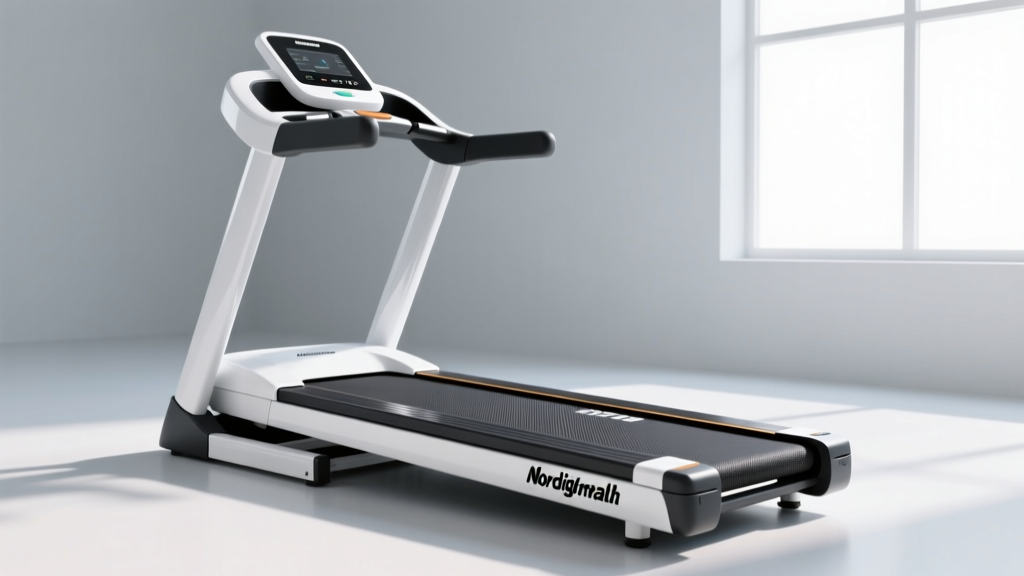
EXP 10i Treadmill Review: Best Folding Pick for Small Spaces in 2026?
We analyze the 2026 folding treadmill market to see if the NordicTrack EXP 10i treadmill truly fits small spaces. Check dimensions, weight, and alternatives.

The 2026 Small-Space Fitness Trend: Premium vs. Compact
As urbanization accelerates and residential square footage shrinks, the home fitness market in 2026 has bifurcated into two distinct categories: ultra-compact walking pads and heavy-duty folding treadmills. Consumers are increasingly searching for equipment that delivers commercial-gym performance without permanently dominating their living rooms. Enter the EXP 10i treadmill by NordicTrack, a machine heavily marketed as a space-saving solution. But does a premium folding treadmill actually solve small-space dilemmas, or does it merely create an illusion of spatial efficiency?
In this comprehensive trend report and market analysis, we dissect the spatial footprint, mechanical realities, and performance trade-offs of the EXP 10i treadmill. We will determine whether it genuinely qualifies as an optimal folding treadmill for small spaces, or if buyers should look toward true compact alternatives.
Market Insight: The 'Folding' Premium
According to recent fitness industry analyses, the demand for foldable cardio equipment has surged by over 22% since 2024. However, consumer return data indicates a high dissatisfaction rate with 'folding' models that exceed 200 pounds, as the daily physical strain of folding negates the space-saving benefit. The EXP 10i sits precisely at this critical weight threshold.
NordicTrack EXP 10i Treadmill: Spatial Footprint Analysis
To evaluate the EXP 10i treadmill as a small-space solution, we must look beyond the marketing brochures and examine the raw dimensional data. The American Council on Exercise (ACE) recommends a minimum clearance of 2 feet on each side and 6 feet behind a treadmill for safe operation and emergency dismounts (ACE Home Gym Guidelines).
When deployed, the EXP 10i requires a functional footprint of roughly 7 feet by 4 feet. But what happens when you fold it? Below is a comparative analysis of the EXP 10i against true compact market competitors in 2026.
| Model | Active Footprint (L x W) | Folded Footprint (L x W x H) | Machine Weight | Best Use Case |
|---|---|---|---|---|
| NordicTrack EXP 10i | 70" x 30" | 35" x 30" x 70" | 205 lbs | Dedicated runners needing to reclaim floor space post-workout. |
| Horizon T101 | 70" x 28" | 34" x 28" x 61" | 148 lbs | Walkers/light joggers in multi-purpose rooms. |
| ProForm Carbon TL | 68" x 28" | 32" x 28" x 65" | 165 lbs | Budget-conscious buyers with low ceiling clearances. |
| Generic Under-Desk Pad | 50" x 20" | 50" x 20" x 5" | 65 lbs | Micro-apartments; stored under beds/sofas. |
The Vertical Clearance Trap
Notice the folded height of the EXP 10i: 70 inches. Many standard apartment closets and alcoves max out at 68 inches. If your small-space strategy involves tucking the treadmill into a closet or a shallow nook, the EXP 10i will likely fail the physical fit test. Furthermore, when folded, the 30-inch width still protrudes significantly into a room, meaning it cannot be pushed flush against a wall due to the rear transport wheels and motor housing geometry.
The Mechanical Realities: Weight, Strain, and Failure Modes
The most overlooked factor in small-space treadmill reviews is the biomechanical cost of daily folding. The EXP 10i weighs approximately 205 pounds. While it features a hydraulic EasyLift shock system, lifting the deck requires an initial upward force of roughly 45 to 55 pounds before the gas shock takes over.
Expert Warning: Industry repair data shows that gas shocks on heavy folding treadmills like the EXP 10i experience a 15-20% degradation in lifting assistance after 3 to 5 years of daily use. If the mechanical safety latch is not manually engaged after every fold, a degraded shock can cause the 60-pound running deck to slam down unexpectedly, posing a severe crush hazard to pets or children.
If your definition of a 'small space' requires you to fold the machine after every single use to access a sofa or dining table, the EXP 10i's 205-pound mass will quickly become a deterrent. In contrast, lighter models like the Horizon T101 (148 lbs) are far more forgiving for daily deployment and stowing.
Performance vs. Space: Is the Trade-Off Worth It?
Why, then, does the EXP 10i treadmill dominate market share in the folding category? The answer lies in the performance-to-space ratio. True compact treadmills sacrifice critical running mechanics: they use 1.5 CHP motors, narrow 16-inch belts, and lack incline capabilities.
The EXP 10i offers a commercial-grade 3.25 CHP Mach Z motor, a spacious 20" x 60" running surface, and a -3% to 12% incline/decline range. For serious runners living in 800-square-foot apartments, this is the ultimate compromise. You get a full-sized, joint-friendly running experience that can be tilted vertically to allow for vacuuming or yoga sessions in the same room.
2026 Pricing and Value Proposition
As of early 2026, the EXP 10i retails between $899 and $1,099, depending on seasonal promotions and iFIT bundle inclusions. When compared to premium non-folding models that cost upwards of $2,500, the EXP 10i remains a high-value proposition for buyers who prioritize deck length and motor longevity over ultra-compact storage.
The 3-Measure Decision Framework
Before purchasing the EXP 10i treadmill for a small space, apply this strict 3-measure framework to avoid costly returns:
- Measure the Ceiling: Ensure you have at least 75 inches of vertical clearance in the deployment zone (70" folded height + 5" safety buffer for ceiling fans/light fixtures).
- Measure the Swing Radius: You need a clear 6-foot semi-circle behind the machine to safely lower the deck. If your bed or sofa is 4 feet behind the treadmill, you cannot safely unfold it.
- Measure the Power Drop: The EXP 10i requires a dedicated 120V, 15-amp circuit. Small apartments often share circuits between the bedroom and living room; running a 3.25 CHP motor on a shared circuit will trip your breaker mid-run.
Verdict: Who Should Actually Buy the EXP 10i?
The EXP 10i treadmill is not a small-space treadmill in the traditional sense; it is a full-size treadmill that happens to fold.
- Buy it if: You are a dedicated runner who needs a 60-inch belt and heavy incline capabilities, but you need to reclaim 15 square feet of floor space for a few hours a day.
- Skip it if: You live in a micro-apartment, need to slide the machine under a bed, lack the physical strength to lift 50 pounds daily, or have ceiling heights below 8 feet.
For a deeper look at how folding mechanisms are evolving across the industry, fitness publications like Forbes Health continue to highlight the EXP series for its robust frame, even as they caution buyers about the sheer physical footprint of premium folding models.
Frequently Asked Questions (FAQ)
Does the EXP 10i treadmill have wheels for moving?
Yes, it features rear transport wheels. However, because the machine weighs 205 lbs, you must tilt it back onto the wheels to move it. On hardwood floors, this is manageable for one adult, but on thick carpet, moving the folded unit across a room requires significant effort.
Can I keep the EXP 10i folded for months at a time?
Yes, but you must engage the manual safety latch pin. Relying solely on the hydraulic gas shock to hold the deck vertically for extended periods will prematurely wear out the shock cylinder, leading to costly replacements.
Is the iFIT subscription required to use the EXP 10i?
No. As of 2026, NordicTrack allows manual mode operation without an active iFIT subscription. You can control speed and incline manually via the console buttons, though you will lose access to the auto-adjusting scenic routes and live trainer metrics.
More gear to consider
All reviews
ProForm Carbon TL Treadmill: Features Comparison & Setup Guide
Snowboard Treadmill Motor Size and Horsepower Buying Guide

Stationary Bike Types vs. NordicTrack T 6.5 S Treadmill-NTL17915: 2026 Trends
Elliptical vs Treadmill Longevity: Daeyegim Treadmill Remote Tips
Taylor Swift Treadmill Strut: Motor Horsepower Guide & Troubleshooting
