Swimming Treadmill Alternatives: Compact Portable Cardio
Skip the $30k swimming treadmill. Discover the best compact, portable cardio equipment for small spaces that delivers full-body, low-impact results.

If you have been researching the biomechanical benefits of aquatic exercise, you have likely encountered the concept of a swimming treadmill. These systems offer unparalleled low-impact, high-resistance cardiovascular conditioning. However, when viewed through the lens of space optimization and residential layout design, traditional aquatic treadmills present a massive spatial and financial paradox. For the vast majority of home gym owners, urban apartment dwellers, and space-conscious fitness enthusiasts in 2026, dedicating 135 square feet and $30,000+ to an indoor pool system is simply not viable.
As a senior layout designer and cardio equipment specialist at FitGearPulse, my objective is to bridge the gap between your desired physiological outcomes and your actual spatial constraints. Below, we deconstruct the spatial reality of aquatic treadmills and provide a blueprint for compact, portable cardio equipment alternatives that replicate the zero-impact, high-resistance benefits of water-based exercise in as little as 20 square feet of floor space.
The Spatial Reality: Aquatic Treadmills vs. Apartment Living
To understand why we must pivot to portable alternatives, we first need to look at the hard data regarding residential aquatic fitness systems. According to specifications from Endless Pools, a standard residential fitness system featuring a swimming treadmill requires a minimum footprint of 15 feet by 9 feet. Beyond the sheer square footage, the structural load of thousands of gallons of water requires reinforced flooring, 220V electrical plumbing, and permanent installation.
Contrast this with modern portable cardio equipment engineered for the 2026 micro-living trend. The following matrix illustrates the spatial and financial disparities between true aquatic systems and their compact, biomechanical equivalents.
| Equipment Category | Model Benchmark (2026) | In-Use Footprint | Storage Footprint | Avg. Cost |
|---|---|---|---|---|
| Aquatic Treadmill System | Endless Pools E500 | 135 sq. ft. | N/A (Permanent) | $32,000+ |
| Water Resistance Rower | WaterRower Club | 12.8 sq. ft. | 3.3 sq. ft. (Vertical) | $1,695 |
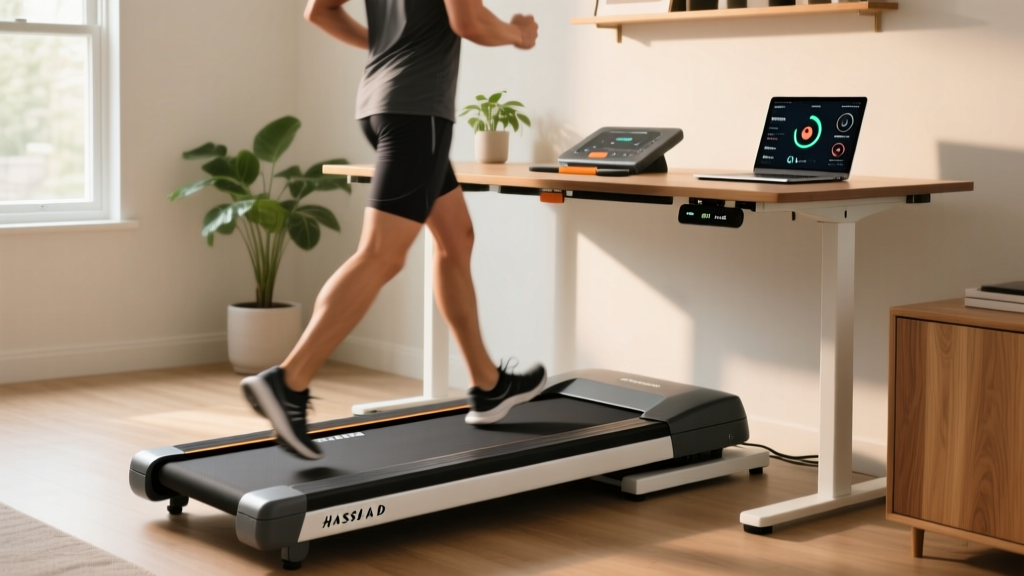
| Folding Walking Pad | UREVO Strol 2E | 9.6 sq. ft. | 2.5 sq. ft. (Under-bed) | $299 |
| Hydraulic Stepper | Xiser Commercial Pro | 1.3 sq. ft. | 1.3 sq. ft. (Closet) | $349 |
Biomechanical Alternatives: Replicating the Aquatic Effect
When a user seeks out a swimming treadmill, they are typically chasing three specific physiological variables: isokinetic resistance (the harder you push, the more resistance you get), zero joint impact, and simultaneous upper-and-lower body engagement. We can replicate these variables using highly optimized, portable dry-land equipment.
1. Water Resistance Rowing (The Full-Body Match)
The closest dry-land equivalent to the fluid dynamics of a swimming treadmill is a water-resistance rowing machine. Unlike magnetic or air rowers, water rowers use a paddle suspended in a sealed tank of water to generate resistance. This provides the exact same isokinetic, infinitely variable resistance profile as moving through a pool.
Space Optimization Insight: The WaterRower Club (84" L x 22" W) is crafted from solid ash wood. While its in-use length is substantial, its vertical storage footprint is a mere 22" x 22" (3.3 sq. ft.). By storing it upright in the corner of a room, it functionally acts as a piece of standing wooden furniture rather than a gym machine, preserving your room's primary traffic flow.Layout Clearance Requirements: When in use, you must allocate an 84-inch longitudinal clearance and a minimum of 18 inches of lateral clearance on the handle side to accommodate the oar handle sweep and chain track. According to the WaterRower official guidelines, the tank holds approximately 4.5 gallons of water. This adds roughly 37 lbs to the machine's 115 lb frame, resulting in a concentrated load of 152 lbs. This is well within the standard 40 PSF (pounds per square foot) load-bearing capacity of modern residential floors, requiring no structural reinforcement.
2. Heavy-Duty Folding Walking Pads (The Joint-Friendly Tread)
If your primary goal with a swimming treadmill was low-impact lower-body conditioning and gait training, a high-quality folding walking pad is the ultimate space-saving alternative. However, not all walking pads are created equal. To mimic the supportive resistance of water, you need a machine with adequate shock absorption and a continuous horsepower (CHP) motor that won't stall under sustained use.
The UREVO Strol 2E represents the current gold standard for compact portable cardio in this category. Priced around $299, it features a 2.5 CHP motor and a top speed of 7.6 MPH. More importantly for space optimization, its dual-fold design allows it to collapse to just 55.1" x 25.2" x 9.8". This specific 9.8-inch height profile is critical: it allows the unit to slide seamlessly under a standard platform bed or a low-profile mid-century modern sofa, effectively reducing its permanent spatial footprint to zero.
3. High-Tension Portable Steppers (The Lower-Body Burn)
Water provides immense resistance to the hip flexors, glutes, and calves during aquatic walking. To replicate this high-tension, low-impact lower-body burn in a tiny footprint, we look to hydraulic steppers. The Xiser Commercial Pro is an aerospace-grade aluminum mini-stepper that weighs just 28 lbs and occupies a mere 14" x 14" base.
Unlike cheap consumer steppers that utilize a fixed pivot point, the Xiser uses independent hydraulic cylinders that allow for a natural, multi-planar range of motion. This prevents the knee valgus (inward collapsing) often seen on poorly designed compact steppers, protecting your joints while delivering a massive cardiovascular and muscular stimulus.
The 20-Square-Foot Micro-Gym Layout Blueprint
Integrating portable cardio equipment into a living space requires more than just measuring the machine; it requires designing the human envelope—the space your body occupies while in motion. Here is a step-by-step framework for designing a 20-square-foot micro-gym zone optimized for portable cardio.
- Establish the Anchor Point: Place your primary machine (e.g., the vertical WaterRower or the folded UREVO pad) in a "dead zone" of the room—typically the corner behind a door swing or the space between a bed and a wall. Avoid placing anchors in the center of primary visual axes to maintain the psychological feeling of spaciousness.
- Deploy a High-Density Equipment Mat: Use a 3/8-inch thick, high-density EVA foam or vulcanized rubber mat (approx. 4' x 6'). This serves three purposes: it dampens acoustic vibration (crucial for apartment dwellers), protects hardwood from the concentrated point-loads of stepper cylinders, and visually defines the "workout zone" without requiring walls.
- Calculate the Dynamic Envelope: For a walking pad, add 24 inches behind the unit for mounting/dismounting safety. For a rower, add 12 inches laterally. Never place a portable cardio machine directly facing a wall; always leave a minimum 36-inch visual buffer to prevent spatial claustrophobia during extended cardio sessions.
- Optimize Airflow and Thermoregulation: Aquatic environments naturally cool the body. Dry-land compact cardio in small rooms leads to rapid heat buildup. Position a 12-inch oscillating floor fan at a 45-degree angle to the user's dominant side. Ensure the room has cross-ventilation or utilize a smart air purifier with a high CADR (Clean Air Delivery Rate) rating to manage CO2 buildup in small, enclosed spaces.
"Low-impact cardiovascular exercise is essential for long-term joint preservation and metabolic health. However, adherence is heavily dictated by environmental convenience. Equipment that integrates seamlessly into a user's daily living space drastically improves long-term exercise compliance compared to equipment that requires significant spatial or logistical sacrifices."
— Adapted from position stands on exercise environment and adherence, American College of Sports Medicine (ACSM)
Final Verdict on Space Optimization
The allure of a swimming treadmill lies in its promise of pain-free, high-resistance conditioning. But true spatial intelligence in home gym design means recognizing when a commercial-grade concept fails the residential reality test. By pivoting to compact portable cardio equipment—specifically water-resistance rowers for full-body isokinetic engagement, folding walking pads for joint-friendly gait training, and precision hydraulic steppers for lower-body isolation—you can achieve the exact physiological outcomes of aquatic exercise. More importantly, you can do it within a 20-square-foot footprint, preserving both your living space and your budget for the realities of 2026 home design.
More gear to consider
All reviews
WHOOP Treadmill Integration: Feature Comparison & Troubleshooting
Walking Pad Treadmill Comparison: Beating Underwater Treadmill Cost
Hammer Strength Treadmill Motors: The Ultimate Horsepower & Sizing Guide

Feeling Dizzy on a Treadmill? 2026 Walking Pad Comparison

Folding Treadmill for Small Spaces Review & Lubing a Treadmill Belt