
Curved vs Motorized: Finding the Best Made in USA Treadmill
Compare curved manual and motorized treadmills. Our step-by-step guide helps beginners choose the best made in USA treadmill for their home gym.

Introduction: The American-Made Cardio Dilemma
Building a home gym in 2026 means investing in equipment that lasts. When fitness enthusiasts search for a made in USA treadmill, they are typically looking for superior quality control, heavy-duty domestic steel frames, and accessible customer support. However, choosing the right American-manufactured machine requires navigating a fundamental split in treadmill technology: the self-powered curved manual treadmill versus the traditional motorized treadmill.
For beginners, this choice can be overwhelming. Do you want the high-intensity, muscle-driven resistance of a curved slat belt, or the precise, automated pacing of a motorized deck? This step-by-step guide will break down the biomechanics, spatial requirements, and top domestic models to help you make an informed, long-term investment.
Why 'Made in USA' Matters: Many global fitness brands design their products in North America but manufacture them overseas. True US-manufactured or US-assembled treadmills (like those from TrueForm, Woodway, and Life Fitness) utilize domestic supply chains, ensuring that replacement parts—such as lower control boards or specialized slat belts—are readily available and that welding standards meet rigorous OSHA guidelines.Step 1: Decode the Drive System Mechanics
The most critical difference between these two machines lies in how the belt moves beneath your feet.
Curved Manual Treadmills
Curved treadmills are entirely self-powered. The running surface is set on a concave curve (typically between 10% and 15%). When you step forward and push down and back, gravity and friction drive the belt. There is no motor, no speed limit, and no electrical cord. The harder you push, the faster the belt moves. This design forces a forefoot or midfoot strike, naturally encouraging proper running posture.
Motorized Treadmills
Motorized treadmills rely on an electric motor (measured in Continuous Horsepower, or CHP) to pull a flat belt over a lubricated wooden or composite deck. The machine dictates the pace. If you set the console to 8.0 mph, the belt moves at 8.0 mph regardless of your stride length or effort level, making it ideal for steady-state pacing and controlled incline training.
Step 2: Map Your Electrical and Spatial Footprint
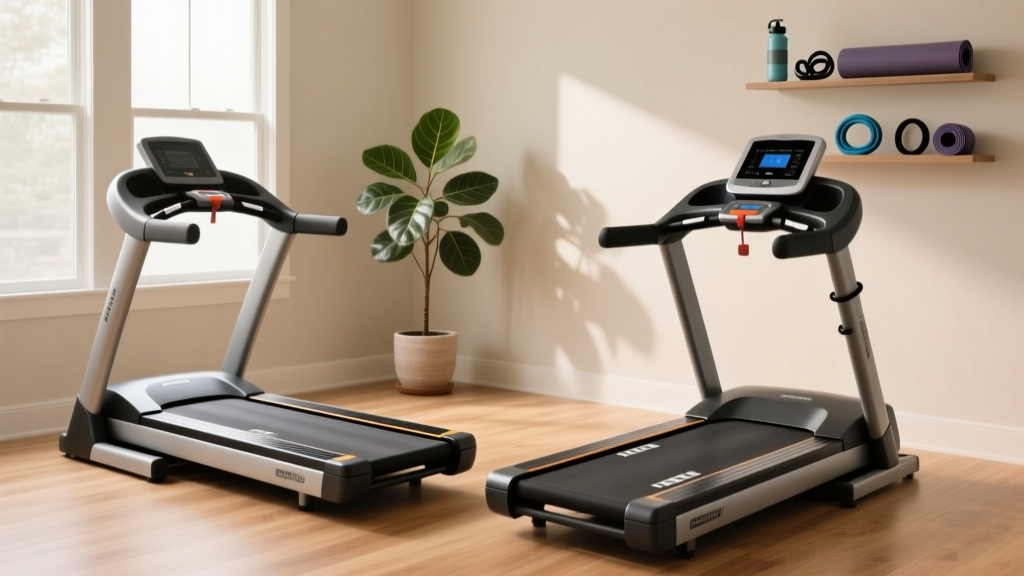
Before purchasing, you must evaluate your physical space and electrical infrastructure. Motorized treadmills demand specific electrical environments, whereas curved treadmills offer ultimate placement freedom.
- Electrical Requirements: A premium US-assembled motorized treadmill with a 3.0 to 4.0 CHP motor requires a dedicated 120-Volt, 20-Amp circuit. Plugging it into a shared 15-Amp living room circuit will frequently trip the breaker during high-incline, high-speed draws (which can peak at 15-18 amps).
- Spatial Freedom: Because a curved manual treadmill requires zero electricity, you can place it in a detached garage, a basement without convenient outlets, or even an outdoor covered patio.
- Footprint: Curved treadmills generally have a slightly longer wheelbase (often around 70 to 75 inches long) to accommodate the slope, while motorized models vary wildly but typically require 80+ inches in length to accommodate a full 55-inch running surface.
Step 3: Analyze Biomechanics and Muscle Recruitment
According to research frequently cited by the National Strength and Conditioning Association (NSCA), self-powered curved treadmills can increase caloric expenditure by up to 30% compared to traditional motorized models at the same perceived exertion. This is due to the increased demand on the posterior chain.
| Biomechanical Factor | Curved Manual Treadmill | Motorized Treadmill |
|---|---|---|
| Primary Muscle Focus | Hamstrings, Glutes, Calves (Posterior Chain) | Quadriceps, Hip Flexors |
| Foot Strike Pattern | Midfoot / Forefoot (Natural) | Heel Strike (Common) |
| Joint Impact | Low (Slat belt absorbs shock naturally) | Variable (Depends on deck cushioning system) |
| Pacing Control | User-driven (Infinite speed changes) | Machine-driven (Exact MPH increments) |
For deeper insights on how varying your cardio equipment impacts long-term joint health and cardiovascular efficiency, the Mayo Clinic recommends mixing impact levels and movement patterns to prevent repetitive strain injuries.
Step 4: Review the Premium 'Made in USA' Contenders
If you are committed to buying domestic, here is a breakdown of the top-tier models available in 2026, including exact pricing and specifications.
1. TrueForm Runner (Curved Manual)
- Origin: Manufactured in Florida, USA.
- Price Range: $5,495 (Standard) to $6,995 (Elite with magnetic resistance).
- Key Specs: Features an aggressive 15% curve and a 62-shore A polyurethane slat belt. The low-profile side rails are ideal for athletes practicing broad jumps or lateral shuffles.
- Best For: CrossFitters, sprinters, and HIIT enthusiasts who need instant speed transitions.
2. Woodway 4Front (Motorized)
- Origin: Assembled in Waukesha, Wisconsin, USA.
- Price Range: $7,500 to $8,500+.
- Key Specs: Uses a patented 100% vulcanized rubber slat belt running on precision ball bearings. Driven by a massive AC motor, it offers a running surface that feels like a suspended track. The slat belt is rated for 150,000 miles.
- Best For: Serious marathoners, heavy runners (up to 375 lbs capacity), and commercial-grade home gyms.
3. Life Fitness Club Series+ (Motorized)
- Origin: Assembled in Illinois, USA.
- Price Range: $6,500 to $7,200.
- Key Specs: Features a 3.0 CHP motor and the proprietary FlexDeck shock absorption system, which reduces knee and joint stress by up to 30% compared to outdoor running, according to data from the American Council on Exercise (ACE).
- Best For: Traditional runners, walkers, and users who prefer guided, automated workout programs.
Step 5: Align the Machine with Your Training Protocol
Your specific fitness goals should dictate your final purchase. Use this decision matrix to finalize your choice:
The Sprinter's Choice: If your routine involves Tabata sprints, 400-meter interval simulations, or sled-push conditioning, the curved manual treadmill is non-negotiable. The ability to accelerate from 0 to 15 mph in two strides without waiting for a motor to spool up is a massive advantage.
The Pacer's Choice: If you are training for a Boston Marathon qualifier and need to lock into a 7:30/mile pace for 18 miles while holding a 2% incline, a motorized treadmill is required. Human beings are notoriously poor at self-pacing on curved treadmills over long distances.
Step 6: Master the Maintenance Schedule
A premium US-made treadmill is a lifelong investment, but it requires specific maintenance protocols to protect your warranty.
Curved Treadmill Maintenance
Because there is no motor, maintenance focuses on the drive belt and bearings. Every 500 miles, check the drive belt tension. If the belt slips during explosive sprints, locate the rear tensioner bolts at the back of the frame. Using a 6mm Allen wrench, adjust the bolts by exactly 2 to 3 turns clockwise. Do not overtighten, as this will degrade the internal ball bearings prematurely.
Motorized Treadmill Maintenance
The silent killer of motorized treadmills is static dust buildup, which fries the lower control board. Every six months, unplug the machine, remove the four screws securing the plastic motor hood, and use a vacuum with a soft brush attachment to clean the fan shroud and motor fins. Additionally, if your model uses a traditional woven belt over a wood deck, apply 100% silicone treadmill lubricant under the belt every 300 miles to reduce friction and amp draw.
Final Verdict
Choosing between a curved manual and a motorized treadmill ultimately comes down to how you prefer to sweat. If you want a raw, unfiltered, high-calorie-burning workout that builds posterior strength and requires zero electricity, a US-made curved model like the TrueForm Runner is an unparalleled asset. If your goals revolve around precise pacing, long-distance endurance, and automated incline control, a US-assembled motorized powerhouse like the Woodway 4Front or Life Fitness Club Series+ will serve you for decades. Evaluate your space, respect the electrical requirements, and invest in domestic steel.
More gear to consider
All reviews
Bowflex Treadmill 10 Reviews vs Stationary Bikes: Budget Guide
Curved vs Motorized Treadmill on Floor: Beginner Setup Guide

Treadmill Motor Setup: Sizing Guide & 100 Meters on a Treadmill Test

Weslo Cadence G 5.9i Treadmill Review: Small Space Layout Guide

Donate Treadmill Salvation Army: Compact Cardio Upgrade Budget Guide
