
Small Space Folding Treadmills: SuperFit Treadmill App Review
Discover the best folding treadmills for small spaces. We review the SuperFit treadmill app, spatial layouts, clearance rules, and top compact picks.

The Spatial Economics of Home Cardio
Designing a functional home gym in a compact apartment or condo requires a ruthless approach to spatial economics. Every square foot of floor space carries a premium, and traditional cardio equipment is notoriously hostile to small layouts. A standard commercial treadmill demands a permanent footprint of roughly 12 square feet, plus mandatory safety clearances that can easily double its spatial impact. For urban dwellers and small-home owners, the folding treadmill is not just a convenience; it is an architectural necessity.
However, not all folding mechanisms are created equal. The market is currently split between two distinct design philosophies: the 'flat-fold' under-desk models and the 'vertical-fold' traditional decks. In this comprehensive space-optimization guide, we evaluate the best folding treadmills for small spaces, with a special deep dive into the budget-friendly SuperFit lineup and how the superfit treadmill app ecosystem fundamentally changes the physical footprint of the machine.
Case Study: SuperFit Folding Treadmill & App Ecosystem
The SuperFit 2-in-1 folding treadmill (typically priced between $169 and $219) has become a staple in the micro-apartment fitness market. Its primary space-saving innovation is not just its hinge mechanism, but its reliance on digital integration to eliminate physical bulk.
Offloading the Console: The superfit treadmill app
Traditional treadmills require massive, protruding LED consoles to house displays, buttons, and internal wiring. This adds 10 to 15 inches of depth to the machine's front end and creates a top-heavy structure that requires a wider, more stable base. By offloading the primary user interface to the superfit treadmill app, the manufacturer has reduced the physical console to a slim, flush-mounted LED strip.
Space-Saving Insight: The superfit treadmill app connects via Bluetooth to handle speed adjustments, workout tracking, and routine selection. This allows the treadmill's handrails to fold completely flat against the deck, reducing the folded height to a mere 5.5 inches. This ultra-slim profile allows the unit to slide under standard sofas (which typically have a 6-inch clearance) or stand vertically against a wall in a narrow closet.Hardware Limitations in Compact Designs
While the spatial footprint is excellent, the SuperFit's 2.25 HP motor and 15-inch wide running belt demand a specific user profile. The narrow belt requires a focused, centered running gait. Furthermore, the lack of a heavy-duty steel frame means the machine weighs only 62 lbs. While this makes it easy to move, it limits the maximum user weight to 220 lbs and causes noticeable lateral sway during running at speeds above 5.0 mph.
The 'Flat-Fold' vs. 'Vertical-Fold' Debate
When optimizing a small room, you must choose how you want to sacrifice your space: vertically or horizontally.
- Flat-Fold (e.g., SuperFit, WalkingPad): Best for sliding under furniture. However, lifting a 60+ lb machine from the floor requires significant physical effort and can cause back strain if done daily.
- Vertical-Fold (e.g., Horizon 7.8, Bowflex): The deck locks into an upright position on transport wheels. This frees up floor space entirely but requires a vertical clearance of at least 72 inches and leaves a bulky visual presence in the room.
2026 Compact Treadmill Comparison Matrix
Below is a spatial and technical comparison of the leading small-space treadmills available this year, highlighting how app integration and folding mechanisms affect room layout.
| Model | Folded Dimensions (L x W x H) | Motor & Belt Width | App Integration | Best Layout Application |
|---|---|---|---|---|
| SuperFit 2-in-1 | 53' x 25' x 5.5' (Flat) | 2.25 HP / 15' | superfit treadmill app (Bluetooth) | Under-desk / Under-sofa storage |
| WalkingPad R2 | 39' x 22' x 10' (Tri-fold) | 1.25 HP / 17' | KS Fit App | Closet storage / Tight corners |
| Horizon 7.8 | 42' x 32' x 73' (Vertical) | 3.0 HP / 22' | InTouch / Zwift compatible | Dedicated alcove / Bedroom corner |
| Bowflex T10 | 52' x 31' x 71' (Vertical) | 3.0 HP / 22' | JRNY Adaptive App | Large living room / Sunroom |
Layout Design: Clearance, Power, and Airflow
Placing a folding treadmill in a small room is not just about the machine's dimensions; it is about the operational envelope. According to safety guidelines published by the Consumer Product Safety Commission (CPSC), treadmills require strict clearance zones to prevent severe friction-burn injuries in the event of a fall.
The 36-Inch Rule
You must maintain a minimum of 36 inches (preferably 48 inches) of unobstructed clearance directly behind the treadmill. In a small bedroom or home office, this means the treadmill cannot be placed facing a wall if the bed or desk is directly behind it. Design workaround: Place the treadmill facing a window or an open doorway, utilizing the room's natural circulation paths as your safety clearance zone.
Power Routing and Cable Management
Budget folding treadmills like the SuperFit often feature shorter power cords (typically 4 to 5 feet) to save manufacturing costs and reduce tripping hazards. In small spaces, this forces you to place the machine near a wall outlet. Use flat-profile, paintable cable raceways to route the power cord along the baseboard. Never run a power cord under a rug or across a high-traffic walking path, as the repetitive friction will degrade the insulation and create a fire hazard.
Acoustic and Thermal Management in Enclosed Rooms
Small rooms trap both heat and sound. When evaluating a compact treadmill, you must consider the environmental impact of the machine on your living space.
Thermal Dynamics
A 2.25 HP motor generates significant heat during a 45-minute run. In a 10x10 foot home office with poor ventilation, a budget treadmill can raise the ambient room temperature by 3 to 5 degrees Fahrenheit. Premium models like the Horizon 7.8 feature advanced internal cooling fans that exhaust heat efficiently, whereas budget models rely on passive convection. If you are using a SuperFit or similar budget model in a small room, ensure you have a secondary oscillating fan to move air across the motor housing and prevent thermal throttling.
Impact Noise Transfer
For apartment dwellers, impact noise is the primary barrier to daily cardio. The American Council on Exercise (ACE) frequently highlights the importance of proper flooring in home gym setups to protect both the user's joints and the structural integrity of the floor.
Pro Tip for Apartment Layouts: Do not rely on the thin PVC mat included with most budget treadmills. Invest in a 3/8-inch thick, high-density EVA foam interlocking mat. Place a layer of rubber anti-vibration pads (often used for washing machines) under the treadmill's rear rollers. This combination can reduce low-frequency impact noise transfer to downstairs neighbors by up to 40%.
Hidden Costs of Space-Saving Treadmills
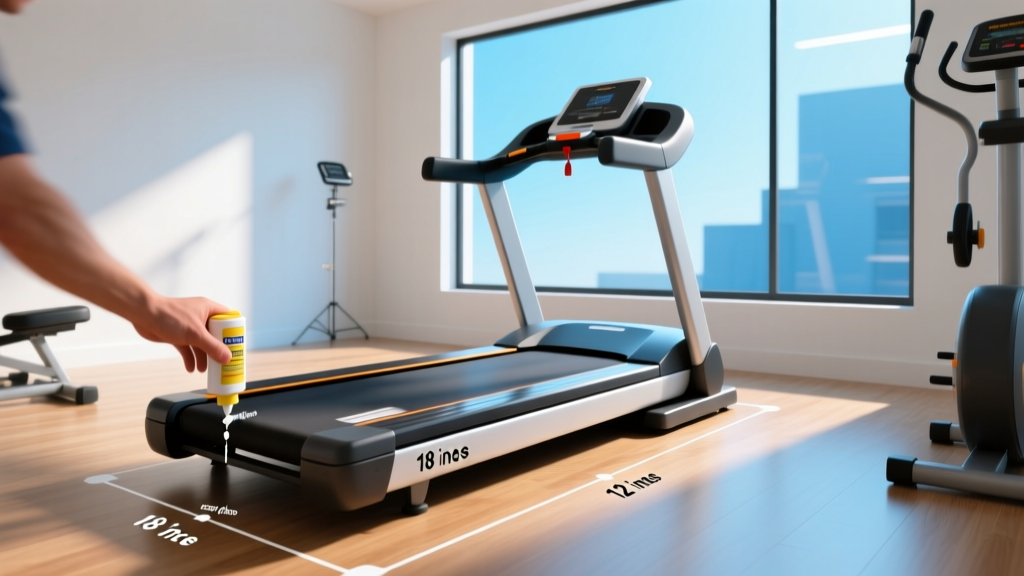
When optimizing for space, consumers often overlook the long-term maintenance realities of compact designs. The hinges on flat-fold treadmills are mechanical failure points. Over time, the repetitive stress of folding and unfolding a 60 lb deck can cause the locking pins to wear, resulting in a deck that 'sags' in the middle during use. To mitigate this, lubricate the hinge joints with white lithium grease every six months and check the tension bolts on the rear roller to ensure the belt remains centered.
Furthermore, while the superfit treadmill app provides excellent basic tracking and remote-control functionality for free, users seeking advanced programming or interactive scenery often find themselves locked out of premium features without third-party subscriptions. Factor in the potential cost of a universal app subscription (like Kinomap or Zwift, if supported via FTMS Bluetooth protocols) when calculating the total cost of ownership.
Final Verdict on Small-Space Optimization
Integrating cardio equipment into a small home requires a shift in perspective: you are not just buying a machine; you are acquiring a piece of modular furniture. The SuperFit folding treadmill, augmented by the superfit treadmill app, represents a highly effective solution for extreme spatial constraints, offering an unmatched 5.5-inch folded profile that disappears under standard furniture. However, for users requiring a wider belt, higher speeds, and a more stable running platform, a vertical-folding mid-tier option like the Horizon 7.8 remains the superior choice, provided your room's ceiling height and floor plan can accommodate its upright storage footprint. Measure twice, map your clearance zones, and prioritize your spatial flow before making your final selection.
More gear to consider
All reviews
2026 Air Bike vs Assault Bike: Kinomap Treadmill App Value Analysis

Motorized vs Curved Treadmills: The Ebbeling Treadmill Test Guide

Life Fitness T3 Treadmill vs Curved Manual Treadmills: Troubleshooting & Mistakes
Ciihi Treadmill Upgrade: Rowing Machine Buying Guide & Technique
Original Treadmill Space Layouts & In-Place Belt Lubrication Guide
