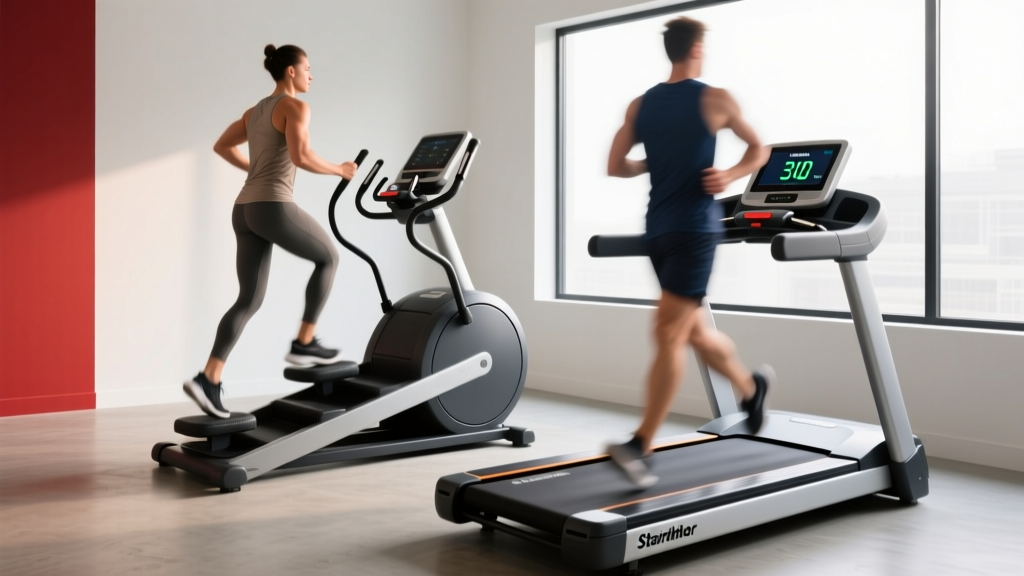
Stairmaster or Treadmill? Feature Comparison Mistakes to Avoid
Avoid costly buying mistakes when choosing a stairmaster or treadmill. Our troubleshooting guide compares features, joint impact, and maintenance.

The Core Dilemma: Why Feature Comparisons Fail
When outfitting a home gym in 2026, the debate between buying a stairmaster or treadmill remains one of the most common hurdles for fitness enthusiasts. Both machines dominate the cardio market, but buyers frequently make critical errors when comparing their feature sets. Instead of evaluating how these machines align with specific biomechanical needs and spatial constraints, consumers often get trapped comparing superficial metrics like digital screen size or Bluetooth connectivity.
According to the Centers for Disease Control and Prevention (CDC), adults need at least 150 minutes of moderate-intensity aerobic activity weekly. Whether you achieve this via a motorized belt or a rotating staircase depends on a nuanced understanding of machine mechanics. This troubleshooting guide deconstructs the most common feature comparison mistakes and provides a diagnostic framework to help you select the right equipment for your home.
Mistake #1: Misinterpreting Motor Metrics and Drive Systems
The most frequent error in treadmill buying guides is the misunderstanding of horsepower (HP) ratings, which becomes even more confusing when compared to the magnetic resistance systems of stair climbers.
Treadmill Continuous vs. Peak Horsepower
Manufacturers often advertise 'Peak HP' to make budget treadmills appear more powerful. A $599 treadmill might boast a 4.0 HP motor, but this is merely the maximum output before the motor overheats. What you must look for is Continuous Horsepower (CHP). For example, the highly rated Sole F80 features a 3.0 CHP motor, which is sufficient to sustain a 250 lb runner at 8 mph without belt stuttering. If you are primarily walking, a 2.5 CHP motor (like the NordicTrack T Series 10) is adequate.
StairMaster Alternators and Eddy Currents
Conversely, commercial-grade stair climbers like the StairMaster Gauntlet do not use traditional rotary motors to drive the steps. They utilize an alternator or magnetic eddy current resistance system driven by your body weight. Comparing a treadmill's 3.0 CHP motor to a StairMaster's resistance levels is an apples-to-oranges comparison. The troubleshooting key here is to look at the step rate range (typically 26 to 162 steps per minute on the Gauntlet) rather than motor wattage.
Expert Troubleshooting Tip: If a budget treadmill belt hesitates or 'grabs' when your foot strikes the deck, the continuous horsepower is too low for your body weight, or the belt friction is too high. This is a primary cause of 'E1' speed sensor error codes on entry-level models.
Mistake #2: Overlooking Biomechanical Impact and Joint Load
Many buyers assume that because a StairMaster is a 'low-impact' machine, it is universally safer for the joints than a treadmill. This is a dangerous oversimplification that leads to poor purchasing decisions and subsequent physical therapy visits.
Incline Treadmills vs. Vertical Stepping
Walking on a flat treadmill generates a ground reaction force of roughly 1.2 times your body weight. However, stepping on a StairMaster requires unilateral load-bearing, where the entire body weight is driven through a single knee and hip joint at an 8-inch step height. The American Academy of Orthopaedic Surgeons notes that repetitive deep flexion under load can exacerbate patellofemoral pain syndrome (runner's knee).
If you have existing knee issues, a high-incline treadmill (such as the NordicTrack X32i, which offers a 40% incline) allows you to achieve the same cardiovascular output and glute activation as a stair climber, but with the biomechanical safety of a closed-chain, flat-foot strike.
Feature Comparison Matrix: Treadmill vs. StairMaster
| Feature / Metric | Premium Treadmill (e.g., Sole F80) | Commercial Stair Climber (e.g., StairMaster Gauntlet) |
|---|---|---|
| Primary Drive System | 3.0 CHP DC Motor & Flywheel | Body-weight driven Alternator / Magnetic Resistance |
| Impact Force | Low to Moderate (cushioned deck) | Low impact, but high unilateral joint torque |
| Footprint (L x W) | ~82" x 36" | ~76" x 32" (narrower, but taller) |
| Ceiling Clearance Needed | User Height + 6 inches | User Height + 15 inches |
| Average 2026 Price | $1,199 - $1,999 | $3,200 - $4,500 |
| Caloric Expenditure (Vigorous) | 600 - 800 kcal/hr (running/incline) | 700 - 900 kcal/hr (continuous stepping) |
Mistake #3: Ignoring Spatial and Maintenance Realities
A frequent troubleshooting call we receive involves buyers who purchase a stair climber only to realize their feet hit the ceiling at the top of the step cycle. Furthermore, the maintenance requirements for these two machines are vastly different.
The Ceiling Height Trap
When measuring your space for a treadmill, you only need to account for the deck height (usually 8 to 10 inches off the ground). A StairMaster, however, elevates you significantly. The pedal height at the top of the stroke on a commercial unit can be over 14 inches. If you are 6 feet tall, you need a minimum ceiling height of 8 feet 4 inches to use a StairMaster safely without ducking during high-intensity intervals.
Maintenance: Silicone vs. Grease
- Treadmill Maintenance: The primary failure point is belt-to-deck friction. You must apply 100% silicone lubricant under the belt every 150 miles or 3 months. Failure to do so will overheat the motor control board, resulting in a costly $250+ replacement.
- StairMaster Maintenance: Stair climbers do not have belts, but they do have drive chains, pedal arm bearings, and proximity sensors. A common troubleshooting issue is a 'squeaking' pedal arm, which requires disassembling the side skirts and applying white lithium grease to the pivot bearings every 6 months.
Troubleshooting Your Decision: A 4-Step Diagnostic Framework
To avoid buyer's remorse, run your household requirements through this diagnostic checklist before pulling the trigger on a stairmaster or treadmill.
Step 1: Audit Your Spatial Envelope
Measure your ceiling height. If it is under 8 feet, immediately eliminate commercial stair climbers from your list and focus on low-profile treadmills or under-desk walking pads.
Step 2: Evaluate Your Joint History
If you have a history of lower back pain or Achilles tendinitis, avoid the StairMaster. The continuous dorsiflexion required to keep your heel flat on an 8-inch step can aggravate the Achilles. Opt for a treadmill with an advanced shock absorption deck, like the ProForm Pro 9000.
Step 3: Define Your Workout Modality
Do you prefer Long Slow Distance (LSD) cardio or High-Intensity Interval Training (HIIT)? Treadmills are superior for steady-state pacing and form work. Stair climbers excel at rapid heart-rate spikes, making them ideal for 20-minute Tabata or HIIT protocols where rapid resistance changes are required.
Step 4: Calculate the Total Cost of Ownership
Factor in maintenance. A $3,500 StairMaster requires less frequent but more mechanically involved maintenance (chain tensioning, bearing greasing). A $1,200 treadmill requires frequent but incredibly easy maintenance (silicone spraying, belt alignment). Choose the machine whose maintenance profile matches your technical comfort level.
Frequently Asked Questions
Which machine is better for weight loss: a stairmaster or treadmill?
According to data published by the Mayo Clinic, weight loss is primarily dictated by sustained caloric deficit and adherence. While a StairMaster may burn 10-15% more calories per hour at maximum effort due to the vertical lift against gravity, a treadmill allows for longer, more sustainable steady-state sessions. The 'better' machine is the one you will use consistently for 150+ minutes a week.
Can I use a stair climber if I have plantar fasciitis?
Generally, no. The rigid footplate and the necessity to push off the ball of the foot can place immense strain on the plantar fascia. A treadmill set to a slight 1% to 2% incline with supportive running shoes is a much safer cardiovascular alternative for this specific condition.
Why does my treadmill belt keep drifting to the left?
This is the most common treadmill troubleshooting issue. It means the rear roller is misaligned. Using the included Allen wrench, turn the left rear adjustment bolt a quarter-turn clockwise. Run the treadmill at 3 mph and observe. Never adjust the belt while the machine is stationary, and never turn the bolt more than a half-turn at a time.
More gear to consider
All reviews
Curved vs Motorized: A Beginner's Guide to Treadmill Uphill Walking

Umay Treadmill vs Motorized: 2026 Curved Manual Comparison

Letter of Medical Necessity for Treadmill: 2026 Under Desk Reviews

Rowing Machine Buying Guide: Upgrading Your Treadmill Training Plan

Treadmill Keeps Shocking Me? Air Bike vs Assault Bike Value Guide
