ProForm 905 CST Treadmill Review: Small Space Layout Guide
Discover how the ProForm 905 CST treadmill fits into small apartments. We review its folded footprint, clearance needs, and layout optimization tips.

The Spatial Reality of the ProForm 905 CST
When optimizing a compact home gym, the physical footprint of your cardio equipment dictates the flow of your entire living space. The ProForm 905 CST treadmill has long been marketed as a budget-friendly, folding solution for apartment dwellers and small-home owners. However, evaluating a folding treadmill for small spaces requires looking past the marketing buzzwords and examining the exact dimensional realities, clearance tolerances, and structural edge cases of vertical storage. In this 2026 spatial layout review, we break down exactly how the ProForm 905 CST integrates into tight floor plans, where it fails the 'closet test,' and how to engineer a safe, ergonomic layout around it.
Quick Footprint Specifications
- Unfolded Dimensions: 68" L x 28" W x 58" H
- Folded Dimensions: 30" L x 28" W x 60" H
- Deck Height (Off Ground): 8.5"
- Total Unit Weight: 135 lbs
- Belt Surface: 20" x 55"
The 'Closet-Depth' Test: Where the 905 CST Fails
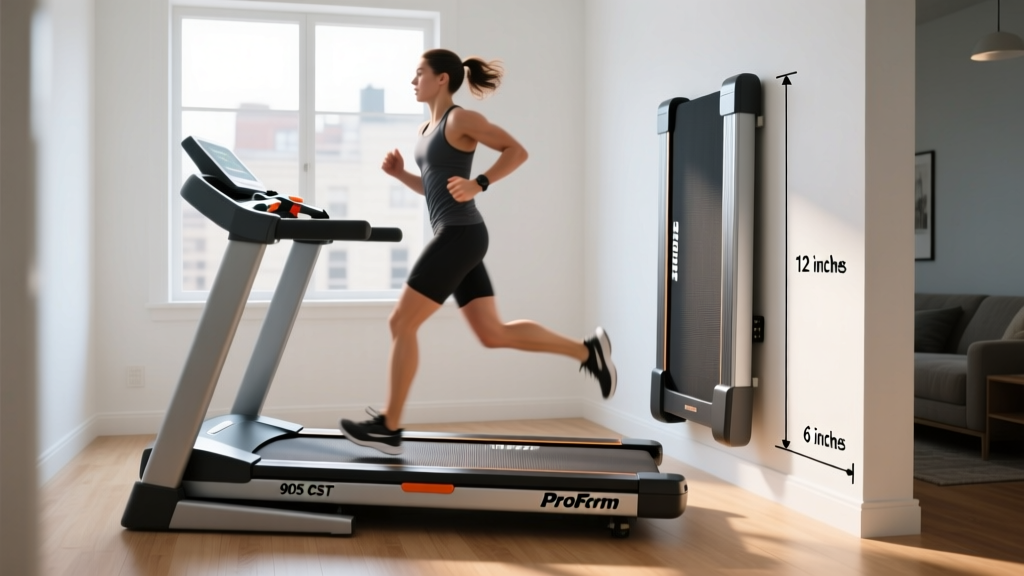
Many buyers assume that a 'folding' treadmill can be neatly tucked away into a standard bedroom or hallway closet when not in use. This is a critical spatial miscalculation. Standard US residential reach-in closets are built to a depth of 24 inches to accommodate clothing hangers. The ProForm 905 CST, even when fully collapsed using its SpaceSaver hydraulic hinge, maintains a folded depth of 30 inches.
Consequently, the 905 CST physically cannot be hidden inside a standard closet with the door closed. You must plan for it to live in the open room, or you need a custom utility closet with a minimum 32-inch depth to allow for the baseboard and hinge clearance. For small-space layouts, this means treating the folded treadmill as a permanent piece of furniture—roughly the size of a narrow bookshelf—rather than a stowaway item.
Unfolded vs. Folded: Measuring the True Clearance
According to the Consumer Product Safety Commission (CPSC), treadmills require strict safety clearances to prevent severe friction-burn injuries in the event of a fall. The CPSC mandates a minimum of 2 feet of clearance on each side and 6 feet of clearance behind the treadmill. When mapping your room layout, you cannot simply measure the 68-inch length of the 905 CST; you must map a 140-inch total operational zone.
| Spatial Metric | ProForm 905 CST | 2026 Ultra-Compact Walking Pad | ProForm Carbon TL (Modern Alternative) |
|---|---|---|---|
| Folded Depth | 30 inches | 10 inches (Under-bed capable) | 29 inches |
| Required Rear Safety Zone | 72 inches | 24 inches | 72 inches |
| Minimum Room Size for Safe Use | 8' x 12' | 6' x 8' | 8' x 12' |
| Vertical Storage Height | 60 inches | N/A (Flat fold) | 62 inches |
Layout Strategy: Integrating the 905 CST into Compact Rooms
If you are committing to the ProForm 905 CST for a small apartment or spare bedroom, spatial planning goes beyond just measuring the floor. You must account for electrical loads, ventilation, and ceiling obstacles.
Electrical and Ventilation Mapping
The 905 CST features a 2.25 CHP Mach Z motor. While not a massive commercial draw, startup amperage on a folding treadmill can spike, which is notorious for tripping GFCI (Ground Fault Circuit Interrupter) outlets commonly found in modern apartments. Layout Rule: Never position the 905 CST on a shared GFCI circuit with a refrigerator, air conditioner, or space heater. Map your layout to a dedicated 15-amp standard breaker.
Furthermore, the American College of Sports Medicine (ACSM) emphasizes the importance of ambient temperature control during indoor cardio. The 905 CST's motor hood relies on passive side-venting. If you push the folded unit flush against a wall, dust accumulates in the vent grates. When unfolded, position the treadmill so the motor hood faces a cross-breeze or an oscillating fan, maintaining at least a 4-inch gap between the rear roller and the wall during operation.
The Ceiling Fan Hazard
Because the 905 CST deck sits 8.5 inches off the floor, a user who is 6 feet tall will have their head at roughly 80.5 inches. In a room with standard 8-foot (96-inch) ceilings, this leaves 15.5 inches of clearance. However, if your layout places the treadmill directly under a low-hanging ceiling fan or a pendant light fixture, the user's arms during a vigorous run can easily strike the blades or glass. Always map the 20" x 55" belt zone entirely clear of overhead fixtures.
Long-Term Spatial Wear: Hinge and Motor Hood Edge Cases
Space optimization isn't just about day one; it's about how the equipment degrades in a tight environment over three to five years. The ProForm 905 CST utilizes a hydraulic cylinder to assist in lowering the heavy 135-pound deck. In small, humid environments (like a converted studio apartment without dedicated climate control), these cylinders are prone to losing internal pressure. When this happens, the 'slow-drop' feature fails, and the deck free-falls, posing a severe crush hazard to pets or children in tight spaces.
Expert Maintenance Tip: If you store the 905 CST vertically for more than 8 months out of the year, the internal lubricants in the hydraulic hinge can settle and degrade. Lower and raise the deck at least twice a month to maintain cylinder pressure and prevent sudden drops.
Additionally, when stored vertically, the 905 CST's motor hood faces outward, acting as a dust shelf. In small spaces with high foot traffic, pet dander and dust will settle directly into the motor's cooling fins. You must vacuum the motor hood vents bi-monthly to prevent thermal shutdowns during your workout.
Floor Load and Vibration Dampening
A 135-pound machine combined with a 180-pound runner generates significant downward force and lateral vibration. In multi-story apartments, this transfers directly to the neighbors below. Do not rely on cheap, thin PVC mats. For the 905 CST, invest in a 3/8-inch thick vulcanized rubber horse-stall mat or a high-density commercial treadmill mat. This adds roughly $80 to your budget but reduces acoustic transfer by up to 40% and protects the floor from the permanent indentation caused by the unit's narrow rear transport wheels.
2026 Alternatives: When to Downsize Your Layout
While the ProForm 905 CST is a capable budget runner, the spatial reality of 2026 offers alternatives if your room fails the 8' x 12' minimum requirement. If your layout cannot accommodate the 72-inch rear safety zone mandated by the CPSC, you must pivot to an under-desk walking pad or a completely flat-folding model like the KingSmith WalkingPad X21. Walking pads eliminate the upright console, reduce the deck height to 4 inches, and allow for true under-bed storage (requiring only 10 inches of vertical clearance). However, you sacrifice the 2.25 HP motor, incline capabilities, and the 55-inch belt length necessary for a full sprinting stride.
Final Layout Verdict
The ProForm 905 CST treadmill remains a viable option for small-space cardio, provided you respect its spatial demands. It is not a 'closet' treadmill; it is a 'corner' treadmill. By mapping a dedicated 8' x 12' zone, avoiding GFCI circuits, and maintaining the hydraulic hinge, you can successfully integrate this machine into a compact floor plan. Just remember: in small-space design, the safety clearance behind the belt is just as important as the footprint of the machine itself.
More gear to consider
All reviews
C950i Treadmill vs Compact Portable Cardio: 2026 Review

Katie Austin Treadmill Maintenance & Compact Portable Cardio Care

Rowing Machine Buying Guide & Karrimor Pace Treadmill Compared
Home Stair Climber Guide: Benefits of Walking Barefoot on Treadmill
Air Bike vs Assault Bike: Budget and Matrix Treadmill App Value