Elliptical vs Treadmill: Replacing an Old Weslo Treadmill for Space
Compare elliptical vs treadmill layouts to replace your old Weslo treadmill. Get exact dimensions, ceiling clearance math, and 2026 space-saving tips.

If you are still holding onto an old Weslo treadmill—like the legacy Cadence G 5.9 or Crosswalk 5.2—you already know the spatial and mechanical frustration. These older budget machines are notorious for their 2.25 HP motors that overheat, narrow 18-inch belts that feel unsafe for running, and folding hinges that warp over time. More importantly, they are massive space hogs that dominate a room even when "folded." As you plan your home gym layout, deciding between an elliptical and a modern treadmill requires more than just comparing calorie burns; it demands a rigorous look at spatial geometry, electrical constraints, and ceiling clearances.
The "Old Weslo" Space Dilemma: Why It's Time to Redesign
Many home gym owners inherit or purchase older Weslo models because they are cheap on the secondhand market. However, from a layout design perspective, they are a nightmare. An old Weslo treadmill typically features a bulky motor cowling that prevents the deck from folding completely flush. Even folded, it often protrudes 29 to 32 inches from the wall, effectively eating up 6 square feet of floor space while creating a tripping hazard. Upgrading your home cardio setup means re-evaluating whether a treadmill is still the right fit for your room's geometry, or if an elliptical offers a superior spatial advantage.
⚠️ Space Hazard Warning: If your old Weslo treadmill is placed less than 24 inches from a wall or furniture, you are violating basic safety clearance standards. In the event of a fall or emergency stop, the user needs a rear buffer zone to prevent impact injuries.Footprint Showdown: Elliptical vs. Treadmill Dimensions
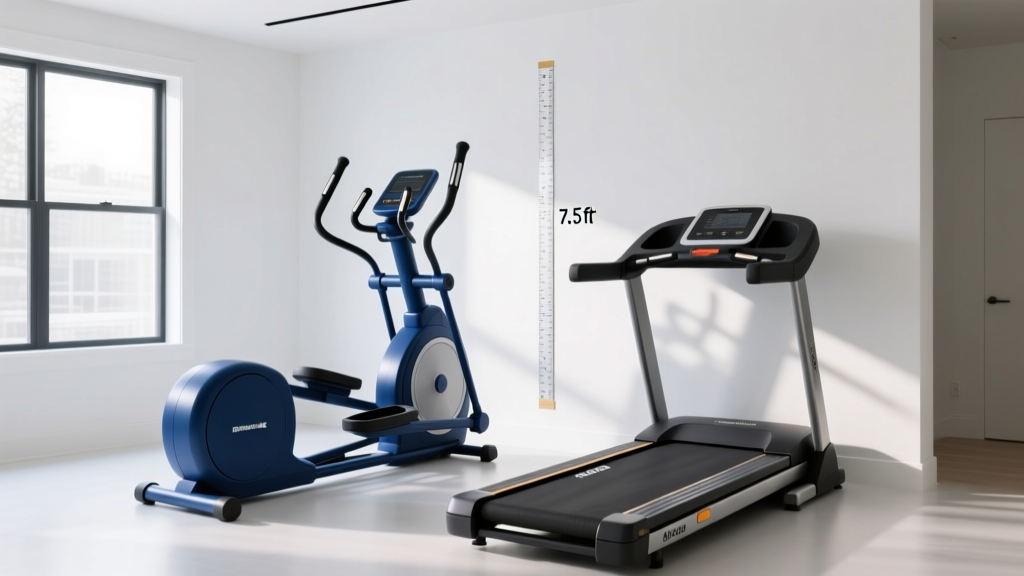
When comparing an elliptical vs treadmill for home cardio, the raw square footage tells only half the story. We must look at the "active footprint" versus the "stored footprint." Below is a dimensional comparison matrix featuring legacy equipment against top-rated 2026 compact alternatives.
| Machine Model | Type | Active Footprint (L x W) | Folded / Stored Depth | Rear Clearance Needed |
|---|---|---|---|---|
| Old Weslo Cadence G 5.9 | Treadmill | 70" x 29" | 29" (Awkward Angle) | 24" Minimum |
| NordicTrack T Series 8 | Treadmill | 68" x 28" | 22" (Flush Fold) | 24" Minimum |
| Sole E25 Elliptical | Elliptical | 70" x 24" | N/A (Does not fold) | 6" (Wall Proximity OK) |
| Bowflex Max M9 | Elliptical/Trainer | 49" x 30" | N/A (Ultra-Compact) | 6" (Wall Proximity OK) |
Notice the rear clearance requirement. According to Consumer Reports, treadmills require a minimum of 24 inches of open space behind the deck to prevent severe friction burns or impact injuries if the user is thrown backward. Ellipticals, being closed-loop kinetic systems, do not require this rear fall zone, allowing you to push them much closer to windows, walls, or entertainment centers.
Vertical Clearance: The 8-Foot Ceiling Rule
The most overlooked metric in home gym layout design is vertical clearance. If you are replacing your old Weslo treadmill with an elliptical, you must calculate the pedal step-up height against your ceiling height.
The Step-Up Math
Standard residential ceilings are 8 feet (96 inches). If a user is 6 feet tall (72 inches), they have 24 inches of headroom when standing flat on the floor. However, elliptical pedals elevate the user. A standard rear-drive elliptical might have a 15-inch step-up height. Add a 5-inch bounce factor at the peak of the stride, and you are consuming 20 inches of vertical space. 72" (User) + 20" (Machine/Bounce) = 92". This leaves only 4 inches of clearance, creating a claustrophobic experience and a high risk of head strikes on ceiling fans or light fixtures.
💡 Pro Layout Tip: If you have standard 8-foot ceilings, opt for a low-step elliptical like the Sole E25 (10-inch step-up height) or a compact stepper-elliptical hybrid like the Bowflex Max series. Treadmills only add about 2 to 4 inches of deck height, making them vastly superior for rooms with low ceilings or sloped attic roofs.Electrical & HVAC Layout Constraints
Space optimization isn't just about physical dimensions; it's about infrastructure. Where you place your machine is heavily dictated by your home's electrical and HVAC layout.
- Electrical Circuit Load: Older Weslo treadmills are notorious for tripping breakers because their aging motors draw 12 to 15 amps on startup. Treadmills require a dedicated 15-amp circuit. If your gym is in a bedroom sharing a circuit with a space heater or window AC, a treadmill will constantly trip the breaker. Ellipticals use magnetic resistance and draw less than 2 amps, allowing them to share standard household circuits safely.
- HVAC Vent Clearance: Treadmill motors require active cooling. Placing a treadmill directly over a floor HVAC vent will choke the motor's cooling fan, leading to premature thermal shutdown. Furthermore, the rear 24-inch safety zone must be kept clear of any furniture or vents.
- Sunlight and UV Degradation: Ellipticals feature complex LCD screens and plastic shrouds that degrade rapidly under direct UV exposure. Treadmill belts also dry out and crack in direct sunlight. Always map your window angles to ensure your chosen machine isn't baking in the afternoon sun.
The 3-Zone Room Layout Framework
To properly integrate your new cardio machine into a 10x10 or 12x12 room, use this 3-zone spatial framework to maximize flow and safety:
- Zone 1: The Machine Footprint (The Anchor). Place the machine parallel to the longest wall, but never flush against it. Leave a 4-inch gap for cord routing and wall scuff prevention. Face the machine toward a door or window to reduce the psychological feeling of being "trapped" in a corner.
- Zone 2: The Safety & Airflow Perimeter. For treadmills, this is the 24-inch rear zone and 12-inch side zones. For ellipticals, this is the 6-inch side and rear zone. Keep this area entirely clear of dumbbells, yoga balls, or flooring transitions that could cause tripping.
- Zone 3: The User Transition Area. You need a minimum 3-foot by 3-foot landing zone adjacent to the machine's primary mounting side. This is where you keep your water bottle, towel, and heart rate monitor. Failing to design this zone results in users stepping off the moving belt or high pedals directly into cluttered spaces.
Biomechanics vs. Square Footage: Which Machine Fits Your Body?
While spatial geometry dictates what fits in your room, biomechanics dictate what you should buy. The Mayo Clinic notes that ellipticals provide a low-impact cardiovascular workout that significantly reduces the ground reaction forces on the knees, hips, and lower back compared to treadmills. If your old Weslo treadmill's worn-out deck cushioning has been causing you joint pain, an elliptical is the logical physiological upgrade.
"Elliptical machines offer a low-impact aerobic alternative to treadmills, allowing users to maintain cardiovascular intensity while minimizing the repetitive impact stress associated with running or walking on a motorized belt." — Cleveland Clinic
However, if you are training for a 5K or need to improve your bone density through weight-bearing impact, a modern folding treadmill like the NordicTrack T Series is irreplaceable. The key is matching your biological needs to the spatial realities of your room.
Final Verdict: Choosing Your Upgrade
Replacing an old Weslo treadmill is one of the best layout decisions you can make for your home gym. If your room suffers from low ceilings, shared electrical circuits, and a lack of rear clearance, an elliptical like the Sole E25 or Bowflex Max M9 is the undisputed champion of space optimization. If you have an 8-foot ceiling, a dedicated 15-amp circuit, and the required 24-inch rear fall zone, a modern folding treadmill will give you the running mechanics you need without the bulky, squeaking footprint of your legacy machine. Measure twice, check your breaker box, and reclaim your floor space.
More gear to consider
All reviews
Home Stair Climber Setup vs Treadmill 8.0 Speed Space Requirements

Are Treadmill Distances Accurate on 2026 Portable Cardio Gear?

Vision Fitness Treadmill T9450 Setup & Noise Comparison Guide

The Treadmilling Meaning: 2026 Folding Treadmill Market Review
dogPacer MiniPacer Treadmill: 2026 Budget & Value Breakdown