
Smart Sport Equipment Storage Ideas for Garage Gyms
Discover space-saving sport equipment storage ideas for your garage gym. Learn layout design, rack dimensions, and organization systems to maximize space.

The Spatial Blueprint: Zoning Your Garage Gym
Transforming a standard two-car garage into a high-performance training facility requires more than just buying gear; it demands a rigorous approach to spatial flow. When evaluating sport equipment storage ideas for a garage environment, the primary constraint is usually the concrete slab footprint, which typically measures 20x20 feet or 24x24 feet. To maximize this space, professional facility designers utilize a zoning methodology that separates the gym into three distinct areas: the Heavy Compound Zone, the Accessory & Dumbbell Zone, and the Cardio/Mobility Zone.
According to facility layout guidelines emphasized by the National Strength and Conditioning Association (NSCA), maintaining a minimum of 36 inches of clearance around all sides of a power rack is non-negotiable for safety and spotter access. However, in a garage gym, sacrificing this clearance to poorly placed storage trees is a common failure mode. By integrating storage directly into the architectural bones of the garage or the rig itself, you preserve the central floor space for dynamic movements like kettlebell swings and sled pushes.
Vertical Sport Equipment Storage Ideas: Wall-Mounted Systems
Wall-mounted storage is the most effective way to reclaim floor space, but garages present unique structural challenges compared to interior drywall rooms. Most residential garages are finished with 5/8-inch fire-code drywall over standard 2x4 wood studs spaced 16 inches on center, or they feature bare concrete block walls.
Load-Bearing Realities and Anchor Spacing
A fully loaded Olympic plate tree can easily exceed 500 pounds. Mounting this to drywall without proper structural engagement will result in catastrophic failure, ripping the drywall paper and sending hundreds of pounds of iron crashing to the floor. As outlined by structural experts at The Family Handyman, you must anchor heavy storage systems directly into the center of the wall studs using 3/8-inch lag screws driven at least 1.5 inches into the wood.
If you are mounting to a masonry or concrete block garage wall, you must use 1/4-inch or 3/8-inch wedge anchors or sleeve anchors, drilling with a hammer drill and a carbide-tipped masonry bit. Never use standard plastic drywall anchors for garage gym storage.
Warning: Slatwall panels (often made of MDF or PVC) are incredibly popular for organizing resistance bands, collars, and belts. However, standard PVC slatwall has a weight capacity of only 10-15 lbs per linear foot. For heavy items like medicine balls or thick bumper plates, you must use structural aluminum slatwall systems, such as those offered by Sorinex Exercise, which bolt directly into studs and can support upwards of 50 lbs per foot.Freestanding vs. Rack-Integrated Storage
If your garage walls are obstructed by water heaters, electrical panels, or garage door tracks, freestanding or rack-integrated storage becomes mandatory. Modern power racks have evolved from simple squat cages into modular storage hubs.
Take the Rep Fitness PR-4000V3 or the Rogue Monster series, for example. Both utilize 3x3-inch, 11-gauge steel uprights with 1-inch or 5/8-inch hole spacing. This modularity allows you to mount plate storage horns, dumbbell shelves, and belt hangers directly to the rear or sides of the rack. This consolidates your footprint, turning a 4x4-foot rack into a 4x6-foot all-inclusive storage and lifting station.
| Storage Modality | Footprint Impact | Avg. Cost Range | Best Use Case |
|---|---|---|---|
| Wall-Mounted Plate Tree | Adds 4-6 inches to wall | $120 - $250 | Garages with clear, unobstructed stud walls |
| Rack-Attached Storage Horns | Adds 8-10 inches to rack depth | $60 - $150 | Renters or homes with finished drywall garages |
| Freestanding Dumbbell Tree | Consumes 2x3 feet floor space | $150 - $350 | High-volume dumbbell sets (5-50 lbs+) |
| Magnetic Rack Shelves | Zero added footprint | $40 - $80 | Chalk, belts, wrist wraps, and small accessories |
The Triangle of Efficiency Layout Framework
To optimize movement during high-intensity interval training or superset workouts, implement the 'Triangle of Efficiency' layout framework. This concept dictates that your three most frequently accessed storage points should form a tight, unobstructed triangle.
- Point A (The Anchor): The power rack or squat stand. This is where barbell work occurs.
- Point B (The Iron): Your primary plate storage or dumbbell tree. This should be placed no more than 4 to 6 feet from the rack, allowing you to load or swap weights without breaking your physiological flow state or letting your core temperature drop.
- Point C (The Accessory Hub): A wall-mounted pegboard or slatwall section holding bands, chains, and specialty bars (like safety squat bars or multi-grip bars).
By keeping Points A, B, and C within a 10-foot radius, you eliminate the 'garage sprawl' effect, where athletes waste time and energy walking across a cold concrete floor to fetch a 25-pound plate.
Micro-Organization and Environmental Defense
Garages are hostile environments for fitness equipment. Uninsulated garages experience massive temperature fluctuations, leading to condensation, which rapidly oxidizes bare steel and ruins stored iron.
'A well-organized garage gym isn't just about aesthetics; it's about equipment preservation. Storing resistance bands on the floor or near garage door tracks exposes them to UV degradation and mechanical pinching, reducing their tensile lifespan by over 60%.'
To combat this, your storage system must include environmental defenses. Store all polyurethane and latex resistance bands on 1.25-inch grip hangers mounted on the interior walls, away from direct sunlight. For your iron storage trees, invest in zinc-plated or chrome-coated storage pins rather than matte black powder-coated pins, as the constant friction of loading and unloading plates will quickly wear powder coat down to bare metal, inviting rust in a humid garage.
Pro-Tip: Place a commercial-grade 50-pint dehumidifier near your primary iron storage zone. Set the humidistat to 45%. This single investment, typically costing between $250 and $350, will prevent micro-rust from forming on your stored bumper plate hubs and steel dumbbell handles, saving you hundreds of dollars in replacement costs over a decade.Ultimately, the best garage gym organization and storage system is one that respects the physical limitations of your space while protecting your investment. By leveraging vertical wall mounts, integrating storage into your rig, and strictly zoning your layout, you create a training environment that rivals any commercial facility.
More gear to consider
All reviews
Precor Dumbbell Rack Value: Garage Gym Storage Budget Breakdown

Wall Mounted Dumbbell Rack & Weight Plate Tree Setup
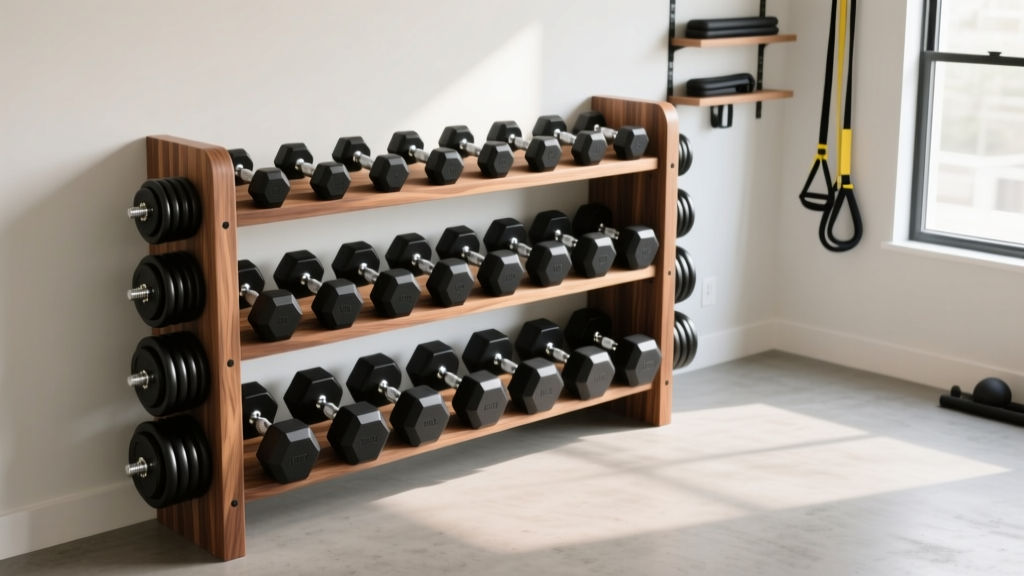
Wood Dumbbell Rack Setup: Complete Installation Walkthrough

Small Space Gym Mistakes: Troubleshooting the DBR 86 Dumbbell Rack

Searching for a Nike Dumbbell Rack? Small Space Storage Guide
