
Space-Saving Kettlebell Guide & Beginner Dumbbell Workout Women Need
Optimize your home gym layout with our cast iron vs competition kettlebell guide, plus a space-saving beginner dumbbell workout women can do anywhere.

As urban living spaces shrink and the 2026 home fitness landscape prioritizes multi-use rooms, spatial efficiency is no longer a luxury—it is a strict requirement for gear selection. When designing a compact home gym, free weights present the ultimate spatial puzzle. This guide breaks down the spatial realities of cast iron versus competition kettlebells, helping you optimize your floor plan and racking footprint. Furthermore, for those operating in micro-gyms where even a kettlebell rack is too intrusive, we provide a highly effective, zero-clearance beginner dumbbell workout women can execute in a mere 3x3 foot footprint.
The Spatial Reality: Cast Iron vs. Competition Kettlebells
When outfitting a dedicated free-weight zone, the choice between cast iron and competition kettlebells dictates your entire storage architecture. Cast iron kettlebells (like the popular Rogue Powder Coat series) scale in physical volume as the weight increases. An 8kg cast iron bell is compact, but a 24kg bell is massive, requiring deeper shelves and wider rack spacing.
Conversely, competition kettlebells (such as those from Kettlebell Kings or Onnit) adhere to strict international dimensional standards. Regardless of whether the bell is 8kg or 32kg, the physical dimensions remain locked at approximately 280mm in height and 210mm in width. The internal cavity is simply filled with more or less steel or lead to adjust the mass.
Expert Insight: The Racking Failure ModeA common layout failure occurs when buyers purchase a single-tier, flush-mounted wall rack designed for competition bells, but populate it with cast iron bells. The wider handles and taller horns of heavier cast iron bells will scrape the wall, damage the powder coating, and overhang the rack lips, creating a severe tipping hazard.
Dimensional Footprint Comparison
| Weight | Cast Iron Dimensions (H x W) | Competition Dimensions (H x W) | Layout & Rack Impact |
|---|---|---|---|
| 8 kg | 205mm x 175mm | 280mm x 210mm | Cast iron fits low, shallow shelves; Competition requires standard 28cm vertical clearance. |
| 16 kg | 240mm x 210mm | 280mm x 210mm | Cast iron requires staggered shelving; Competition allows flush, single-tier racking. |
| 24 kg | 285mm x 235mm | 280mm x 210mm | Cast iron needs deep floor racks; Competition fits standard 10-inch deep wall mounts. |
According to the biomechanical standards taught by StrongFirst, the uniform diameter of competition kettlebells ensures consistent positioning against the forearm during cleans and snatches, which is crucial for technique. From a layout perspective, this uniformity means you can install a sleek, 4-foot wide single-tier wall rack in a hallway or bedroom corner, maximizing vertical space without eating into your floor plan.
Designing Your Compact Kettlebell Zone
If you commit to competition kettlebells for their spatial predictability, your layout design must account for the kinetic envelope of the exercises. Kettlebell swings and snatches require a clearance zone of at least 4 feet in front of and 2 feet behind the user.
- Wall-Mounted Single Tier: Ideal for 3 to 5 bells. Mount at 30 inches off the ground to allow easy hip-level lifting without excessive spinal flexion during the initial pick-up.
- Vertical Corner Storage: Use a tiered vertical cradle. This occupies only 21x21 inches of floor space but requires 45 inches of vertical wall clearance.
- Impact Protection: Competition bells are dense. If you are dropping them during high-rep snatch cycles, a 3/4-inch thick horse-stall mat (4x6 ft) is mandatory to protect subflooring and dampen acoustic transfer to neighbors.
When Space Shrinks Further: The Adjustable Dumbbell Pivot
There are scenarios where even a 4-foot wall rack is impossible. Studio apartments, shared living rooms, and bedroom micro-gyms often demand gear that can be hidden in a closet. This is where adjustable dumbbells (like the Nuobell 5-50lb or PowerBlock Pro series) become the undisputed kings of spatial optimization. A single pair of adjustable dumbbells replaces 15 pairs of fixed-weight bells, condensing roughly 40 square feet of storage into a 1-square-foot footprint.
Transitioning from kettlebells to adjustable dumbbells requires a shift in programming. To maximize this ultra-compact footprint, curating the perfect beginner dumbbell workout women can use safely without striking walls or furniture is essential. The focus shifts to controlled, closed-chain movements that require zero overhead clearance and minimal lateral sway.
The 3x3 Footprint: Beginner Dumbbell Workout Women Can Do Anywhere
The American Council on Exercise (ACE) emphasizes that space constraints should never compromise exercise variety or progressive overload. Using a pair of adjustable dumbbells, you can execute a comprehensive full-body stimulus in a space no larger than a standard yoga mat.
The Micro-Gym Circuit Protocol
Perform this circuit 3 times through. Work for 45 seconds, followed by 15 seconds of transition/rest. Adjust the dial on your dumbbells during the 15-second window.
- Dumbbell Goblet Reverse Lunge (Quads/Glutes): Hold one dumbbell vertically against your chest. Step backward into a lunge, keeping the front knee aligned over the ankle. Spatial requirement: 2x4 ft. No forward momentum means you won't kick furniture.
- Dumbbell Romanian Deadlift (Hamstrings/Posterior Chain): Hold a dumbbell in each hand. Hinge at the hips, pushing them back toward the wall behind you until you feel a deep hamstring stretch. Spatial requirement: 2x2 ft. Strictly vertical and hinged movement.
- Floor Glute Bridge with Chest Press (Glutes/Pectorals): Lie on your back, knees bent, feet flat. Drive hips up into a bridge while simultaneously pressing the dumbbells overhead. Spatial requirement: 2x6 ft (mat size). Zero vertical clearance needed, making it perfect for rooms with low ceilings or ceiling fans.
- Renegade Row (Core/Lats): Assume a push-up position gripping the dumbbells. Row one dumbbell to your hip while stabilizing your core to prevent torso rotation. Spatial requirement: 2x5 ft. Keeps the center of gravity low and contained.
Cast Iron Set (8-24kg): ~$210 total. Requires $80 wall rack. Total footprint: 4 sq ft wall, 6 sq ft floor.
Competition Set (8-24kg): ~$345 total. Requires $120 flush rack. Total footprint: 4 sq ft wall, 4 sq ft floor.
Adjustable Dumbbells (5-50lb pair): ~$399 total. Requires $0 rack (stored on floor mat). Total footprint: 1.5 sq ft floor.
Expert Verdict on Layout & Gear Selection
Your choice between cast iron, competition kettlebells, and adjustable dumbbells should be dictated by your room's dimensional hard limits. If you have a dedicated 4-foot stretch of blank wall and want the tactile, biomechanical perfection of traditional lifting, invest in competition kettlebells and a flush-mounted single-tier rack. The uniform dimensions will save you from layout headaches and racking failures.
However, if your gym is a shared living space that must be 'erased' after every session, adjustable dumbbells are the superior investment. By utilizing the enclosed beginner dumbbell workout women can execute in a 3x3 footprint, you maintain a high-intensity, progressive resistance routine without sacrificing your home's livability. In the modern era of fitness design, the best equipment isn't just what feels good in the hand—it's what respects the space you live in.
More gear to consider
All reviews
Cast Iron vs Competition Kettlebells & Neck Exercises with Dumbbells
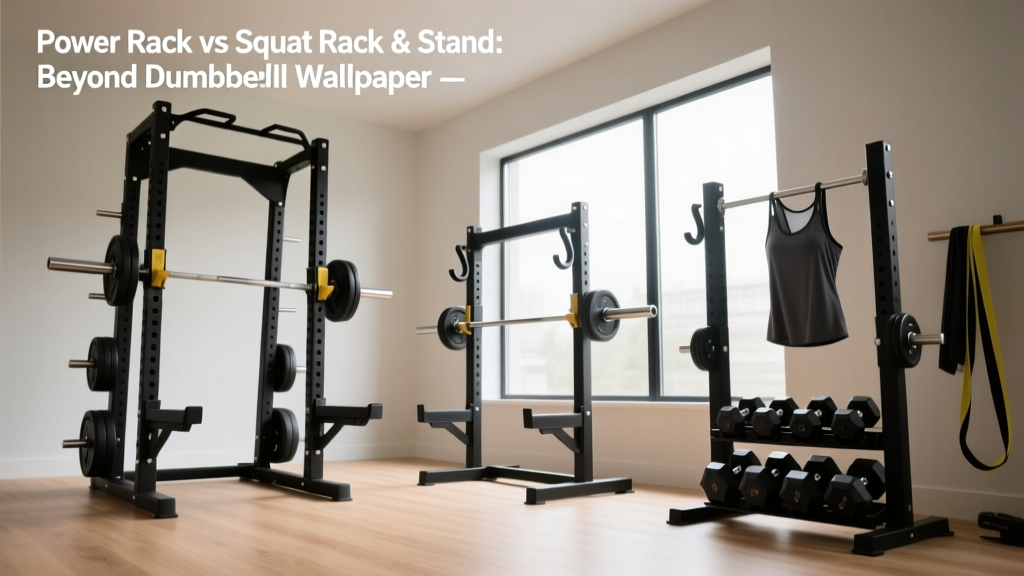
Power Rack vs Squat Rack vs Stand: Beyond Dumbbell Wallpaper
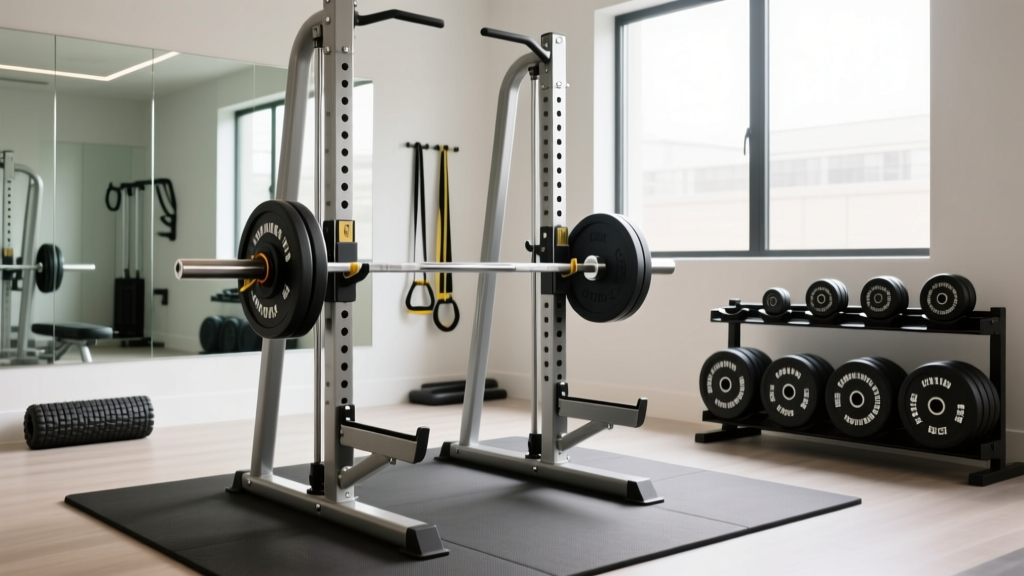
Barbell Collar Setup: Beyond Dumbbell Exercises for Underarm Fat
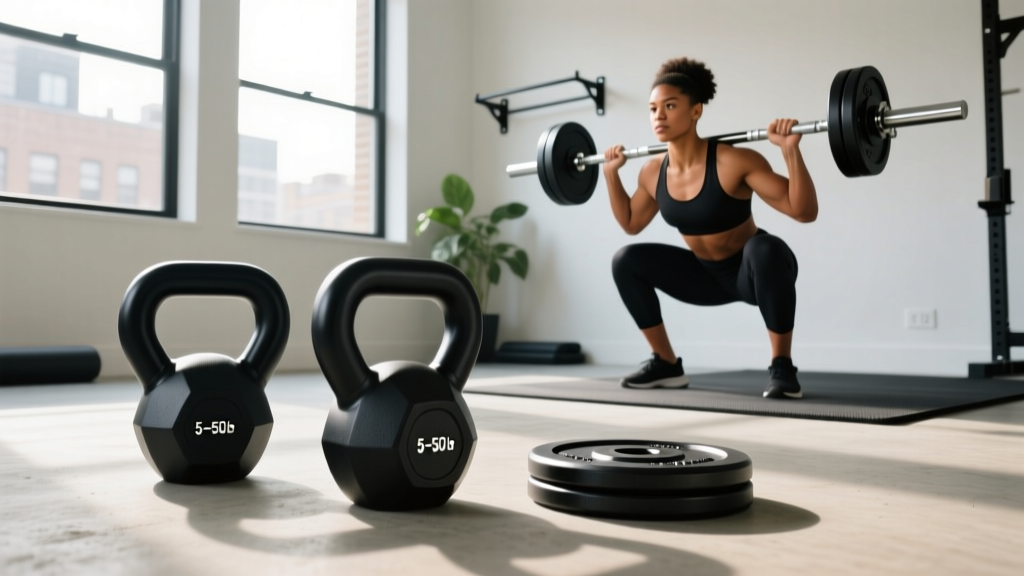
Loadable Goblet Squat Dumbbells: 2026 Value Breakdown

Top Dumbbell Racks for Circuit Training With Dumbbells in 2026
