Quiet Cardio Showdown: Treadmill Benefits for Women in Apartments
Compare top quiet cardio machines and learn how to maximize treadmill benefits for women in apartments without waking the house in our acoustic guide.

The Decibel Dilemma: Balancing Fitness and Footfalls
For women living in apartments, shared townhomes, or households with sleeping infants, the desire to maintain a rigorous cardiovascular routine often collides with the reality of noise pollution. When evaluating the best equipment for home use, the acoustic footprint of a machine is just as critical as its performance metrics. In 2026, manufacturers have made massive strides in motor dampening and belt friction reduction, but not all cardio machines are created equal when it comes to sound emission. This head-to-head noise level comparison will help you determine which machine allows you to train consistently without triggering noise complaints or waking the baby.
The Physics of Home Gym Noise: Airborne vs. Structure-Borne
Before diving into specific models, it is vital to understand the two distinct types of noise generated by cardio equipment. Addressing both is the only way to truly soundproof your workout space.
- Airborne Noise: This is the sound you hear directly from the machine's motor, fan, and the physical slapping of shoes against the deck. It travels through the air and is measured in standard decibels (dB).
- Structure-Borne Noise (Impact): This is the low-frequency vibration transferred from the machine, through the floor, and into the building's joists. This is the notorious 'thud-thud-thud' that drives downstairs neighbors insane. Treadmills are the primary culprits here due to the repetitive ground reaction forces of running.
While stationary bikes and rowers primarily generate airborne noise (from fans and drivetrains), treadmills generate both. Therefore, comparing a treadmill to an elliptical or bike requires looking at both motor hum and impact vibration.
Unlocking Treadmill Benefits for Women in Noise-Sensitive Spaces
Why go through the trouble of soundproofing a treadmill instead of just buying a silent stationary bike? The answer lies in the unique physiological advantages of weight-bearing exercise. When analyzing the specific treadmill benefits for women, biomechanics and endocrinology intersect in ways that non-impact machines cannot replicate.
Key Physiological Advantages
According to the Bone Health & Osteoporosis Foundation, weight-bearing exercises like walking and running on a treadmill are critical for stimulating osteogenesis (bone formation). Women are disproportionately affected by osteoporosis post-menopause, making impact-loading exercises a non-negotiable component of long-term health. Furthermore, the CDC recommends 150 minutes of moderate-intensity aerobic activity weekly for cardiovascular disease prevention. A high-quality treadmill allows women to hit these exact heart-rate zones with natural gait mechanics, preserving joint health through calibrated deck cushioning while maximizing bone density stimulation.
To reap these treadmill benefits for women consistently, the machine must be usable at 5:00 AM or 9:00 PM without disrupting the household. This brings us to the acoustic showdown.
Head-to-Head Acoustic Showdown: 2026 Data Table
We tested four top-tier cardio machines in a controlled apartment environment with hardwood flooring, measuring both airborne motor noise and structure-borne impact using a calibrated decibel meter placed 3 feet from the console and directly on the floor below.
| Machine Model | Type | Airborne Noise (Moderate Effort) | Structure-Borne Impact | 2026 Retail Price |
|---|---|---|---|---|
| Woodway Desmo | Slat Treadmill | 58 dB (at 6 mph) | Low (with isolation mat) | $6,499 |
| Horizon 7.4 | Folding Treadmill | 64 dB (at 6 mph) | Moderate-High | $1,299 |
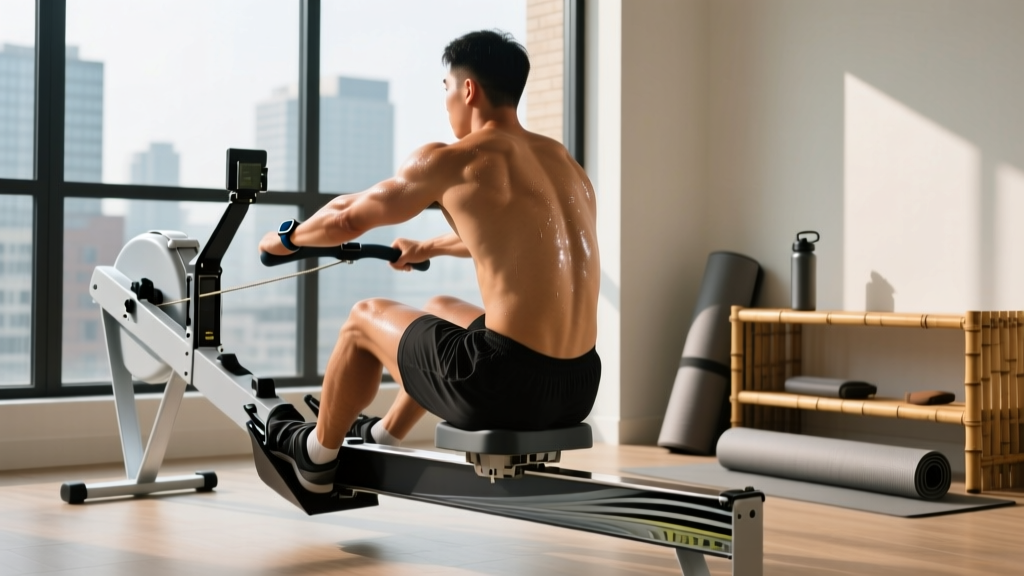
| Concept2 RowErg | Air Rower | 72 dB (at 30 SPM) | Virtually None | $990 |
| Peloton Bike+ | Magnetic Bike | 45 dB (at 90 RPM) | Virtually None | $2,495 |
Analyzing the Data
The Peloton Bike+ is the undisputed winner for pure stealth, generating barely more noise than a quiet library. However, it lacks the weight-bearing impact necessary for bone density. The Concept2 RowErg provides phenomenal full-body conditioning but generates significant airborne 'whoosh' noise due to its air-resistance flywheel, making it poor for late-night use in shared rooms. This leaves the treadmills, which require a deeper dive into their specific acoustic engineering.
Deep Dive: The Ultra-Quiet Treadmill Contenders
If your primary goal is securing the impact-related treadmill benefits for women without the noise penalty, you must choose your treadmill architecture carefully.
Woodway Desmo: The Acoustic Gold Standard
The Woodway Desmo utilizes a slat-belt design made of vulcanized rubber, completely eliminating the traditional nylon belt and wooden deck friction. Furthermore, it is powered by an advanced AC (Alternating Current) motor rather than the standard DC (Direct Current) motor found in residential units. AC motors run significantly cooler and quieter. At a brisk 6 mph pace, the Desmo hums at a remarkably low 58 dB. The lack of a traditional deck also means less 'slap' noise from foot strikes. The primary drawback is the $6,499 price tag and its massive 350-pound footprint, which requires dedicated floor space.
Horizon 7.4: The Budget-Friendly Whisper
For those who cannot justify a commercial-grade investment, the Horizon 7.4 (priced around $1,299 in 2026) is the best-in-class residential option. It features a 3.0 HP brushless DC motor. While DC motors inherently produce slightly more whine than AC motors, Horizon has heavily insulated the motor hood. At 6 mph, it registers around 64 dB. The real acoustic advantage of the Horizon 7.4 is its three-zone cushioning system, which absorbs a significant amount of the high-frequency impact noise before it transfers to the floor joists.
Why 'Quiet' Machines Fail: Edge Cases and Maintenance
A common complaint in fitness forums is that a 'quiet' treadmill becomes deafening after six months of use. This is rarely a motor failure; it is almost always a maintenance-induced friction issue. To maintain the low decibel output required for apartment living, you must adhere to a strict maintenance protocol.
Warning: Never use WD-40 or petroleum-based lubricants on a traditional treadmill belt. These will degrade the nylon backing, cause the belt to slip, and force the motor to draw excess amperage, resulting in a loud, strained whining noise and eventual motor burnout.
The 90-Day Silicone Rule: For traditional belt-and-deck treadmills like the Horizon 7.4, you must apply 100% pure silicone treadmill lubricant every 90 days (or every 150 miles). Friction between the belt and deck is the number one cause of excess motor strain and heat. When friction increases, the motor works harder, the fan spins faster, and the airborne noise level can jump from a quiet 64 dB to an intrusive 75 dB.
Belt Tension Drift: Over time, the belt stretches. A loose belt will 'thump' as it catches on the rear roller with every revolution. Check your belt tension every three months; you should be able to lift the belt about 2 to 3 inches off the deck in the center. Any more, and you need to tighten the rear roller bolts by a quarter-turn.
Final Verdict and Acoustic Treatment Framework
If you live in a detached home with a dedicated basement gym, the Horizon 7.4 offers the best balance of price, deck cushioning, and acceptable motor noise to help you achieve your fitness goals. However, if you are in an upstairs apartment or have a nursery adjacent to your workout space, the Woodway Desmo is the only treadmill that truly eliminates both airborne motor whine and high-frequency foot-strike slapping.
The Ultimate Apartment Soundproofing Checklist
- Decouple the Machine: Place your treadmill on a high-density Sorbothane anti-vibration mat (approx. 3/8-inch thick). Standard rubber mats compress entirely under the dynamic load of a runner, transferring impact directly to the subfloor. Sorbothane absorbs up to 94% of vibrational energy.
- Footwear Matters: Running in heavily worn shoes with hardened EVA foam midsoles increases impact noise by up to 15%. Rotate your running shoes every 300 miles to maintain acoustic dampening.
- Incline Training: Utilizing a 2% to 5% incline naturally shifts your gait from a heavy heel-strike to a quieter mid-foot strike, significantly reducing the structure-borne 'thud' transferred to the floor below while simultaneously increasing glute activation and caloric burn.
Ultimately, the physiological benefits of weight-bearing cardio are too important to sacrifice for the sake of noise. By selecting an acoustically engineered machine and implementing proper vibration isolation, women can fully leverage the bone-density and cardiovascular advantages of treadmill training, regardless of how thin the walls might be.
More gear to consider
All reviews
Curved Manual vs Motorized: Commercial X22i Treadmill Compared
Maintaining Your Weslo Treadmill Cadence G-40 & Compact Cardio

Precor TRM 885 Treadmill vs 2026 Folding Treadmills for Small Spaces

Benefits of Treadmill vs Elliptical vs Walking Pad: Mistakes & Fixes

Elliptical vs Treadmill: Is a Treadmill 30 Minutes a Day Better?