Power Rack vs Squat Stand: How to Draw Dumbbells & Plan Your Gym
Compare power racks, squat racks, and stands. Learn how to draw dumbbells and equipment on your floor plan to build the perfect 2026 home gym layout.

The Home Gym Dilemma: Choosing Your Primary Rig
Building a home gym in 2026 requires more than just dropping a credit card on the most expensive steel you can find. The foundation of any serious free-weight setup is the squatting and pressing rig. But with spatial constraints, budget limitations, and varying safety needs, choosing between a full power rack, a half squat rack, and minimalist squat stands can be paralyzing. Furthermore, before you purchase, you must map your space. Many lifters overlook spatial planning, leading to cramped workouts and unsafe barbell paths.
According to the National Strength and Conditioning Association (NSCA), proper equipment spacing and safety clearances are critical for preventing impact injuries in home and commercial environments. In this comprehensive guide, we will break down the structural differences between power racks, squat racks, and squat stands, provide a 2026 pricing and spec comparison matrix, and teach you the exact methodologies for mapping your floor plan.
Defining the Big Three: Racks and Stands
1. The Power Rack (Full Cage)
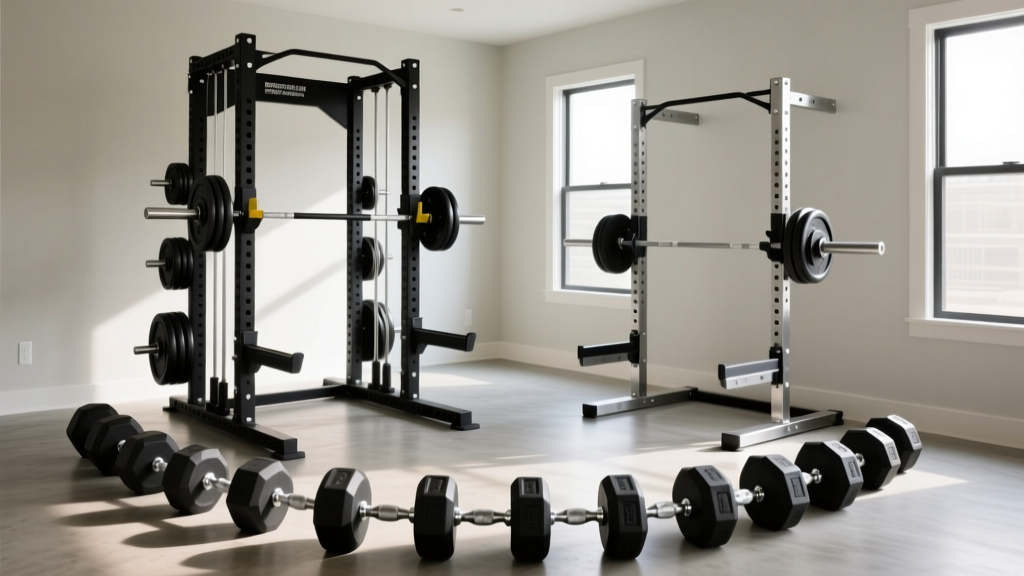
A power rack consists of four vertical uprights connected by crossmembers, creating a 'cage' that you step inside. It features adjustable J-cups to hold the barbell and safety spotter arms or straps to catch failed lifts. Power racks are the gold standard for safety, allowing you to bench press and squat heavy without a human spotter. Standard premium models in 2026 utilize 3x3-inch 11-gauge steel uprights with Westside hole spacing (1-inch spacing in the bench press zone for precise micro-adjustments).
2. The Squat Rack (Half Rack)
A squat rack typically features two main front uprights and two shorter rear uprights, often connected by a pull-up bar or weight storage horns. It offers a smaller footprint than a full cage and provides an open feeling, which is ideal for Olympic lifts like cleans and snatches where the barbell path might extend outside the cage. However, it requires careful weight balancing to prevent tipping if the user fails a rep and dumps the bar forward.
3. Squat Stands
Squat stands are two independent, freestanding uprights (or an A-frame base) designed purely to hold the barbell off the floor. They are the most budget-friendly and space-efficient option, easily tucked into a corner when not in use. The major drawback is safety: without a connected cage or extended spotter arms, failing a squat or bench press requires you to safely dump the weight to the floor, which can damage subflooring and the barbell itself.
Spatial Planning: How to Draw Dumbbells and Racks on Your Floor Plan
Before buying a rig, you must draft your layout. A common question among home gym designers is how to draw dumbbells, kettlebells, and rack footprints to scale on graph paper or CAD software to ensure proper clearances. Here is the professional framework for mapping your gym:
Drafting to Scale (1/4 Inch = 1 Foot)
- The Barbell Sweep: A standard Olympic barbell is 86 inches (7'2") long. When drawing your rack, you must draw a 90-inch horizontal line to account for the barbell sleeves extending past the uprights. Ensure you have at least 12 inches of clearance on each side to load and unload plates.
- How to Draw Dumbbells and Storage: A standard 5-tier commercial dumbbell rack measures roughly 48 inches wide by 28 inches deep. When drawing this on your blueprint, you must also map a 36-inch semi-circle clearance zone in front of the rack. This accounts for the biomechanics of deadlifting or rowing heavy dumbbells off the floor without clipping your shins or elbows on the rack frame.
- Ceiling Height Constraints: Standard residential ceilings are 96 inches (8 feet). If you are drawing a pull-up bar clearance, ensure the top of the rack is at least 84 inches, leaving 12 inches for head clearance during pull-ups.
By mapping these exact dimensions, you will quickly realize whether a 41-inch deep power rack will choke your garage, or if a 24-inch deep squat stand is the only viable option.
2026 Deep Dive Comparison Matrix
To provide actionable data, we have analyzed three top-tier rigs dominating the 2026 market. As noted by the equipment testing experts at Garage Gym Reviews, the shift toward UHMW-lined safety straps and 1-inch hole spacing has become the baseline expectation for premium racks.
| Feature | Rogue RML-390F (Power Rack) | REP Fitness PR-4000 (Power Rack) | Titan Fitness T-2 (Squat Stand) |
|---|---|---|---|
| Type | Fold-Back Full Cage | Standard Full Cage | Freestanding Squat Stand |
| Upright Steel | 3x3" 11-Gauge | 3x3" 11-Gauge | 2x2" 14-Gauge |
| Hole Spacing | Westside (1"/2") | 1" Throughout | 2" Standard |
| Depth / Footprint | 21.5" (Folds to 4") | 24" or 30" options | 24" x 24" base |
| Safety Mechanism | Flip-down safeties / Straps | UHMW-lined spotter straps | None included (Sold separately) |
| Approx. 2026 Price | $895 - $950 | $699 - $799 | $299 - $349 |
Expert Insight: The REP PR-4000 offers the best value proposition in 2026 due to its 1-inch hole spacing throughout the entire upright and included UHMW plastic-lined J-cups, which protect your barbell's knurling from steel-on-steel degradation.
Failure Modes and Edge Cases to Avoid
When selecting your rig, amateur buyers often fall victim to specific failure modes that compromise safety and equipment longevity. The American College of Sports Medicine (ACSM) emphasizes that environmental and equipment setup errors are leading causes of home-gym resistance training injuries.
1. The Tipping Hazard (Squat Stands)
If you opt for squat stands with a small 2x2-inch base and attempt to rack a heavy barbell (e.g., 400+ lbs) slightly off-center, the kinetic energy can tip the stand forward. Solution: If you must use stands, buy models with an extended A-frame base (like the REP A-Frame) and always bolt them to a reinforced plywood platform if lifting near your 1RM.
2. Knurling Destruction
Budget racks often use bare steel pin-pipe safeties and unlined steel J-cups. Dragging a bare steel barbell across bare steel safeties during a failed lift will instantly grind away the center knurl and oxidize the shaft. Solution: Only buy racks that include or offer UHMW (Ultra-High-Molecular-Weight) polyethylene plastic liners on all contact points.
3. The 'Garage Door' Clearance Error
Many lifters buy a 30-inch deep power rack and place it against the back wall of a garage, forgetting that the garage door tracks and motor hang down 12 to 18 inches from the ceiling. When you press the bar overhead or do pull-ups, the barbell or your head will strike the garage door mechanism. Always measure from the floor to the lowest hanging obstruction, not just the drywall ceiling.
Step-by-Step Decision Framework
Use this rapid-fire framework to finalize your purchase:
- Assess Your Spotter Situation: Do you train alone 90% of the time? If yes, eliminate squat stands immediately. You need the enclosed safety of a power rack or half rack with extended spotter arms.
- Measure the Depth: Pull your car out of the garage. Measure the distance from the back wall to where your car bumper rests. If you have less than 48 inches of depth, you must look at fold-back power racks (like the Rogue RML-390F) or ultra-compact squat stands.
- Evaluate Your Lift Selection: If your programming includes heavy Olympic variations (power cleans, snatches), a full cage will restrict your bar path and force you to drop the bar inside the cage, potentially bending your barbell sleeves. Choose an open squat rack or stands for Olympic lifting.
- Finalize the Footprint Draft: Return to your 1/4-inch scale drawing. Ensure your chosen rig, combined with your mapped dumbbell storage zone, leaves a minimum 36-inch walking pathway for safe egress and emergency access.
Final Verdict
The choice between a power rack, squat rack, and squat stand ultimately hinges on the intersection of your budget, your ceiling height, and your tolerance for risk. For the vast majority of home gym owners in 2026, a 3x3-inch 11-gauge power rack with 1-inch Westside hole spacing remains the undisputed king of versatility and safety. However, by taking the time to properly measure your space, map your barbell sweep, and learn how to draw dumbbells and storage footprints to scale, you ensure that whichever rig you choose will serve you safely for decades.
More gear to consider
All reviews
Dumbbell Bulgarian Split Squat Trends: Rubber Hex vs Urethane 2026

Best Neoprene Dumbbells for Home Use & Bicep Reverse Dumbbell Curls

EZ Curl Bar vs Straight Bar: Space-Saving Bowflex Dumbbell Workouts

Rubber vs Urethane Care & Chin-Up Alternative with Dumbbells

Bumper vs Iron Plate Care & Lunges Exercise with Dumbbells Tips
