Incline Dumbbell Chest Setup: Power Rack vs Squat Rack Mistakes
Avoid common incline dumbbell chest press mistakes. We troubleshoot setup errors across power racks, squat racks, and squat stands for safer lifts.

The Geometry Problem: Bench Angles vs. Rack Uprights
Dragging an adjustable bench into your home gym rig to perform the incline dumbbell chest press seems like a trivial task. However, the intersection of human biomechanics, adjustable bench dimensions, and rig geometry is where catastrophic setup mistakes happen. According to biomechanical analyses published in the National Center for Biotechnology Information (NCBI), a 30-degree bench angle optimally targets the clavicular head of the pectoralis major without excessively recruiting the anterior deltoids. Yet, achieving this precise 30-degree angle inside a confined rack footprint often leads to spatial conflicts, compromised range of motion, and severe safety hazards.
Whether you are operating a fully enclosed power rack, an open-back squat rack, or a minimalist squat stand, the incline dumbbell chest press introduces unique spatial variables. The dumbbell heads (which can span 8 to 12 inches in diameter on heavier 80lb+ pairs) require significant lateral clearance. When you combine this with the backward tilt of an incline bench, your pressing path shifts directly toward the rack's uprights. In this troubleshooting guide, we break down the most common equipment-specific mistakes and how to fix them in 2026.
Mistake #1: The Squat Stand Tipping Hazard
Misunderstanding Forward Spotter Arm Physics
Squat stands (like the popular Rogue SML-2 or Titan T-2 Short) are essentially two independent uprights. To safely bench inside them, you must attach forward-extending spotter arms. The most critical mistake lifters make is failing to account for the kinetic energy of a failed incline dumbbell chest press. If you fail a rep at the bottom of the movement and drop a pair of 90-pound dumbbells onto the spotter arms, the forward weight distribution can easily tip an unbolted squat stand forward, pulling the entire rig onto your chest or face.
WARNING: Never perform heavy incline dumbbell presses on a squat stand unless the rear base is heavily loaded with weight plates or the stand is bolted to a structural platform. The forward center of gravity during an incline press exponentially increases the tipping risk compared to a flat bench press.Mistake #2: Upright Interference in Standard Power Racks
The Range of Motion (ROM) Killer
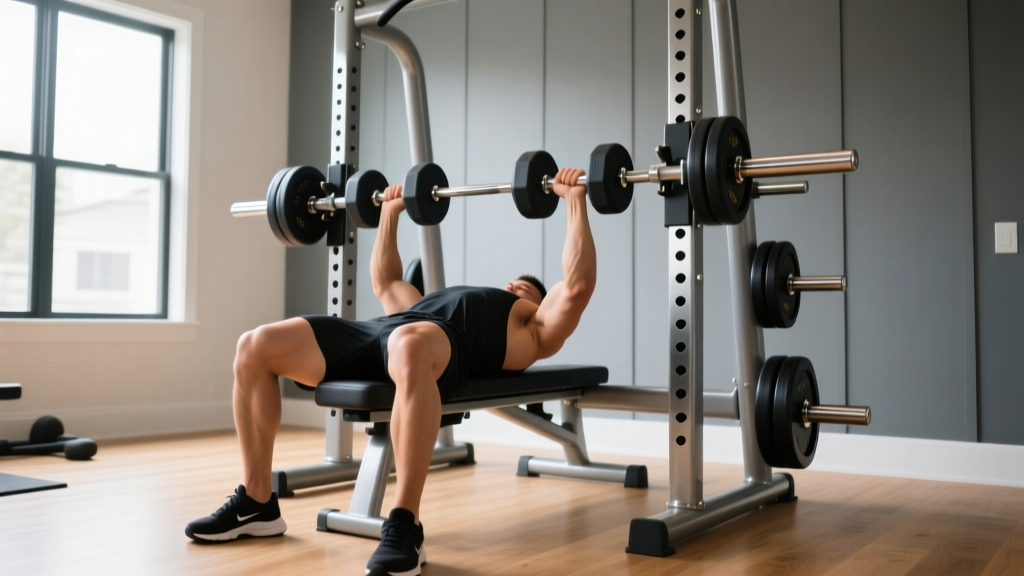
Power racks offer unparalleled safety, but their interior width can sabotage your incline dumbbell chest press. A standard power rack has an outside width of 49 inches and an inside clearance of roughly 43 inches. A standard adjustable bench is about 12 inches wide. This leaves exactly 31 inches of lateral space—meaning you have only 15.5 inches per arm to maneuver the dumbbell.
If you set your bench at a steep 45-degree angle (which ExRx.net notes shifts excessive load to the anterior deltoids), your head and torso move closer to the rear uprights. As you press the dumbbells up and slightly back to lock out, the outer plates of the dumbbells will violently collide with the 3x3-inch steel uprights. This not only halts your hypertrophy stimulus but can cause you to lose wrist stability and drop the weight.
Equipment Matrix: Incline DB Press Usability
To help you troubleshoot your specific home gym setup, we have compiled a 2026 comparison matrix focusing exclusively on how different rack types handle the incline dumbbell chest press.
| Equipment Type | Interior Clearance | Safety Mechanism | Incline DB Rating | 2026 Avg. Price |
|---|---|---|---|---|
| Power Rack (e.g., Rogue RM-6) | 43" - 49" | Internal Strap Safeties | Excellent | $1,100 - $1,800 |
| Squat Rack (e.g., Titan T-3) | 41" - 43" | Extended Spotter Arms | Moderate | $600 - $900 |
| Squat Stand (e.g., Rogue SML-2) | 49" (Open) | Forward Spotter Arms | Poor (Hazardous) | $350 - $550 |
Troubleshooting Workflow: Fixing Your Setup
If you are experiencing spatial conflicts or safety anxieties during the incline dumbbell chest press, follow this step-by-step troubleshooting protocol to recalibrate your equipment.
- Drop the Bench Angle: Lower your adjustable bench from the 45-degree notch to the 30-degree notch. This moves your head and pressing path away from the rear uprights, instantly solving 90% of dumbbell-to-steel interference issues.
- Offset the Bench Placement: Instead of aligning the bench perfectly in the dead center of the rack, shift it 2 to 3 inches forward. Ensure your eyes are aligned with the J-cups rather than the rear uprights.
- Swap Pin-and-Pipe for Straps: If using a power rack, remove the metal pin-and-pipe safeties. Metal pipes cause round dumbbells to bounce and roll off upon impact. Install heavy-duty nylon safety straps (like the Rogue Monster Safety Straps) set exactly 4 inches below your bottom-range elbow depth.
- Angle the Dumbbells: At the top of the pressing movement, rotate your wrists slightly inward (neutral grip variation) to pull the outer plates of the dumbbells away from the rack uprights, preserving your lockout without clipping the steel.
The 'Drop Zone' Hazard on Open Racks
According to equipment safety guidelines discussed by experts at BarBend, open-back squat racks lack the lateral and rear enclosure of a power rack. When performing an incline dumbbell chest press, the natural fatigue-induced path of the dumbbells drifts backward toward the lifter's face and the rear uprights. If you fail a rep on an open squat rack, the instinct is to drop the dumbbells backward. On a squat stand or open rack, this often results in the dumbbells crashing into the J-cups, dislodging them, or bouncing into the lifter's torso.
Pro-Tip: Always utilize the 'knee-kick' momentum to return heavy dumbbells to your lap at the end of an incline set. Never attempt to guide 80lb+ dumbbells backward to the floor from a 30-degree incline position, as this places extreme shear force on the rotator cuff and risks tearing the biceps tendon.
Advanced Rigging: Using Band Pegs as Spotters
For lifters using budget squat stands in 2026 who cannot afford to bolt their rig to a concrete floor, an advanced troubleshooting method involves using resistance bands as a supplementary safety net. By looping heavy-duty loop bands from the rear base of the squat stand to a distant wall anchor or heavy plate tree, you create a rearward tension vector. This tension actively counteracts the forward-tipping kinetic energy generated when dropping heavy dumbbells onto forward-mounted spotter arms during an incline press.
Frequently Asked Questions
Can I just do the incline dumbbell chest press outside the rack?
Yes, but you lose the ability to safely fail a rep. If you are pressing outside the rack, you must be proficient in the 'dumping' technique, where you safely guide the dumbbells to the sides of your torso and kick them forward to the floor. However, doing this on an incline bench is biomechanically awkward and risks bruising your hips or tearing a groin muscle.
Why do my dumbbells hit the crossmembers of my squat rack?
Many 4-post squat racks feature lower crossmembers for structural rigidity. If your adjustable bench has a wide wheelbase or a long rear support leg, it will hit the crossmember, preventing you from sliding the bench deep enough into the rack. The fix is to either elevate the bench on stacked rubber horse-stall mats to clear the crossmember or switch to a flat-base competition bench.
More gear to consider
All reviews
Bumper vs Iron Plates: Budgeting Your Dumbbell and Barbell Workout
Olympic Barbell Guide: Knurling & Bent Over Dumbbell Row Machine Alts
Olympic Barbell Buying Guide & Quad Workouts with Dumbbells
Protecting Your Rack: Tricep Extension Dumbbell Storage & Care

Standard vs Olympic Plates for Your Sitting Dumbbell Workout Setup