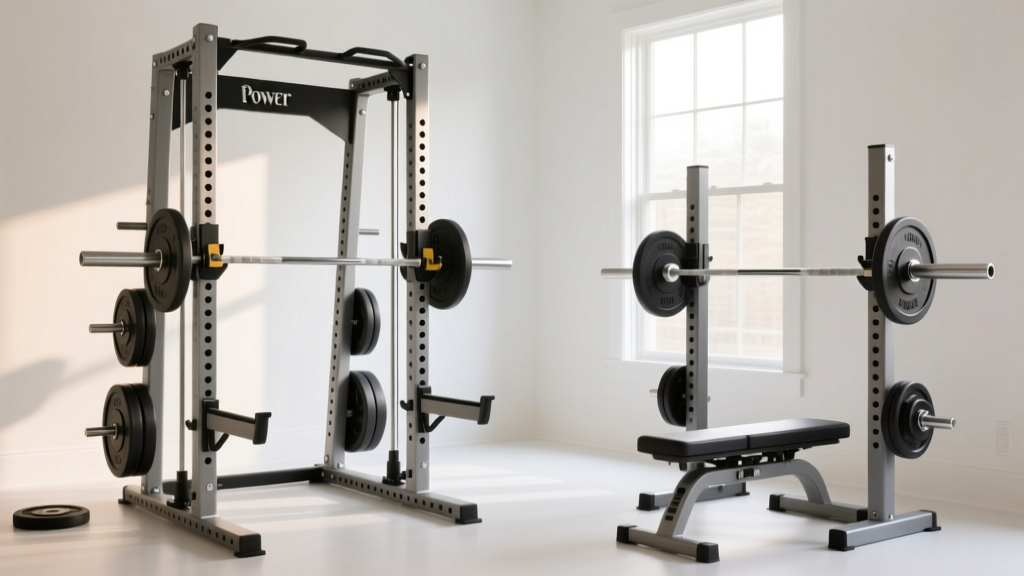
Power Rack vs Squat Rack vs Stand: Setup Errors and Dumbbell Flys
Avoid costly setup mistakes when choosing a power rack, squat rack, or squat stand. Learn spacing, safety, and clearance tips for squats and dumbbell flys.

Equipping a home gym in 2026 requires navigating a minefield of steel dimensions, gauge thicknesses, and footprint constraints. While most lifters focus heavily on barbell squats and bench presses when debating a power rack vs squat rack vs squat stand, a massive troubleshooting blind spot often emerges once the barbell is put away. That blind spot is lateral clearance for accessory movements—most notably, dumbbell flys.
Choosing the wrong rack configuration doesn't just limit your heavy compound lifts; it can actively sabotage your hypertrophy work, force you to shorten your range of motion, or result in chipped dumbbells and damaged steel uprights. This troubleshooting guide breaks down the most common setup mistakes lifters make when selecting and configuring their racks, ensuring your equipment supports everything from a 500-pound squat to a deep, uninterrupted chest fly.
The Enclosure Illusion: Why Bigger Isn't Always Better
The most frequent mistake first-time buyers make is assuming that a fully enclosed 4-post power rack is universally superior to an open squat stand or half rack. While a power rack offers unparalleled safety for solo barbell lifting, its enclosed nature creates a physical cage.
When you step inside a standard power rack, you are confined to its interior dimensions. For exercises that require a wide lateral arc, this steel perimeter becomes a major liability. Conversely, squat stands (two independent uprights) and half racks (typically 2-post or 4-post with an open front) eliminate the side-cage effect, granting your arms infinite lateral clearance. Understanding this trade-off is the first step in troubleshooting your gym layout.
The 43-Inch Interior Trap: Troubleshooting Dumbbell Flys
If you have ever felt your knuckles graze a steel upright or heard the sickening clank of a cast-iron dumbbell hitting a rack post during the eccentric phase of a chest fly, you have fallen victim to the 43-inch interior trap.
The Biomechanical Math
According to ExRx.net's biomechanical guide to the dumbbell fly, the pectoralis major undergoes maximum stretch when the humerus is abducted and extended laterally behind the torso. To achieve this safely, your wingspan plus the length of your dumbbells must fit within the rack's interior width.
- The Standard Rack: Most flagship power racks (like the standard Rogue RML-390 series) feature a 49-inch exterior width. Subtracting two 3x3-inch uprights leaves you with a 43-inch interior clearance.
- The Lifter's Wingspan: An average male lifter holding 35-pound hex dumbbells (which are roughly 13 inches long each) will have a total lateral wingspan of 48 to 54 inches at the bottom of a deep fly.
- The Result: The dumbbells will strike the uprights before the pectoral muscle reaches a full stretch, completely ruining the biomechanical intent of the exercise.
Expert Troubleshooting Fix: If your primary rack is a standard 49-inch wide power rack, you must angle your bench diagonally inside the cage, or utilize squat stands for your benching station. Alternatively, look for specialized wide-body racks (like the Rep Fitness PR-5000 V3 in its 53-inch or wider configurations) which push the uprights outward to accommodate wide arcs.
Spotter Arm Geometry: Catching the Bar vs. Dumping the Dumbbell
Another critical error is misapplying barbell safety logic to dumbbell training. The National Strength and Conditioning Association (NSCA) educational resources on facility safety emphasize that spotting protocols and equipment catches must match the implement being lifted.
In a power rack, you can set four safety spotter arms to catch a failed barbell bench press. But what happens when you fail a heavy dumbbell bench press or a dumbbell fly? You don't lower the dumbbells to a central bar; you dump them laterally to the floor.
The Mistake: Leaving spotter arms extended while doing dumbbell work. If you drop a heavy dumbbell to escape a failed rep, it can bounce off a protruding steel safety arm, deflecting back into your face or torso.
The Fix: When transitioning from barbell to dumbbell work, squat stands are inherently safer for heavy dumbbell pressing and flys because there are no lateral safety arms to deflect dropped weights. If you must use a power rack, ensure all pin-pipe or sandwich safeties are completely removed or pushed to the furthest rear setting before executing dumbbell flys.
2026 Rack Configuration Matrix
To help you troubleshoot your specific needs, here is a comparison of the three primary rack categories based on current 2026 market standards, pricing, and spatial dynamics.
| Equipment Type | Example Model (2026) | Interior Clearance | Est. Price Range | Best Use Case & Fly Compatibility |
|---|---|---|---|---|
| Power Rack (4-Post) | Rogue RML-390F | ~43 inches | $1,100 - $1,300 | Heavy solo barbell lifting. Poor for wide-grip dumbbell flys unless bench is angled. |
| Half Rack (Open Front) | Titan T-3 Series | ~43 inches (front open) | $800 - $1,000 | Barbell work with plate storage. Allows forward bench slide for fly clearance. |
| Squat Stand (2-Post) | Rep Fitness SR-4000 | Infinite lateral | $450 - $600 | Small footprints, Olympic lifts, and unrestricted dumbbell flys/presses. |
Anchoring Failures: Bolt-Down vs. Flat-Foot Dynamics
A common troubleshooting complaint on fitness forums is the 'walking rack'—a squat stand or half rack that shifts forward when re-racking a heavy barbell. This is a severe safety hazard that stems from misunderstanding the moment of force.
When you review the Rogue Fitness RML-390F specifications or similar flagship racks, you will notice options for flat-foot designs versus bolt-down configurations.
- Bolt-Down Racks: If you are buying 2-post squat stands, bolting them to a concrete slab or a reinforced wooden platform is practically mandatory if you plan on doing heavy rack pulls or using resistance bands. Without anchoring, the leverage of a 400-pound barbell being pulled forward will tip the stands.
- Flat-Foot Racks: These rely on the weight of the rack itself and the loaded barbell to maintain stability. A 4-post power rack with a rear crossmember and rear storage pegs acts as a counterbalance. Troubleshooting tip: If your flat-foot power rack wobbles during pull-ups, you have likely failed to tighten the corner gusset plates. Always use a torque wrench on 5/8-inch hardware to ensure the 11-gauge steel frame remains perfectly square.
Hardware Mistakes: UHMW Plastics and Pin-Pipe Safeties
The final layer of troubleshooting involves the hardware that actually interfaces with your weights. In the rush to compare rack heights and widths, buyers often ignore the J-cups and safety mechanisms.
The Bare Metal Mistake: Budget squat stands often ship with bare steel J-cups. Racking a knurled barbell onto bare steel will grind away the zinc or cerakote finish on your bar within a month. Always verify that your chosen rack includes UHMW (Ultra-High Molecular Weight) plastic sandwich J-cups. These protect the barbell and dampen the acoustic shock of re-racking.
Safety Strap vs. Pin-Pipe: For heavy squats, pin-pipe safeties can bend or bind if the barbell comes down unevenly, making it nearly impossible to remove them after a failed lift. High-density polyethylene (HDPE) safety straps are vastly superior. They catch the barbell without damaging the knurling, and they never bind under asymmetric loads. If your rack didn't come with straps, upgrading to them should be your first post-purchase modification.
Pre-Purchase Troubleshooting Checklist
Before finalizing your cart, run through this rapid diagnostic checklist:
- Measure your ceiling: Standard racks are 84 or 90 inches. If you have 85-inch ceilings, an 84-inch rack leaves only 1 inch for pull-up clearance. Opt for a 72-inch short rack or an open squat stand instead.
- Check your barbell shaft: Ensure the rack's exterior width is narrower than your barbell's sleeve-to-sleeve distance (usually 51.5 inches for Olympic bars) so the plates don't scrape the uprights during squats.
- Visualize the fly arc: Sit on your bench with a tape measure. Simulate the bottom position of your dumbbell flys. If your hands extend past 43 inches laterally, cross the standard power rack off your list and invest in squat stands or a wide-body half rack.
By looking beyond the barbell and troubleshooting for the full spectrum of your training—including the lateral demands of dumbbell flys—you will build a home gym in 2026 that is as functional and safe as it is aesthetically imposing.
More gear to consider
All reviews
Barbell Collar vs Clamp: Securing Weight Bench Dumbbells & Bars
Olympic vs Standard Plates: Buying Guide & Dumbbell Flys for Back

Bumper vs Iron Plate Care & Dumbbell 5 kg Maintenance

Loadable Dumbbell Only Chest Workout: Budget Breakdown & Value Analysis
Kettlebell Value: Cast Iron vs Competition & Seated Alternating Dumbbell Curl
