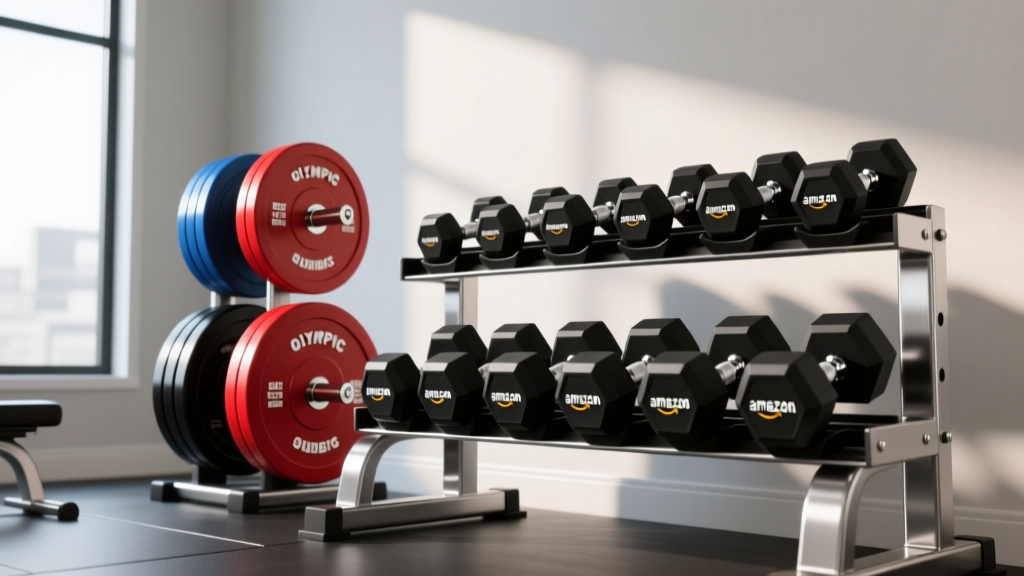
Olympic vs Standard Plates & Amazon Basics Rubber Hex Dumbbell Hand Weight
Compare Olympic vs standard weight plates for your home gym. Plus, we review the Amazon Basics rubber hex dumbbell hand weight for accessory lifts.

The Foundation of Free Weights: Plate Sizing and Fixed Dumbbells
Building a resilient, long-term home gym in 2026 requires navigating a market flooded with conflicting equipment standards. The most critical decision you will make when purchasing free weights is choosing between Olympic and standard weight plates. This choice dictates not only your barbell compatibility but also the structural safety of your heavy compound lifts. However, a complete strength ecosystem extends beyond the barbell. Unilateral movements, drop sets, and joint rehabilitation require dedicated fixed implements. This is where the highly popular Amazon Basics rubber hex dumbbell hand weight enters the conversation as a pragmatic, budget-friendly accessory to complement your primary plate-loaded arsenal.
In this comprehensive guide, we break down the metallurgical and dimensional differences between Olympic and standard plates, analyze failure modes under heavy loads, and provide an in-depth review of the Amazon Basics rubber hex dumbbell hand weight to help you finalize your home gym layout.
Olympic vs Standard Weight Plates: The Dimensional Divide
The distinction between Olympic and standard weight plates is not merely a matter of branding; it is a fundamental difference in engineering tolerances and load-bearing capacity. According to equipment testing by Garage Gym Reviews, mismatching plates and barbell sleeves is one of the most common and dangerous errors made by novice home gym owners.
| Feature | Olympic Plates (2-Inch) | Standard Plates (1-Inch) |
|---|---|---|
| Center Hole Diameter | 50.8 mm (2 inches) | 25.4 mm (1 inch) |
| Bar Sleeve Compatibility | 50 mm rotating sleeves | 25 mm fixed smooth sleeves |
| Max Safe Load Capacity | 500 to 1,500+ lbs | 200 to 300 lbs (bar dependent) |
| Common Plate Materials | Cast Iron, Urethane, Virgin Rubber Bumper | Cast Iron, Cement-filled Vinyl |
| Avg. Cost Per Pound (2026) | $1.50 - $3.00 | $0.80 - $1.20 |
Olympic plates are the undisputed standard for commercial facilities and serious garage gyms. The 2-inch sleeve diameter allows for a thicker, high-tensile steel barbell shaft that can withstand massive bending forces without permanent deformation. Standard plates, conversely, are designed for light-duty recreational use, often pairing with hollow-core or low-grade mild steel bars that lack the structural integrity for heavy squats or deadlifts.
Metallurgy and Failure Modes: Why 1-Inch Bars Bend
To understand why the National Strength and Conditioning Association (NSCA) and elite coaches universally recommend Olympic setups for heavy compound lifting, we must look at the physics of the bending moment. When you load a barbell, the weight on the sleeves creates a lever arm that exerts immense downward shear force on the center shaft.
The Yield Strength Problem
Standard 1-inch barbells are typically manufactured from mild steel with a low tensile strength (often under 30,000 PSI). When loaded beyond 200 to 250 pounds, the center shaft exceeds its yield strength, resulting in permanent plastic deformation. In practical terms, the bar bends and will never roll straight again. Olympic barbells, such as those benchmarked by Rogue Fitness, are forged from high-tensile spring steel ranging from 190,000 to 215,000 PSI. This allows the bar to flex (or 'whip') under heavy loads and elastically return to its perfectly straight resting state.
Critical Warning: Never attempt to use standard 1-inch plates on an Olympic bar by sliding on cheap plastic adapter sleeves. The tolerance gap introduces micro-vibrations during lifts that can crack the adapter, scratch the bar's knurling, and create a severe pinch-point hazard for your fingers.Accessory Isolation: The Amazon Basics Rubber Hex Dumbbell Hand Weight
While Olympic plates and barbells form the foundation of progressive overload, a complete training program requires fixed dumbbells for accessory isolation, muscle imbalances, and high-rep metabolic conditioning. The Amazon Basics rubber hex dumbbell hand weight has dominated the budget fitness market for years, and its 2026 iterations remain a staple for cost-conscious lifters.
Construction and Ergonomics
The Amazon Basics rubber hex dumbbell hand weight features a solid cast-iron core encased in a thick, recycled rubber matrix. This coating serves two vital purposes: it dampens acoustic noise when dropped on rubber mats, and it protects your garage floor from impact spalling. The hexagonal head design is a crucial safety feature; it prevents the dumbbell from rolling away when placed on the floor, which is essential for exercises like renegade rows, floor presses, and plank pull-throughs.
The handle is constructed from textured steel with a contoured grip that accommodates chalk. Unlike adjustable dumbbells that can rattle or fail internally, this fixed-weight design is virtually indestructible under normal use cases.
Pros and Cons of the Amazon Basics Hex Dumbbell
- Pro: Exceptional price-to-weight ratio, often hovering around $1.30 to $1.60 per pound for mid-range increments (e.g., 25 lb to 40 lb).
- Pro: Hexagonal anti-roll design enhances safety during floor-based movements.
- Pro: Solid cast-iron core ensures accurate weight calibration compared to cement-filled alternatives.
- Con: The recycled rubber coating emits a strong volatile organic compound (VOC) odor upon unboxing. You must let them off-gas in a well-ventilated garage or outdoors for 10 to 14 days before bringing them into a basement or spare bedroom gym.
- Con: The rubber can degrade and become brittle if exposed to direct, prolonged UV sunlight or extreme freezing temperatures.
Space, Storage, and Economic Breakdown
When outfitting a home gym, you must balance the footprint of your equipment against your budget. Olympic plates require a heavy-duty A-frame or wall-mounted rack, and the 2-inch diameter sleeves demand more horizontal storage space. Standard plates are slightly more compact but limit your ceiling for strength progression.
Integrating a set of Amazon Basics rubber hex dumbbell hand weights (e.g., a pair of 15s, 25s, and 40s) requires a dedicated 3-tier A-frame dumbbell rack. Budget approximately $450 to $600 for a comprehensive starter dumbbell set, and reserve the bulk of your $1,000+ budget for a high-quality Olympic barbell, 300 lbs of cast-iron or bumper Olympic plates, and a power rack.
'Invest 80% of your free-weight budget into a high-tensile Olympic barbell and calibrated plates. Use the remaining 20% for fixed accessories like the Amazon Basics hex dumbbells to target lagging muscle groups and perform joint-friendly isolation work.' — Home Gym Engineering Principles
Frequently Asked Questions
Can I mix Olympic and standard plates in the same gym?
Yes, but they must be kept on entirely separate storage racks and used with their respective, dedicated barbells. Mixing them up mid-workout leads to frustration and potential equipment damage if forced onto incompatible sleeves.
Are the Amazon Basics rubber hex dumbbells accurate in weight?
Testing shows that the Amazon Basics rubber hex dumbbell hand weight typically falls within a 2% to 3% variance of its stated weight. While not competition-calibrated (which requires a 0.5% tolerance), this variance is entirely negligible for hypertrophy and general fitness training.
Which plate type is best for dropping from overhead?
Neither standard cast iron nor standard Olympic iron plates should be dropped. If you plan to perform Olympic weightlifting movements (cleans, snatches) or heavy overhead presses where dropping the weight is a safety necessity, you must purchase Olympic Bumper Plates made from high-density crumb or virgin rubber.
More gear to consider
All reviews
How to Use Dumbbells for Arms: Adjustable Setup & 2026 Review

Cast Iron vs Competition: Kettlebell vs Dumbbell Exercise Cost

EZ Curl vs Straight Bar: Bowflex SelectTech 560 Dumbbells Value

Plate Sizing for a Chest and Shoulder Workout with Dumbbells

EZ Curl Bar vs Straight Bar & Black Widow Dumbbell Cart
