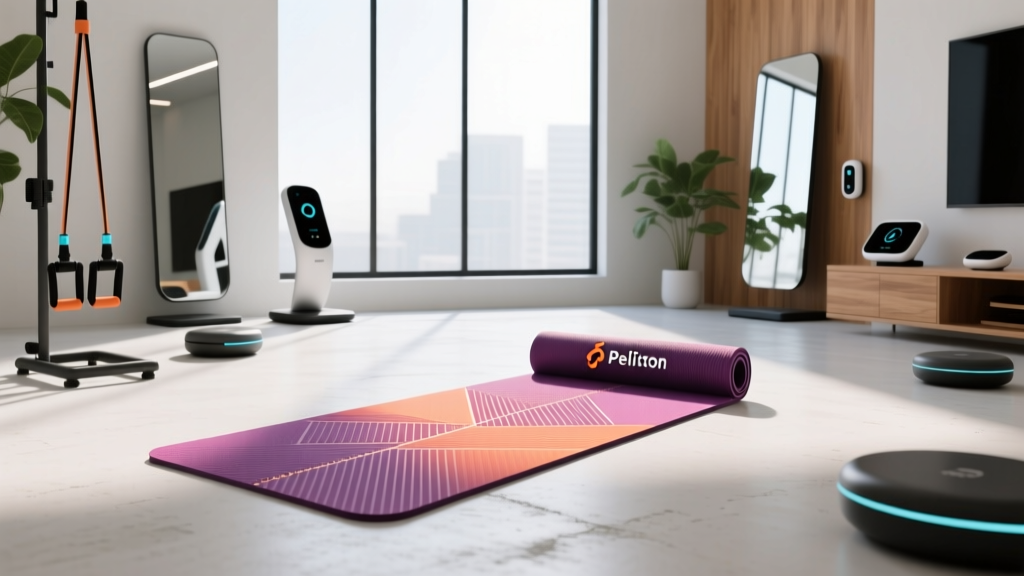
Peloton Yoga Mat Value Breakdown for AI Smart Gyms
Is the Peloton yoga mat worth the premium price for AI-powered smart home gyms? We break down the budget, materials, and tech compatibility.

The Intersection of AI Pose Estimation and Floor Gear
As we navigate the 2026 landscape of connected fitness, the home gym has evolved from simple screen-mirroring to sophisticated, AI-driven spatial computing. Devices like the Peloton Guide, Tempo Move, and Lululemon Mirror rely heavily on computer vision and pose estimation algorithms to track your movements, count reps, and correct form in real-time. But while consumers obsess over camera resolutions and processor speeds, a critical component of the AI tracking ecosystem is often overlooked: the floor mat. Specifically, how does the official Peloton yoga mat perform when tasked with supporting not just your joints, but the optical sensors of your smart home gym?
At $89, the Peloton-branded mat sits in a premium tier compared to big-box store alternatives. For the budget-conscious connected athlete, the question is whether this price tag represents a genuine technological synergy with AI tracking systems, or merely a branded ecosystem tax. In this comprehensive value analysis, we break down the material science, spatial dimensions, and cost-per-use metrics of the Peloton yoga mat to determine its true worth in an AI-powered workout environment.
Tech Insight: The Glare Factor in AI TrackingAI skeletal tracking models, such as those utilizing MediaPipe architecture, rely on high-contrast visual data to map 33 distinct bodily keypoints. Standard PVC mats often reflect overhead 5000K LED lighting, creating 'blind spots' or glare that can cause AI cameras to drop lower-body tracking during floor work. The matte polyurethane (PU) top layer of the Peloton mat is engineered to absorb light, providing a consistent, non-reflective canvas for optical sensors.
Budget Breakdown: Peloton vs. The AI-Ecosystem Alternatives
To understand the value proposition of the Peloton yoga mat, we must contextualize its $89 price point against other mats frequently used in smart home gym setups. The following matrix evaluates cost, material composition, and specific suitability for AI camera environments.
| Mat Model | 2026 Price | Material & Thickness | AI Tracking Suitability |
|---|---|---|---|
| Peloton Yoga Mat | $89.00 | PU Top / TPE Base (6mm) | Excellent (Matte finish eliminates sensor glare) |
| Manduka PRO | $120.00 | High-Density PVC (6mm) | Good (Dense, but slight surface sheen under ring lights) |
| YogiFi Smart Mat | $149.00 | Embedded Pressure Sensors | Niche (Redundant if using Peloton Guide camera tracking) |
| Gaiam Essentials | $35.00 | NBR Foam (6mm) | Poor (Compresses unevenly, disrupting AI depth mapping) |
As noted in Tom's Guide's extensive hardware review of the Peloton Guide, the camera's 102-degree field of view requires a stable, high-contrast environment to maintain accurate bounding boxes around the user. While the $35 Gaiam mat saves you $54 upfront, its NBR foam construction compresses unpredictably under dynamic loads. When an AI camera attempts to measure the depth of a lunge or a yoga warrior pose, the uneven compression of cheap foam can introduce millimeter-level discrepancies that confuse the pose estimation algorithm, leading to inaccurate rep counting or form correction alerts.
Material Science and Durability in Connected Workouts
The Peloton yoga mat utilizes a dual-layer construction: a thermoplastic elastomer (TPE) base for structural integrity and cushioning, topped with a polyurethane (PU) skin for grip and moisture management. From a budget perspective, this material choice directly impacts the lifespan of the mat in a high-frequency smart gym setting.
The 14-Month Edge Case: PU Degradation
Most users report excellent performance during the first year of ownership. However, an edge case emerges around the 14-month mark for users who exclusively perform high-sweat, AI-guided HIIT or Pilates flows. Polyurethane is highly porous, which grants it exceptional grip when slightly damp. However, if cleaned with harsh, enzyme-based chemical sprays rather than mild soap and water, the PU layer can begin to micro-peel at the high-friction zones (where hands and feet repeatedly plant during burpees or downward dogs).
- Preventative Maintenance: To protect your $89 investment, wipe the mat with a microfiber cloth dampened only with water or a specialized, pH-neutral yoga mat cleaner after every AI-tracked session.
- The Replacement Cycle: A well-maintained Peloton mat will easily last 2.5 to 3 years of daily use. A budget PVC mat subjected to the same lateral friction from AI-guided agility drills will typically flake and degrade within 8 to 10 months, negating any initial savings.
"When evaluating floor gear for AI-tracked home gyms, joint preservation is just as critical as optical clarity. A 6mm density threshold is the minimum required to prevent micro-trauma during repetitive, algorithm-counted plyometrics. The user must feel stable, or the AI will register compensatory, flawed movement patterns."
— Biomechanics & Fitness Tech Analysis, Wirecutter's Mat Testing Methodology
Spatial Dimensions and Camera Calibration
The Peloton yoga mat measures exactly 72 inches long by 24 inches wide. In the context of AI smart gyms, these dimensions dictate your 'tracking zone.' According to Wired's spatial analysis of the Peloton Guide, the AI requires the user to remain within a specific geometric frustum to maintain full-body skeletal mapping.
- The Lateral Limitation: At 24 inches wide, the mat is perfectly suited for linear movements (squats, forward lunges, yoga flows). However, for AI-guided lateral skater jumps or wide-stance sumo squats, users frequently step off the 24-inch boundary.
- AI recalibration delays: When your foot leaves the high-contrast mat and hits a low-contrast hardwood or carpet floor, the AI camera may experience a 0.5 to 1-second tracking dropout as it recalibrates the lighting and depth differential.
- The Value Workaround: To maximize the value of the Peloton mat in a smart gym, position your AI camera tripod precisely 8 feet away, centered on the mat's longitudinal axis, and angle it slightly downward to prioritize the 72-inch length over the 24-inch width.
Cost-Per-Use Framework for the Connected Athlete
To definitively answer whether the Peloton yoga mat is a sound financial decision, we must apply a cost-per-use (CPU) framework over a standard 24-month hardware lifecycle. Let us assume a dedicated user engages in AI-tracked floor workouts four times per week.
The 2-Year CPU Calculation
Total Workouts (24 Months): 416 sessions
Peloton Yoga Mat ($89): $89 / 416 = $0.21 per workout
Budget NBR Mat ($35 x 2 replacements): $70 / 416 = $0.16 per workout
Analysis: While the budget mat saves five cents per session, the user must endure the friction of recalibrating their AI camera twice a year due to mat warping, surface flaking, and degraded contrast ratios. For the tech-forward consumer whose primary goal is seamless AI integration, the $0.05 premium per workout is overwhelmingly justified by the elimination of tracking friction.
Final Verdict: Maximizing Your AI Gym Investment
The Peloton yoga mat is not merely a branded accessory; it is a highly functional piece of optical calibration equipment disguised as fitness gear. Its matte polyurethane surface solves the pervasive issue of LED glare that plagues AI pose estimation, while its 6mm TPE base provides the consistent depth mapping required for accurate rep counting.
Who Should Buy It?
- Owners of the Peloton Guide, Tempo Move, or camera-based smart mirrors who struggle with lower-body tracking dropouts during floor routines.
- Users with dedicated, well-lit home gym spaces where light reflection off standard PVC mats disrupts computer vision algorithms.
- Athletes prioritizing joint stability during high-volume, AI-tracked plyometric programming.
Who Should Skip It?
- Users who primarily perform standing, off-mat strength training and only use a mat for brief post-workout stretching.
- Budget-restricted consumers who are willing to manually adjust their AI camera settings and lighting to compensate for the glare of a $30 generic mat.
Ultimately, when building a smart home gym in 2026, your AI hardware is only as intelligent as the environment it operates in. Investing $89 in the Peloton yoga mat ensures that your floor space is optimized for the exacting demands of computer vision, transforming your living room into a flawlessly calibrated, AI-responsive training facility.
More gear to consider
All reviewsHow To Match Long-Term Smart Home Value With Budget
Is the Peloton Treadmill FSA Eligible? Setup & Smart Integration Guide

Top Peloton Treadmill Workouts Alternatives: 2026 Setup Guide

Peloton or Treadmill? AI Equipment Maintenance & Longevity Tips

Leaving Peloton Treadmill Classes? Troubleshooting Smart Alternative Equipment
