
Peloton Treadmill Death Lessons: Fitness Mirrors vs Traditional Gear
Learn crucial safety lessons from the Peloton treadmill death incident. Compare fitness mirrors vs traditional equipment to avoid fatal home gym mistakes.

The Catalyst for Change: Understanding the Tragedy
The home fitness boom brought unparalleled convenience, but it also introduced severe spatial and operational risks into our living spaces. The tragic 2021 incident involving a child and a Peloton Tread+—an event that sparked widespread search queries regarding the peloton treadmill death—remains the most sobering cautionary tale in connected fitness history. It exposed a critical flaw in how consumers evaluate home gym equipment: we prioritize screen size and software ecosystems over physical safety clearances and mechanical failure modes.
As we navigate the smart home gym landscape in 2026, the debate between wall-mounted fitness mirrors (like the Tonal 2 and Echelon Reflect 50) and traditional motorized equipment (like the Peloton Tread and NordicTrack EXP 10i) is no longer just about aesthetics or workout variety. It is fundamentally about risk mitigation, spatial zoning, and hardware troubleshooting. According to the Consumer Product Safety Commission (CPSC), exercise equipment accounts for tens of thousands of emergency room visits annually, with motorized belts and unanchored heavy machinery posing the highest risks to vulnerable household members.
This guide breaks down the most common placement mistakes, troubleshooting protocols, and safety comparisons between smart mirrors and traditional gear to ensure your home gym is a sanctuary, not a hazard.
Fitness Mirrors vs. Traditional Equipment: 2026 Safety Matrix
When comparing smart mirrors to traditional cardio and strength equipment, the risk profiles are vastly different. Mirrors primarily pose blunt force and anchoring risks, while traditional treadmills pose friction, ejection, and entanglement risks. Below is a comparative safety audit of leading 2026 models.
| Equipment Type | 2026 Flagship Model | Primary Hazard Profile | Required Safety Clearance | Child/Pet Mitigation Strategy |
|---|---|---|---|---|
| Smart Resistance Mirror | Tonal 2 | Wall-anchor failure, cable snap, glass shatter | 78" ceiling height, 24" lateral wingspan | Physical lockout pin, software user-recognition |
| Cardio/Reflective Mirror | Echelon Reflect 50 | Tip-over (if freestanding), heat exhaustion near outlets | 12" rear ventilation, 36" front user zone | Hidden cable management, auto-sleep screen |
| Smart Treadmill | Peloton Tread (Standard) | Rear belt ejection, console tip-over | 78" rear ejection zone, 24" lateral | Magnetic safety key, physical child-lock on console |
| Traditional Treadmill | NordicTrack EXP 10i | High-speed friction burns, motor overheating | 78" rear ejection zone, 36" lateral | Safety lanyard, master power switch |
5 Fatal Home Gym Placement Mistakes (And How to Fix Them)
The core lesson from the peloton treadmill death tragedy is that manufacturer warnings are often ignored in favor of interior design convenience. Here are the five most dangerous mistakes homeowners make when integrating smart and traditional fitness gear, and how to troubleshoot them.
1. The '36-Inch Rear Clearance' Myth on Treadmills
Many users place their treadmills facing a wall or a window, leaving only a few feet of space behind the machine. If a user trips at 8 MPH, the belt acts as a conveyor, ejecting them backward with immense kinetic force. The CPSC and biomechanics experts recommend a minimum 78-inch (6.5 feet) clear drop zone behind any motorized treadmill. If your room does not accommodate this, you must pivot to a smart mirror or an elliptical, which lack the continuous rear-ejection hazard.
2. Ignoring the 'Drop Zone' for Smart Mirrors
While mirrors like the Echelon Reflect 50 don't have moving belts, they are essentially 50-inch sheets of heavy, tempered glass and aluminum. A common mistake is mounting these on drywall without hitting structural studs, or placing them above baseboard heaters. Troubleshooting fix: Always use a stud finder to locate 16-inch-on-center wooden studs. If you must use toggle bolts, ensure the drywall is at least 5/8-inch thick and rated for 150 lbs of sheer force. Furthermore, maintain a 12-inch clearance from HVAC vents to prevent internal condensation from shorting the mirror's logic board.
3. Bypassing the Tonal 2 Anchoring Protocol
The Tonal 2 generates up to 200 lbs of digital electromagnetic resistance. A catastrophic failure mode occurs when users mount the unit to masonry or plaster walls using standard lag screws meant for modern wood studs. When the digital weight stack 'drops' during a failed rep, the shockwave can rip the unit from the wall. Troubleshooting fix: For masonry walls, you must use wedge anchors drilled at least 3 inches into solid concrete. For older plaster-and-lath homes, you must open the wall and install horizontal wooden backing boards before mounting the Tonal 2.
4. Disabling AI Auto-Pause and Camera Shutoffs
In 2026, premium smart mirrors utilize LiDAR and optical cameras to detect if a user steps out of the designated workout zone or if a foreign object (like a pet or child) enters the frame. A common software mistake is disabling these features in the settings menu because users find the auto-pause 'annoying' during interval training. Troubleshooting fix: Never disable spatial awareness software. If the mirror is falsely pausing, recalibrate the room boundaries in the companion app and ensure no reflective surfaces (like opposing mirrors or glossy paint) are blinding the LiDAR sensor.
5. The Lanyard Bypass on Traditional Gear
The magnetic safety key on treadmills is the single most important life-saving device on the machine. Yet, Consumer Reports notes that a vast majority of users clip the lanyard to their shorts but leave the magnetic key permanently attached to the console, defeating its purpose. If a user falls, the belt continues to spin. Troubleshooting fix: Implement a strict household rule: the treadmill will not be powered on via the main breaker unless the magnetic key is physically removed from the console and clipped to the user's collar.
⚠️ CRITICAL WARNING: The Child Access FactorThe peloton treadmill death incident highlighted the danger of unsupervised access to active machinery. In 2026, smart home gyms must be treated like swimming pools or workshops. According to the American Academy of Pediatrics (AAP), home gym equipment is a leading cause of severe pediatric friction burns and crush injuries. You must install a physical door lock (not just a child-proof knob cover) on the room housing traditional motorized equipment. Smart mirrors are safer in shared spaces, provided their power cords are routed through internal wall conduits rather than dangling where toddlers can pull the 100-lb glass panel down.
Step-by-Step Home Gym Safety Zoning Protocol
To systematically eliminate hazards, apply this 4-step zoning framework to your smart home gym layout:
- Zone 1: The Active Strike Radius (0-36 inches from equipment)
This area must be completely devoid of furniture, sharp corners, or glass decor. For smart mirrors, this is where you perform lateral movements. Ensure ceiling fans are mounted at least 84 inches from the floor to prevent hand-strike injuries during overhead presses on the Tonal 2. - Zone 2: The Ejection & Recovery Path (36-78 inches behind cardio)
This zone applies strictly to treadmills and rowing machines. It must feature high-density EVA foam flooring to absorb impact in the event of a fall. No doors should swing into this zone, as a falling user could be trapped against a closing door. - Zone 3: The Thermal & Power Corridor
Smart mirrors and motorized treadmills draw massive peak current (often 12-15 amps). Never daisy-chain these devices on a standard 15-amp household circuit with other appliances. Dedicate a 20-amp circuit to your gym zone to prevent breaker trips mid-workout, which can cause sudden belt stops or mirror blackouts, leading to disorientation and falls. - Zone 4: The Perimeter Lock
All power strips must be wall-mounted at least 48 inches off the ground. Cords must be secured in rigid cord-channels. If using a freestanding mirror, it must be tethered to the wall using an anti-tip furniture strap rated for 200 lbs.
Software Troubleshooting: When Smart Safety Features Fail
Connected fitness relies heavily on firmware, and software bugs can inadvertently disable safety mechanisms. Here is how to troubleshoot common smart-safety failures in modern equipment:
- Treadmill Belt Stuttering (Sensor Misalignment): If your smart treadmill abruptly stops or stutters, it is often not a motor failure but a misaligned optical sensor reading the belt's RPM. Fix: Unplug the machine, remove the motor hood, and use compressed air to clean the optical sensor eye near the front roller. Realign it to sit exactly 2mm from the RPM tone ring.
- Mirror Auto-Spotter Failure (Tonal 2): The Tonal 2 features an AI 'Spotter' that reduces weight if it detects you struggling. If this fails to engage, it is usually due to dirty rep-sensors on the handles. Fix: Wipe the capacitive touch sensors on the handles with isopropyl alcohol to ensure the machine can accurately read your grip tension and bar-path velocity.
- Ghost Touches on Console Screens: Sweat and humidity can cause traditional treadmill touchscreens to register 'ghost touches,' sometimes inadvertently increasing speed or stopping the belt. Fix: Apply a hydrophobic nano-coating to the console screen and ensure a dehumidifier keeps the room's ambient humidity below 50%.
Final Verdict: Choosing the Right Risk Profile
The haunting legacy of the peloton treadmill death incident forced the entire fitness industry to re-evaluate hardware design and consumer education. When choosing between a fitness mirror and traditional equipment in 2026, you are ultimately choosing between different risk profiles. Smart mirrors like the Tonal 2 and Echelon Reflect 50 offer superior safety regarding ejection and entanglement hazards, making them ideal for multi-use living spaces and homes with children or pets. However, they demand rigorous structural anchoring and electrical management.
Traditional treadmills remain unparalleled for cardiovascular conditioning but require a dedicated, locked room with strict adherence to the 78-inch rear ejection zone and mandatory magnetic lanyard usage. By treating your home gym not just as a collection of screens and motors, but as an industrial space requiring rigorous safety zoning, you can leverage the best of connected fitness without compromising your household's well-being.
More gear to consider
All reviews
Mirror vs Traditional Equipment: Peloton Treadmill Moving Service

Peloton or Treadmill? AI Equipment Maintenance & Longevity Tips

Step-by-Step: Sync Peloton Treadmill Incline With Smart Apps
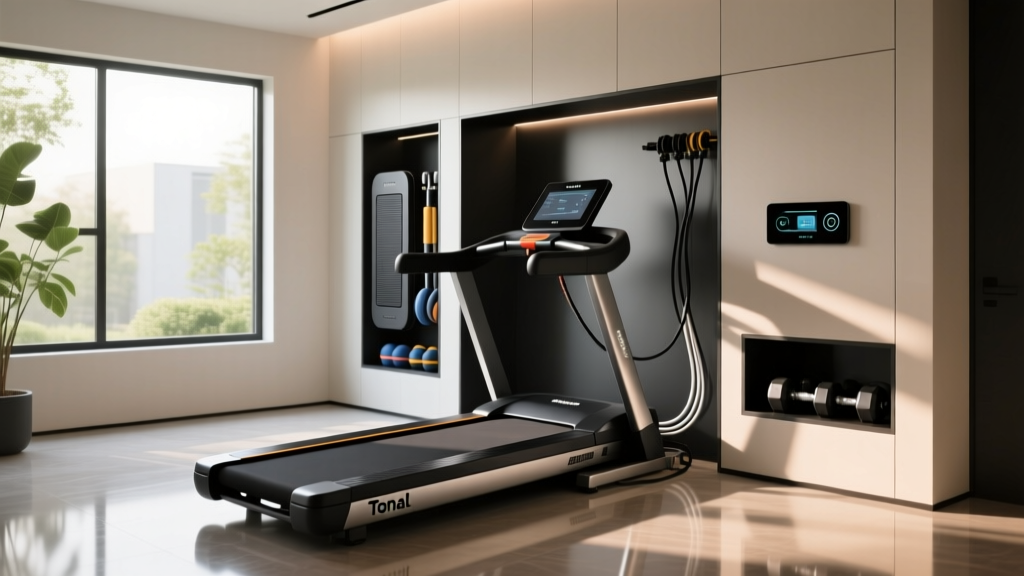
Tonal Treadmill Combo: Smart Resistance Space Layouts

How To Start Sports-Specific Training at Home: A Practical, Science-Backed Guide for Athletes and Fitness Enthusiasts
