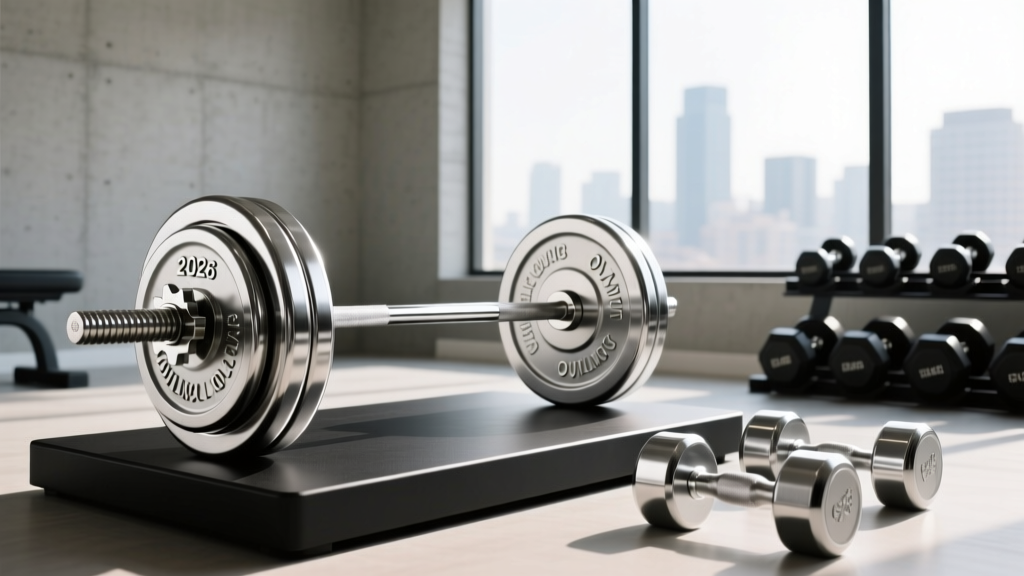
2026 Olympic Barbell Guide: Knurling & Dumbbell Guillotine Press
Master your 2026 Olympic barbell purchase. We compare weight tolerances, knurling profiles, and pressing mechanics from the dumbbell guillotine press.

The Biomechanical Bridge: Barbell Stability vs. The Dumbbell Guillotine Press
When advanced lifters seek to isolate the clavicular head of the pectoralis major, the dumbbell guillotine press remains a legendary, albeit brutal, tool. Popularized by Vince Gironda, this movement requires a narrow, neutral grip, severely flared elbows, and a straight-line pressing path that demands immense wrist stability and grip endurance. However, the limiting factor in the dumbbell guillotine press is rarely pure chest strength; it is almost always grip fatigue and wrist extension failure under heavy loads.
As we move through 2026, many strength athletes and bodybuilders are transitioning the biomechanical intent of the guillotine press to the barbell to bypass grip limitations and overload the upper chest safely. But making this transition requires a profound understanding of your primary tool: the Olympic barbell. The barbell's weight calibration, shaft diameter, and—most critically—its knurling profile will dictate whether your pressing mechanics translate into hypertrophy or result in catastrophic shoulder impingement due to micro-slippage.
This comprehensive buying guide dissects the exact weight tolerances and knurling matrices you need to evaluate when purchasing an Olympic barbell for heavy, precision-based pressing.
Weight Tolerances: The Hidden Metric of Olympic Barbells
Not all 20-kilogram bars are created equal. In commercial gyms, it is common to find 'Olympic' bars that deviate by 2% to 5% from their stated weight. On a 20kg bar, a 5% tolerance means the bar could weigh anywhere from 19kg to 21kg. While this seems negligible for casual lifting, when you are executing high-tension isolation movements like a barbell guillotine or tracking strict progressive overload over a 12-week mesocycle, a 400-gram discrepancy in the bar's actual weight ruins your data tracking and alters the bar's center of gravity.
Calibration Standards: IPF vs. Commercial Grade
As of 2026, the industry standard for premium home and commercial gym equipment aligns closely with competition tolerances. When evaluating a barbell, look for the following weight certifications:
- IPF/IWF Competition Standard: Calibrated to +/- 10 grams. These bars (like the Eleiko Competition Series) are meticulously machined and typically cost between $800 and $1,200.
- High-End Commercial Standard: Calibrated to +/- 1% (approx. +/- 200 grams). Bars in the $250 to $400 range, such as those from Rogue or Kabuki, fall here and are more than sufficient for 99% of lifters.
- Budget/Economy Standard: Uncalibrated or +/- 5%. Usually priced under $150. Avoid these for serious pressing, as the inconsistent weight distribution can cause bar whip and uneven loading during the lift-off.
Decoding the Knurling Matrix: Volcano, Mountain, and Hill
Knurling is the cross-hatched pattern cut into the steel shaft to increase friction. For pressing movements—where the bar rests in the open palm or the base of the fingers—knurling depth and geometry dictate your neural drive and grip security. According to comprehensive industry analyses like the BarBend Knurling Guide, there are three primary profiles machined via CNC lathes:
1. The Volcano Profile (The Pressing Gold Standard)
Volcano knurling is cut with a specialized tool that leaves a small 'crater' at the peak of each diamond. This creates a wide surface area of sharp edges that bite into the skin without puncturing it. Best for: Heavy bench pressing and barbell guillotine variations. It provides maximum grip security without tearing calluses during high-volume hypertrophy blocks. The Rogue Ohio Power Bar is the benchmark for this profile, featuring a 29mm shaft that perfectly fills the palm during narrow-grip pressing.
2. The Mountain Profile (Aggressive & Unforgiving)
Mountain knurling leaves sharp, pointed peaks. It feels like holding a cheese grater. While it offers unparalleled grip for heavy deadlifts, it is generally too aggressive for high-rep pressing or guillotine-style movements, where the bar must remain stable against the heel of the hand without causing micro-abrasions that lead to skin tearing by week three of your program.
3. The Hill Profile (Smooth & Passive)
Hill knurling flattens the peaks significantly, resulting in a smooth, almost polished feel. While comfortable for front squats and high-rep Olympic lifts, a hill profile is a massive liability for heavy pressing. If your hands sweat during a heavy dumbbell guillotine press or its barbell equivalent, a hill-knurled bar will micro-slip, forcing your rotator cuff to stabilize the lateral deviation.
⚠️ Expert Warning: The Black Oxide TrapMany budget bars in 2026 use black oxide finishes over shallow knurling to look premium. Black oxide offers zero corrosion resistance. Within six months of exposure to ambient humidity and sweat, the knurling will rust smooth, effectively turning your mountain profile into a slick, dangerous hill profile. Always invest in Hard Chrome, Stainless Steel, or Cerakote shafts to preserve knurling depth.
2026 Olympic Barbell Comparison Matrix
Below is a data-driven comparison of the top Olympic barbells on the market, specifically evaluated for their suitability for heavy pressing and precision isolation work.
| Brand & Model | Knurl Profile | Tensile Strength | Shaft Diameter | Est. Price (2026) |
|---|---|---|---|---|
| Rogue Ohio Power Bar (Stainless) | Volcano (Deep) | 205,000 PSI | 29.0mm | $395.00 |
| Kabuki New Generation Power Bar | Mountain (Aggressive) | 250,000 PSI | 29.0mm | $385.00 |
| Eleiko IPF Competition Bar | Volcano (Refined) | 215,000 PSI | 29.0mm | $1,150.00 |
| Bells of Steel Bare Steel Power Bar | Mountain (Moderate) | 190,000 PSI | 29.0mm | $189.99 |
Tensile Strength and Shaft Diameter: The Pressing Prerequisites
When transitioning from the dumbbell guillotine press to barbell equivalents, the shaft diameter is just as critical as the knurling. The dumbbell variation forces the wrist into slight extension, relying on the lifter's forearm flexors to maintain a neutral joint angle. A standard 28mm Olympic weightlifting bar is designed to flex and whip, which is detrimental to heavy pressing.
For pressing, you must select a bar with a 29mm shaft diameter. This extra millimeter fills the palm, reducing the lever arm on the wrist joint and providing a more stable base for force transfer. Furthermore, look for a tensile strength of at least 190,000 PSI, though 205,000 PSI is the 2026 sweet spot. Bars below 190k PSI are prone to permanent plastic deformation (bending) if you drop a heavy bench press onto the J-cups or fail a rep and dump the bar.
Bushing vs. Bearing: Why Spin Matters
Do not buy a barbell with needle bearings for pressing. Needle bearings are designed for the high-velocity rotational spin required in Olympic weightlifting (snatches and cleans). For slow, controlled, high-tension movements like the bench press or guillotine press, bronze or composite bushings are vastly superior. Bushings provide a stiffer, more predictable rotation that won't 'spin out' in your hands when you are fighting to stabilize a heavy load at the bottom of the pressing motion.
Real-World Failure Modes: What Cheap Knurling Costs You
In our testing of budget-tier barbells over the past three years, the most common failure mode for pressing isn't the bar snapping—it's the degradation of the center knurl and the primary grip zones. Cheap bars use shallow, machine-pressed knurling rather than deep CNC cutting. Under the pressure of a 225lb+ press, the skin compresses into the shallow grooves, resulting in a 'hydroplaning' effect where sweat acts as a lubricant.
This micro-slippage forces the lifter to over-grip, which immediately spikes forearm fatigue and alters the bar path. If you are programming guillotine-style presses to target the upper chest, a slipping bar forces you to tuck your elbows to regain control, instantly shifting the biomechanical load away from the clavicular pecs and onto the anterior deltoids. You are no longer training the muscle you intended to train; you are merely surviving the equipment.
Final Verdict: Matching Your Bar to Your Training Style
If your training revolves around powerlifting and heavy pressing variations derived from bodybuilding staples like the dumbbell guillotine press, the Rogue Ohio Power Bar in Stainless Steel remains the undisputed champion for 2026. Its volcano knurling provides the exact friction required to lock the bar into the heel of the hand without tearing tissue, while the 205,000 PSI steel and bronze bushings ensure absolute stability under maximal loads.
Investing in a properly calibrated, deeply knurled 29mm barbell is not just about safety; it is about ensuring that the neurological output of your muscles is translated directly into the bar, without being lost to equipment slippage or wrist instability. Treat your barbell as a precision instrument, and your pressing mechanics will follow suit.
More gear to consider
All reviews
Lower Chest Dumbbell Workout Mistakes Using Neoprene Weights

Loadable Dumbbells vs Bowflex Dumbbells Set: Maintenance Guide

Power Rack vs Squat Stand: Troubleshooting Flat Dumbbells & Space

Rubber Hex vs Urethane: Best Dumbbells for Pulling Exercises

Compact Gyms: Bumper vs Iron Plates & Best Dumbbell Lat Exercises
