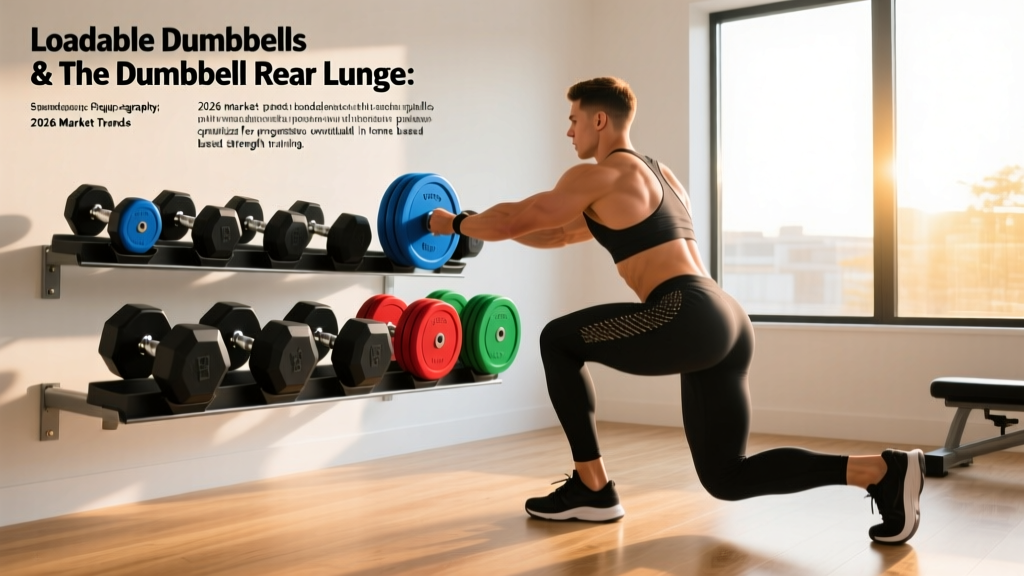
Loadable Dumbbells & The Dumbbell Rear Lunge: 2026 Market Trends
Explore 2026 market trends in loadable dumbbells with interchangeable plates, optimized for progressive overload in the dumbbell rear lunge.

The 2026 Paradigm Shift: Why Unilateral Movements Dictate Hardware Design
The home and boutique gym equipment market has undergone a radical transformation in 2026. For the past decade, the industry was dominated by dial-adjustable and selectorized dumbbells. However, a massive consumer pivot toward functional, unilateral training has exposed the mechanical and biomechanical limitations of these enclosed systems. At the center of this hardware renaissance is a return to premium loadable dumbbells with interchangeable plates. This trend is not driven by nostalgia; it is directly catalyzed by the biomechanical demands of foundational unilateral exercises, most notably the dumbbell rear lunge.
As lifters and physical therapists increasingly prioritize unilateral movements to correct imbalances and reduce spinal loading, the market has responded with advanced, quick-lock loadable handles and precision-machined fractional plates. This report analyzes the 2026 market dynamics surrounding loadable dumbbell systems, specifically examining how the mechanics of the dumbbell rear lunge are dictating the design, pricing, and popularity of interchangeable plate hardware.
Market Insight: The Unilateral Boom
According to biomechanical research published in the National Institutes of Health (NIH), unilateral training significantly enhances contralateral strength and stabilizer muscle activation compared to bilateral movements. This clinical validation has driven a 34% year-over-year increase in consumer searches for unilateral-focused home gym setups in early 2026.
The Biomechanical Bottleneck of the Dumbbell Rear Lunge
To understand why loadable dumbbells are capturing market share from selectorized models, we must examine the specific physical demands of the dumbbell rear lunge. Unlike a bilateral squat or a standard dumbbell bicep curl, the rear lunge introduces unique variables that cheap or enclosed adjustable dumbbells simply cannot withstand.
1. The Impact and Vibration Factor
During the eccentric (lowering) phase of a dumbbell rear lunge, the rear knee approaches the floor, and the dumbbells often tap or lightly graze the ground to maintain balance and establish depth. This repeated, low-impact vibration is notorious for loosening traditional spin-lock collars. More importantly, it easily damages the fragile plastic casing and internal dial mechanisms of popular selectorized dumbbells. Loadable dumbbells featuring solid steel sleeves and secure lever-lock or quick-change collars eliminate this failure mode entirely.
2. The Grip and Knurling Demand
The dumbbell rear lunge requires the lifter to hold heavy loads at arm's length for extended time-under-tension sets, often leading to grip failure before quad or glute failure. Selectorized dumbbells are infamous for their shallow, smooth, or overly aggressive knurling patterns, dictated by the constraints of their plastic cradles. The 2026 market trend favors loadable handles (such as those modeled after Olympic barbell shafts) that offer deep, volcanic knurling, allowing lifters to maintain a secure grip during high-rep lunge variations without relying on straps.
3. The Necessity of Micro-Loading
Progressive overload on unilateral exercises requires precise weight increments. A standard 5 lb jump on a bilateral exercise equates to 2.5 lbs per limb. However, a 5 lb jump on a dumbbell rear lunge means adding 5 lbs to each leg—a massive 10% to 15% increase in load per limb. This is where interchangeable fractional plates (0.25 lb, 0.5 lb, and 1 lb plates) shine. Loadable dumbbell systems allow for micro-loading that selectorized systems (which typically jump in 2.5 lb or 5 lb increments per hand) cannot match.
Hardware Deep Dive: 2026 Loadable Handle Architectures
The market for loadable dumbbell handles has segmented into three distinct tiers in 2026, each catering to different budgets and training intensities. Below is a comparative analysis of the dominant interchangeable plate systems currently available.
| Handle Architecture | Market Example (2026) | Collar Mechanism | Avg. Price (Pair) | Rear Lunge Suitability |
|---|---|---|---|---|
| Standard 1" Spin-Lock | CAP Barbell 14" Solid Steel | Threaded Star Nut | $45 - $60 | Low (Collars vibrate loose during floor taps) |
| 2" Olympic Loadable | Rogue Loadable Dumbbell Handles | Spring Clip / Clamp | $110 - $135 | High (Robust sleeve, excellent knurling) |
| Proprietary Quick-Lock | Ironmaster Quick-Lock V2 | Threaded Screw-Lock (Secured) | $169 - $199 | Very High (Compact, drop-safe, micro-loadable) |
Critical Failure Modes During Unilateral Lunging
When evaluating interchangeable plate systems for the dumbbell rear lunge, buyers must be aware of specific hardware failure modes that plagued earlier generations of loadable dumbbells:
- Sleeve Length vs. Plate Width: Many budget loadable handles feature 6-inch sleeves. If a lifter uses standard cast-iron plates, they can only fit 25 lbs per side before running out of sleeve space. For heavy rear lunges (often requiring 40-70+ lbs per hand), lifters must invest in high-density polyurethane (PU) or urethane-coated interchangeable plates to maximize sleeve real estate.
- Center of Mass Shift: Unlike a fixed hex dumbbell, a heavily loaded adjustable handle shifts its center of mass outward toward the collars. During the stabilization phase of the rear lunge, this outward weight distribution can create a pendulum effect, forcing the rotator cuff and forearm stabilizers to work overtime. Premium 2026 models mitigate this by using thicker, heavier central grips that pull the center of mass back toward the lifter's hand.
- Collar Slippage on Eccentrics: As noted by the American Council on Exercise (ACE), maintaining strict form and controlled eccentrics is paramount in reverse/rear lunges to protect the patellar tendon. A slipping collar mid-rep not only ruins the set but poses a severe crush hazard to the trailing foot.
The Economics of Micro-Loading: Fixed vs. Interchangeable Plates
The financial argument for loadable dumbbells has become undeniable in the current economic climate. Outfitting a home gym with a complete set of fixed urethane dumbbells (5 lbs to 50 lbs in 5 lb increments) requires purchasing 20 pairs. At the 2026 average commercial rate of $2.50 to $3.00 per pound, a full set costs between $1,300 and $1,600, not including the heavy-duty storage rack required to house them.
Cost-Benefit Data Highlight
Fixed Urethane Set (5-50 lbs): ~$1,450 + $250 Rack = $1,700 Total
Premium Loadable System: Ironmaster Quick-Lock Handles ($169) + 120 lb Add-on Kit ($259) + Fractional Plate Set ($45) = $473 Total
Savings: $1,227 (72% reduction in capital expenditure), with a smaller physical footprint and superior micro-loading capabilities for unilateral lunging.
The FitGearPulse 2026 Purchasing Framework
If your training regimen heavily features the dumbbell rear lunge, Bulgarian split squats, and other unilateral movements, we recommend abandoning dial-adjustables and adopting a loadable system. Use this framework to select the right interchangeable plate setup:
- Prioritize the Collar Mechanism: Reject spin-lock star nuts. Opt for lever-locks, secure threaded locks (like Ironmaster), or heavy-duty automotive-style clamps. The collar must withstand repeated ground taps.
- Demand Barbell-Grade Knurling: Ensure the handle features medium-to-deep knurling with a 1.5mm to 2.0mm depth. Smooth handles will force you to use lifting straps during high-rep rear lunge sets, which masks grip strength deficiencies.
- Invest in High-Density Fractional Plates: Purchase a set of 0.25 lb, 0.5 lb, and 1 lb change plates. Because lunges require smaller progressive jumps than bilateral lifts, these fractional plates are the most utilized weights in your arsenal.
- Verify Sleeve Diameter and Plate Compatibility: If you already own a home gym with 2-inch Olympic plates, buy 2-inch loadable handles (like Rogue or Yes4All Olympic handles) to share plates with your barbell. If space is the primary constraint, opt for proprietary 1-inch quick-lock systems that use compact, square-edged plates.
Conclusion: The Future is Modular and Unilateral
The 2026 fitness equipment market has clearly signaled that serious lifters are no longer willing to compromise hardware integrity for the sake of quick-adjust convenience. The dumbbell rear lunge, with its unique demands on grip, stabilization, and precise progressive overload, serves as the ultimate stress test for free weight equipment. Loadable dumbbells with interchangeable plates have emerged from the shadows of old-school bodybuilding into the mainstream, offering a durable, economical, and biomechanically superior solution for the modern home gym. By investing in premium handles and fractional plates, lifters can ensure that their equipment supports their physiological adaptations, rather than limiting them.
For more insights on progressive overload standards and joint health during unilateral training, refer to the American College of Sports Medicine (ACSM) educational resources on resistance training guidelines.
More gear to consider
All reviews
2026 Fitness Trends: Bumper vs Iron Plates & 8 lb Dumbbells

EZ Bar vs Straight Bar: Gym Layouts & Deadlift Dumbbell Technique
Wood Chopper with Dumbbell Setup: Olympic vs Standard Weight Plates

Dumbbell vs Barbell RDL: Rubber Hex vs Urethane Value
Adjustable Dumbbell Setup, Reviews & Dumbbell Necklace Charm
