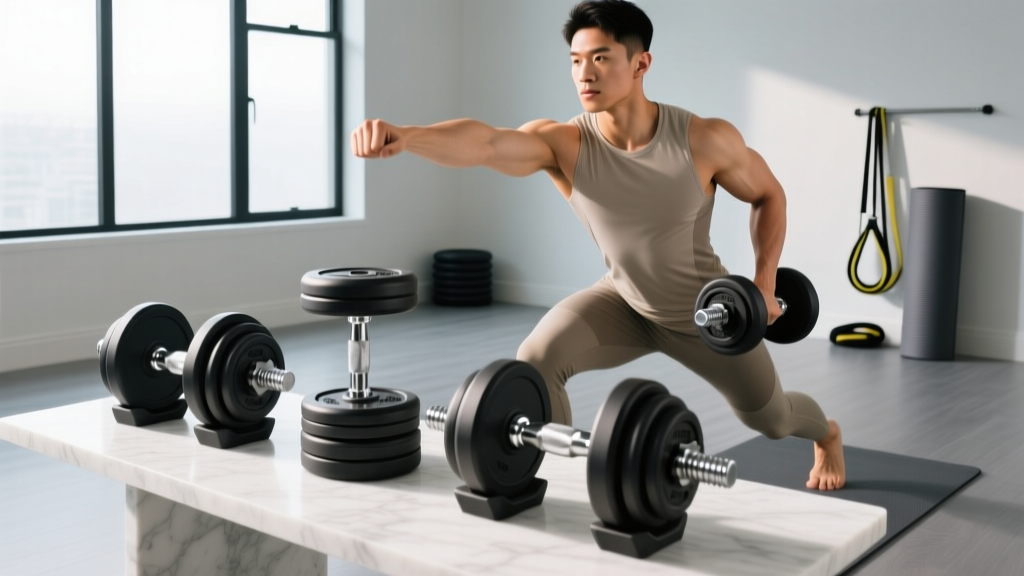
Budgeting Loadable Dumbbells for the Alternating Dumbbell Front Raise
Analyze the true cost and biomechanical value of using loadable dumbbells for the alternating dumbbell front raise. Compare 1-inch vs Olympic setups.

The Biomechanics of the Alternating Dumbbell Front Raise and Gear Selection
The alternating dumbbell front raise is a staple isolation movement targeting the anterior deltoid. Because the shoulder joint is highly mobile and the anterior deltoid is a relatively small muscle group, this exercise demands strict load management. According to biomechanical analyses from ExRx.net, the torque curve of a front raise peaks when the arm is parallel to the floor, placing immense stress on the shoulder capsule. Consequently, most lifters max out between 15 and 35 pounds per hand for strict, controlled repetitions.
When outfitting a home gym on a budget, many lifters default to loadable dumbbells with interchangeable plates rather than purchasing a full rack of fixed hex dumbbells. However, not all loadable dumbbells are created equal—especially for isolation work. The handle diameter, sleeve length, and bare handle weight drastically alter the biomechanics and financial viability of using loadable setups for the alternating dumbbell front raise.
The "Empty Handle" Trap: Olympic vs. Standard 1-Inch Loadables
The most critical failure mode for home gym owners attempting isolation exercises with loadable dumbbells is the "empty handle" weight. Olympic loadable dumbbells, such as the Rogue Loadable Dumbbell, are engineered for heavy compound movements. A single bare Olympic handle weighs between 12.5 and 15 pounds. When you add a pair of 2.5-pound spring collars and the smallest standard 10-pound bumper plate, your starting weight is nearly 25 pounds per hand. For many beginners and intermediates, 25 pounds is already too heavy for a strict alternating front raise, rendering the equipment useless for this specific movement.
Expert Insight: For anterior deltoid isolation, the 50mm handle diameter of an Olympic dumbbell also forces excessive grip fatigue. The lever arm created by a thick handle shifts the center of mass slightly forward, increasing wrist extension torque and compromising the strict form required for the front raise.
Conversely, standard 1-inch loadable dumbbell handles (often made of cast iron or chrome-plated steel) weigh between 4.5 and 6 pounds bare. This allows you to load 2.5-pound plates on each side, creating a highly manageable 10-pound starting weight. Furthermore, the 35mm handle diameter mimics standard fixed dumbbells, ensuring optimal grip mechanics as endorsed by the American Council on Exercise (ACE).
2026 Budget Breakdown: Fixed Hex Sets vs. Loadable Kits
To understand the true value proposition, we must compare the cost of purchasing fixed rubber hex dumbbells against building a standard 1-inch loadable kit specifically calibrated for the 10 lb to 35 lb range required for front raises.
| Equipment Type | Components Required | Estimated 2026 Cost | Weight Increments | Convenience Factor |
|---|---|---|---|---|
| Fixed Hex Dumbbells | 6 Pairs (10, 15, 20, 25, 30, 35 lbs) | $280 - $350 | 5 lb jumps | High (Grab and go) |
| Olympic Loadable Kit | 2 Handles + 2x10lb, 2x5lb, 2x2.5lb Plates | $310 - $400 | Starts at 25 lbs (Too heavy) | Low (Requires wrench/collars) |
| Standard 1" Loadable Kit | 2 Handles + 1" Plate Set (100 lbs total) | $110 - $145 | 2.5 lb jumps (or less) | Medium (Spin-lock collars) |
As the data illustrates, the standard 1-inch loadable dumbbell setup offers a massive 60% cost savings over fixed hex sets while providing superior micro-loading capabilities. The Olympic setup is entirely disqualified for this specific exercise due to the high starting weight and prohibitive cost of fractional Olympic plates.
Micro-Progression: The Hidden Necessity of Fractional Plates
The alternating dumbbell front raise is notorious for progression stalls. Moving from a 15-pound dumbbell to a 20-pound dumbbell represents a 33% increase in load. For a small muscle group like the anterior deltoid, this violates the principle of progressive overload and often leads to compensatory momentum (swinging) rather than muscle hypertrophy.
The Fractional Plate Solution
To maintain strict form, you must utilize 1.25-pound and 0.5-pound fractional plates. A pair of 1.25 lb standard plates allows for 2.5 lb total increments per dumbbell. In 2026, a high-quality cast iron 1.25 lb standard plate pair costs roughly $12 to $15. Investing $30 in fractional plates extends the lifespan of your loadable dumbbell kit by months, if not years, ensuring continuous adaptation without sacrificing joint health.
Collar Security and the Moment of Inertia
When performing an alternating movement, the dumbbell undergoes rapid acceleration and deceleration. If your collar system fails, the plates shift outward on the sleeve. This shifts the dumbbell's center of mass away from your hand, drastically increasing the moment of inertia and placing dangerous shear forces on the wrist and rotator cuff.
- Standard Spin-Lock Collars: Cheap and included with most 1-inch handles. Prone to loosening during alternating reps. Requires manual tightening mid-set.
- 1-Inch Spring Collars: Faster to swap, but lack the clamping force to hold cast iron plates securely during dynamic isolation work.
- Upgraded Clamp Collars (e.g., Proloc or standard aluminum clamps): The mandatory upgrade. Costing about $15-$20 for a 1-inch pair, they provide zero-slip security, ensuring the weight distribution remains perfectly balanced throughout the front raise.
Step-by-Step: Building Your 2026 Isolation Kit on a Budget
If you are allocating funds specifically for upper-body isolation and hypertrophy, follow this exact purchasing framework to maximize value and biomechanical safety.
- Purchase Standard 1-Inch Handles ($25 - $35): Source a pair of 14-inch or 16-inch chrome-plated standard handles. Avoid 12-inch handles, as they lack the sleeve length to accommodate multiple plates and clamps.
- Acquire Base Cast Iron Plates ($45 - $60): Buy four 5-pound plates and four 2.5-pound plates. This allows you to build dumbbells ranging from 15 lbs to 25 lbs. Sourcing used cast iron locally via marketplace apps can reduce this cost by up to 50%.
- Invest in Fractional Plates ($25 - $35): Purchase two pairs of 1.25 lb plates and one pair of 0.5 lb micro-plates. This is non-negotiable for the alternating front raise.
- Upgrade Your Collars ($18): Discard the included star-lock spin nuts. Purchase a pair of high-quality 1-inch aluminum clamp collars to guarantee sleeve security during alternating reps.
Total Investment: $113 - $148. This provides a fully micro-loadable, biomechanically sound dumbbell system that perfectly services the alternating dumbbell front raise, lateral raises, and tricep extensions, saving you over $150 compared to buying fixed pairs.
Expert Verdict
Loadable dumbbells with interchangeable plates are an exceptional budget-friendly solution for home gyms, provided you select the correct sleeve diameter. For heavy compound lifts, Olympic loadables are king. However, for the strict, torque-sensitive demands of the alternating dumbbell front raise, the standard 1-inch loadable dumbbell is the undisputed champion of value. By prioritizing a lightweight bare handle, a 35mm grip diameter, and investing heavily in fractional plates and secure clamp collars, you can achieve commercial-gym isolation quality for a fraction of the cost in 2026.
More gear to consider
All reviews
Cast Iron vs Competition Kettlebells & Neck Hump Dumbbell Exercises

Bumper vs Iron Plate Care: Beyond Dumbbell Max Bench Calculators
How to Grip Dumbbells vs Barbells: Olympic Barbell Knurling Guide

Power Rack vs Squat Rack vs Stand: Dumbbell Exercises Without Bench

Bumper Plate vs Iron Plate: EZ Bar Curl vs Dumbbell Curl Setups
