Rack Layouts for the Standing Overhead Press with Dumbbells
Optimize your gym layout for the standing overhead press with dumbbells. Explore rack heights, clearance zones, and heavy-duty storage solutions.

When designing a home or commercial gym, equipment storage is frequently treated as an afterthought. However, if your programming heavily features the standing overhead press with dumbbells, your dumbbell rack and storage solutions dictate not just organization, but safety, biomechanical efficiency, and spatial flow. The kinetic chain of a strict overhead press requires specific lateral clearances, while the initial 'clean' phase to get heavy dumbbells into position demands precise rack height ergonomics. In this guide, we break down the exact spatial requirements, layout configurations, and heavy-duty storage models needed to optimize your facility for overhead pressing.
The Biomechanical Clearance Problem
The standing overhead press with dumbbells is a highly dynamic movement. Unlike a barbell press, which locks the hands into a fixed plane, dumbbells require a natural lateral arc to avoid shoulder impingement at the top of the movement. According to kinesiological data from ExRx.net, the anterior deltoid and triceps brachii are maximally engaged when the dumbbells are allowed to track slightly outward and backward during the ascent.
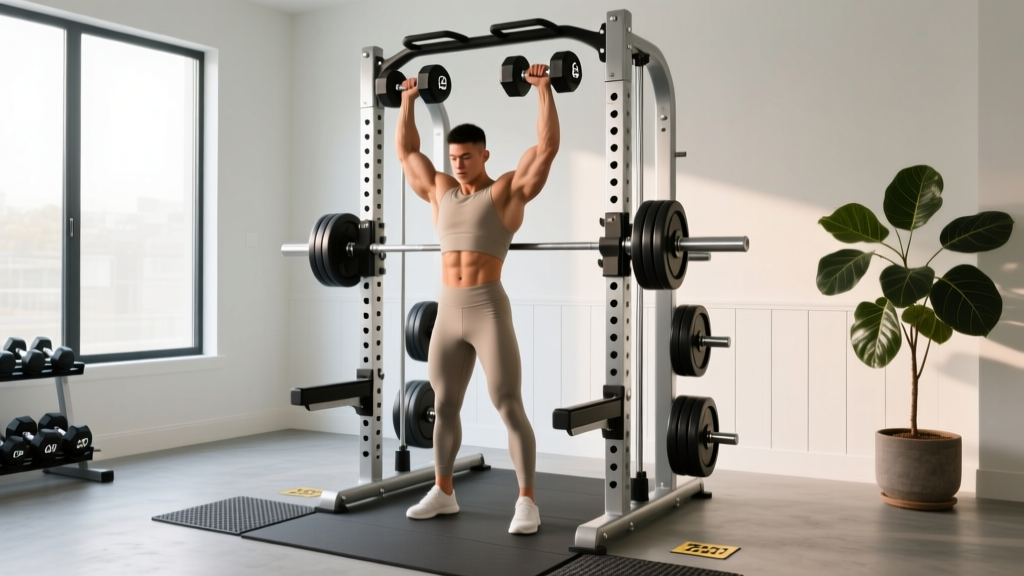
This arc creates a massive spatial footprint. For a 6-foot-tall lifter holding 80-pound hex dumbbells, the wingspan at the bottom of the pressing arc can easily exceed 65 inches. When you factor in the 15-inch length of the dumbbells themselves, plus a mandatory 12-inch safety buffer on either side to prevent wall-strikes or mirror-shatters, you need a minimum lateral clearance zone of 104 inches (8.6 feet) dedicated purely to the pressing movement. Placing a dumbbell rack directly behind or immediately adjacent to this zone is a critical layout failure that restricts the lifter's range of motion and creates a severe collision hazard.
Rack Height and the 'Clean' Phase Ergonomics
The most overlooked aspect of dumbbell storage for overhead pressing is the pick-up height. To initiate a standing overhead press with dumbbells, the lifter must first clean the weights from the rack to the shoulders. Standard commercial 3-tier dumbbell racks typically position the top tier at roughly 32 to 34 inches off the ground.
While this height is excellent for storing lighter weights, it becomes a liability when lifting heavy. Attempting to curl or clean a 90-pound dumbbell from a 34-inch shelf forces the lifter into an awkward, compromised leverage position, placing immense shear stress on the distal biceps tendon and the rotator cuff. The Cleveland Clinic notes that repetitive overhead reaching and heavy lifting from awkward angles are primary contributors to shoulder impingement syndrome and rotator cuff tendinopathy.
Ergonomic Warning: The Top-Tier Trap
If your primary use for heavy dumbbells (60 lbs and above) is the standing overhead press, avoid storing them on the top tier of a standard 3-tier rack. Opt for a 2-tier rack where the top shelf sits at 22 to 24 inches, allowing you to hinge at the hips, grip the dumbbells, and use a explosive hip extension to clean them to your shoulders safely.
Storage Configuration Matrix for OHP Layouts
Choosing the right rack profile depends on your available square footage and the maximum weight you intend to press. Below is a comparison of standard storage configurations evaluated specifically for overhead press workflows.
| Rack Style | Footprint (L x W) | Max Capacity | OHP Ergonomic Score | Best Application |
|---|---|---|---|---|
| 3-Tier Horizontal | 52" x 24" | 1,200+ lbs | Moderate | General storage; light-to-medium OHP |
| 2-Tier Horizontal | 52" x 22" | 900 lbs | High | Heavy OHP focus; optimal clean height |
| A-Frame Vertical | 30" x 30" | 600 lbs | Low | Tight spaces; avoid for heavy OHP cleans |
| Wall-Mounted Saddle | 48" x 6" | 800 lbs | High | Garage gyms; customizable pick-up height |
Designing the OHP 'Drop Zone'
When executing a standing overhead press with dumbbells to muscular failure, the lifter must safely return the weights to the ground. Dropping a 90-pound dumbbell from a height of 7 feet generates over 1,400 Newtons of impact force. Your layout must include a dedicated 'Drop Zone' that protects both the flooring and the nearby storage racks.
Step-by-Step Drop Zone Configuration
- Define the Perimeter: Mark a 6-foot by 4-foot rectangle directly in front of the pressing station using gym floor tape or contrasting rubber tiles.
- Install Shock-Absorbing Flooring: Standard 3/8" EVA foam tiles will compress and tear under heavy dumbbell drops. Upgrade to 3/4" (19mm) vulcanized rubber horse stall mats or specialized drop pads rated for 100+ lb impacts.
- Rack Setback Distance: Position your dumbbell rack at least 36 inches away from the edge of the Drop Zone. A bouncing heavy dumbbell can easily travel 24 inches horizontally after hitting the floor; the 36-inch buffer prevents the dumbbell from striking and destabilizing the rack.
Heavy-Duty Rack Recommendations for 2026
Not all storage solutions are built to withstand the vibrations and accidental impacts inherent to heavy overhead pressing. Here are the top-tier racks that provide the stability required for intense OHP layouts.
1. Rogue RM-6 Monster Dumbbell Rack
The Rogue Fitness RM-6 remains the gold standard for commercial and high-end garage gyms. Built from 11-gauge steel, it features a massive 50-inch footprint and laser-cut UHMW plastic saddles that protect dumbbell knurling. For OHP practitioners, its lower tier sits at an ergonomic 16 inches, making it an excellent staging area for heavy cleans before the press. Priced around $895, it is an investment in absolute structural rigidity.
2. Rep Fitness 2-Tier Dumbbell Rack
For lifters who specifically want to avoid the 'top-tier trap' mentioned earlier, the Rep Fitness 2-Tier rack is an ideal solution. By eliminating the third tier, the top shelf sits at a highly favorable 24 inches. This allows lifters to safely hinge and clean dumbbells up to 100 lbs for their standing overhead press with dumbbells without compromising their lower back or biceps. It retails for approximately $249, offering incredible value for heavy-pressing home gyms.
3. Titan Fitness Wall-Mounted Dumbbell Storage
If floor space is at an absolute premium, wall-mounted saddles are the ultimate space optimization tool. By bolting heavy-duty steel cradles directly into wall studs or concrete, you can customize the exact height of your dumbbell storage. Mounting the heavy dumbbell cradles at 22 inches off the ground creates a bespoke, ergonomic pick-up station specifically tailored to your OHP workflow, entirely eliminating the footprint of a freestanding rack.
Anchoring Protocols and Failure Modes
A critical failure mode in poorly designed gym layouts is the tipping of freestanding dumbbell racks. If a lifter misses a rep during a standing overhead press with dumbbells and drops a weight that clips the leg of an unanchored A-frame or lightweight 3-tier rack, the center of gravity shifts violently. The rack can tip forward, turning hundreds of pounds of stored iron into a dangerous projectile.
The Solution: Every freestanding dumbbell rack placed within 5 feet of a pressing zone must be anchored. Use 3/8" wedge anchors for concrete floors, or 1/2" lag screws driven into floor joists for wooden subfloors. If anchoring is impossible (e.g., rented commercial space with finished flooring), you must utilize a rack with an extended rear stabilizer bar and load the bottom tier with the heaviest dumbbells to lower the unit's center of gravity.
Frequently Asked Questions
Can I use a kettlebell rack for dumbbell storage?
While kettlebell racks feature wide, flat shelves that can technically hold hex dumbbells, they are generally not recommended for heavy OHP setups. Kettlebell racks lack the contoured UHMW saddles found on dedicated dumbbell racks, meaning the dumbbell handles will rest directly on bare steel or wood, potentially damaging the knurling and making grip securement difficult during the clean phase.
How much weight should I allocate per tier on a 3-tier rack?
For optimal stability and safety, always store the heaviest dumbbells (50 lbs and above) on the bottom tier, medium weights (25-45 lbs) on the middle tier, and lighter accessories or warm-up weights (5-20 lbs) on the top tier. This distribution lowers the rack's center of gravity, crucial for preventing tip-overs when weights are aggressively removed for overhead pressing.
Is a staggered stance better for heavy dumbbell overhead presses?
Yes. When pressing heavy dumbbells overhead, adopting a staggered stance (one foot slightly forward) significantly increases your anteroposterior stability. This requires a slightly longer, rather than wider, clearance zone in your layout design—ensure you have at least 48 inches of depth behind your starting position to accommodate your trailing foot.
More gear to consider
All reviews
Gym Setup: Olympic Barbell Knurling & Leg Exercises with Dumbbells

Best Adjustable Dumbbells for 30 Day Dumbbell Workout Before and After
Dumbbell Rack Storage: Organophosphate Solvents to Avoid
Neoprene Dumbbells Compared: Best for Your Dumbbell Pullover Workout

What Do Dumbbell Deadlifts Work? Cast Iron vs Competition Kettlebell Value Guide