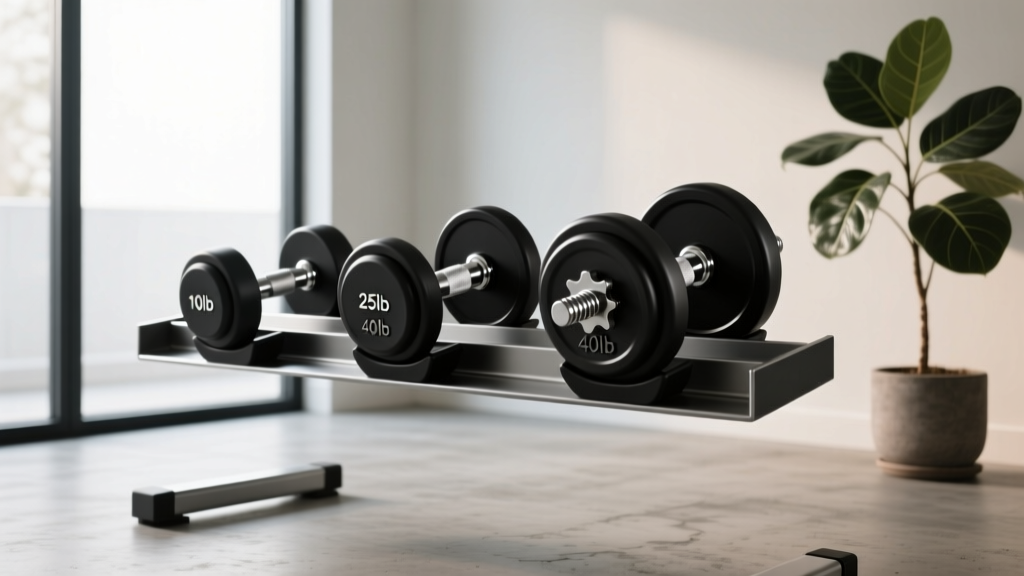
EZ Curl vs Straight Bar: Space Layouts & Dumbbell Rear Flyes
Compare EZ curl vs straight bar footprints for small home gyms. Learn layout optimization for barbell storage and dumbbell rear flyes clearance.

The Footprint Dilemma: 86 Inches vs. 47 Inches
When designing a compact home gym, every square inch of floor and wall space is a premium commodity. The debate between purchasing a standard Olympic straight bar versus a specialized EZ curl bar often centers on biomechanics and wrist comfort. However, from a space optimization and layout design perspective, the physical dimensions of these bars dictate your entire room's flow. A standard 7-foot Olympic barbell demands significant horizontal clearance, while an EZ curl bar offers a condensed profile that can fundamentally change how you zone your workout area.
To understand the spatial impact, we must look at the exact measurements of industry-standard equipment. For example, the Rogue Curl Bar measures 47 inches in total length and weighs 35 pounds. In contrast, a standard straight bar like the Rogue Ohio Bar spans 86 inches and weighs 45 pounds. That 39-inch difference is not just a number; it is the difference between safely executing lateral isolation movements and repeatedly smashing your weight plates into drywall.
Dimensional & Clearance Comparison Matrix
| Equipment | Total Length | Horizontal Wall Mount | Vertical Storage Footprint | Lateral Swing Clearance |
|---|---|---|---|---|
| Standard 7ft Olympic Bar | 86 inches | Requires 90" wall space | 12" x 12" floor base | 8+ feet wide |
| Olympic EZ Curl Bar | 47 inches | Requires 50" wall space | Not recommended (angled shaft) | 5 feet wide |
| Standard Dumbbells (Pair) | 12-16 inches (varies) | Rack dependent (approx 24" wide) | Requires multi-tier rack | User wingspan + 24" |
Layout Zoning: Accommodating Dumbbell Rear Flyes
The true test of a home gym layout is not how it looks when empty, but how it functions during complex, multi-plane movements. This is where the integration of barbell storage and free-weight isolation zones becomes critical. Consider the spatial requirements for dumbbell rear flyes. Whether performed standing in a bent-over hinge or seated chest-supported on an adjustable FID (Flat/Incline/Decline) bench, this movement requires a massive lateral wingspan.
According to ExRx posterior deltoid biomechanics, maximizing the range of motion for the rear delts requires the arms to extend fully laterally at the top of the movement. For an average adult male with a 72-inch wingspan, holding 15lb hex dumbbells adds another 12 inches to that lateral profile. You need a minimum clearance lane of 8 feet wide to perform standing dumbbell rear flyes safely without striking nearby equipment.
The 15-Square-Foot Isolation Rule
When mapping your gym floor, designate a 15-square-foot 'Isolation Zone' specifically for lateral dumbbell work like rear flyes and lateral raises. If you mount a 7-foot straight bar horizontally on the wall bordering this zone, the sleeves will protrude into your swing path. By swapping to a wall-mounted EZ curl bar on that specific wall, you reclaim 3 feet of lateral clearance, allowing you to push your adjustable bench closer to the wall and open up the center of the room for heavy compound lifts.
Biomechanics in Tight Spaces: Can the EZ Bar Replace Dumbbells?
A common space-saving question is whether an EZ curl bar can replace dumbbells for rear deltoid work, thereby eliminating the need for a bulky dumbbell rack. The short answer is no, but the long answer involves understanding movement vectors in confined spaces.
You can perform wide-grip bent-over reverse flyes with an EZ curl bar. The angled grips actually place the wrists in a slightly more natural semi-pronated position compared to a straight bar, reducing medial epicondyle strain. However, the fixed hand placement of an EZ bar (usually around 28-30 inches apart) restricts the peak contraction phase of the rear delt. Dumbbells allow you to bring the weights together or slightly cross them at the top of the movement, a vector that is impossible with a solid steel bar.
Furthermore, as noted in the comprehensive Garage Gym Reviews EZ curl bar guide, the sleeve length on most EZ bars is limited to 10-12 inches. This restricts the number of plates you can load, making progressive overload for larger muscle groups difficult, even if you are trying to use it for high-rep bent-over rows to supplement your rear delt work.
Edge Cases and Failure Modes in Micro-Gyms
- Wall Scuffing: When storing a straight bar horizontally on standard J-hooks or wall cradles, the knurling or the greased sleeves can easily scuff drywall if the bar is not perfectly level during un-racking.
- Vertical Storage Hazards: While a 7ft straight bar can be stored vertically in a 12x12 inch base, lowering a 45lb barbell vertically in a room with an 8-foot ceiling requires you to tilt it, risking damage to ceiling drywall or overhead lighting fixtures.
- Bench Placement Conflicts: An FID bench on a 30-degree incline for chest-supported dumbbell rear flyes extends nearly 5 feet in length. If your straight bar is on a floor-based squat stand, the bench footprint will overlap with the barbell's 86-inch span.
Strategic Storage Solutions for Under 150 Sq Ft
If you are building out a garage gym, spare bedroom, or apartment corner that is under 150 square feet, you must choose your barbell inventory based on spatial ROI (Return on Investment). Here is a step-by-step framework for optimizing your bar storage to maximize your isolation movement zones.
- Map the Swing Zones First: Before drilling any holes, stand in the center of the room with your arms extended holding imaginary dumbbells. Simulate dumbbell rear flyes. Mark the furthest point your knuckles reach with painter's tape. This is your hard boundary.
- Mount the EZ Bar Horizontally: Install a 2-hook horizontal wall mount for the EZ curl bar inside secondary zones (e.g., near the door or in a corner). Its 47-inch length allows it to fit between standard wall studs (16 inches on center) without requiring heavy-duty toggle bolts across a massive span.
- Store the Straight Bar Vertically: Invest in a vertical barbell holder (such as the Rogue Vertical Barbell Storage unit, approx $85). Place this in a dead corner where lateral swing space is already compromised by walls or doorframes.
- Utilize Adjustable Dumbbells: To facilitate rear flyes without a massive 5-tier rubber hex dumbbell rack, utilize adjustable dumbbells (like Nuobell or PowerBlock). They store in a footprint of roughly 18x10 inches, keeping your isolation zone completely clear of tripping hazards.
Final Verdict: Which Bar Wins the Space War?
From a pure versatility standpoint, the 7-foot straight bar is non-negotiable for heavy squats, deadlifts, and standard bench pressing. However, from a space optimization perspective, the EZ curl bar is the ultimate micro-gym utility player. Its compact 47-inch profile allows for flexible wall mounting, keeps sleeve grease away from your walls, and most importantly, preserves the critical lateral clearance required for strict isolation movements like dumbbell rear flyes. If your budget and space allow for only one secondary barbell, the EZ curl bar provides the highest spatial efficiency for upper-body hypertrophy in tight layouts.
More gear to consider
All reviews
Barbell Collar Setup & Grip Prep for Dumbbell Curls for Forearms

Barbell Collar & Clamp Comparison: The Dumbbell Cake Test

Bumper vs Iron 2026 & Reverse Grip Dumbbell Press Muscles Worked

Power Rack vs Squat Stand Setup for Dumbbell Thrusters Exercise
Cast Iron vs Competition Bells: Care & Convert Dumbbell to Kettlebell