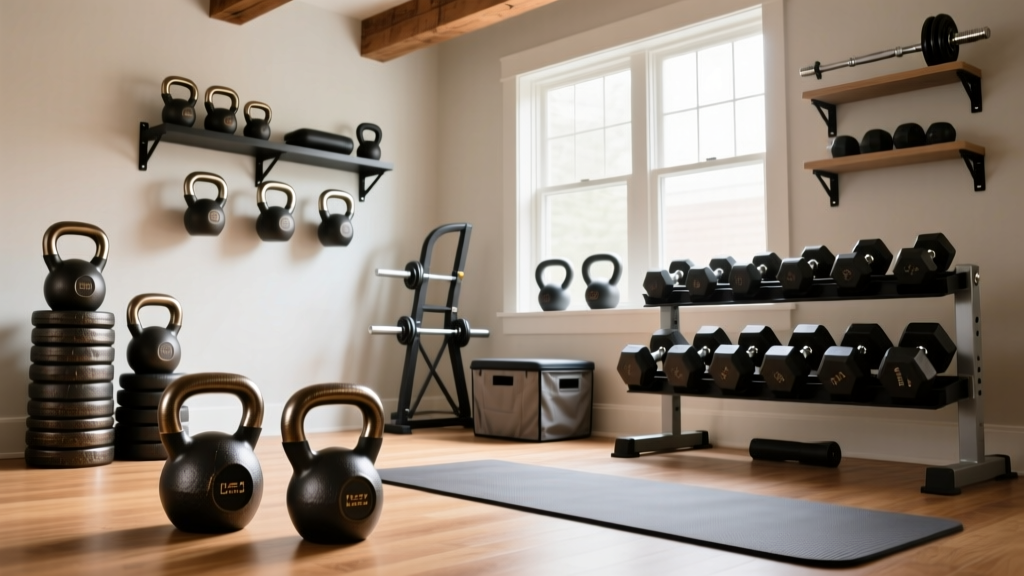
Kettlebell Guide & Layouts for an Upper Body Dumbbell Workout at Home
Optimize your home gym layout. Compare cast iron vs competition kettlebells for space-saving storage and upper body dumbbell workout at home routines.

The Compact Home Gym Blueprint: Merging Dumbbells and Kettlebells
Designing a highly functional home gym in 2026 requires ruthless space optimization. When your primary focus is an upper body dumbbell workout at home, your floor plan is likely already dominated by adjustable dumbbell sets, a foldable bench, and perhaps a compact squat stand. But as you introduce ballistic movements, offset loading, and rotational core work, the question becomes: which kettlebells should you add, and how do you store them without sacrificing your limited square footage?
The choice between cast iron and competition kettlebells is rarely just about aesthetics or grip feel; it is fundamentally a spatial decision. The outer dimensions, handle clearances, and storage footprints of these two styles dictate how you design your training zones. This guide breaks down the spatial realities of cast iron versus competition kettlebells, providing a layout-driven buying framework to maximize your training footprint.
Space Footprint Analysis: Cast Iron vs. Competition
Before purchasing, you must understand how the physical geometry of these tools impacts your floor plan. Below is a dimensional comparison based on standard 16kg (35lb) models from leading 2026 manufacturers like Rogue Fitness and Kettlebell Kings.
| Specification | Rogue Cast Iron (16kg) | Kettlebell Kings Competition (16kg) |
|---|---|---|
| Dimensions (H x W x D) | 10.5in x 8.5in x 7.5in | 11in x 8.3in x 8.3in (280x210x210mm) |
| Base Footprint | ~63 sq in (Tapers) | ~68 sq in (Flat, Uniform) |
| Handle Clearance | Variable (~5.5in) | Strict 33mm inner diameter |
| Average 2026 Price | $65.00 | $115.00 |
| Storage Predictability | Low (Grows with weight) | High (Uniform across 8kg-32kg) |
Cast Iron Kettlebells: The Space-Saving Workhorse
Cast iron kettlebells are poured into molds, meaning their physical volume scales directly with their weight. A 12kg cast iron bell is significantly smaller than a 32kg bell. From a space optimization perspective, this presents both a massive advantage and a frustrating logistical hurdle.
Spatial Pros & Cons of Cast Iron
- Pro: Compact Light Weights. If your upper body dumbbell workout at home focuses on high-rep lateral raises, halos, and light presses, a 8kg or 12kg cast iron bell takes up minimal shelf space and can easily be tucked under a bench or stored in a closet.
- Pro: Lower Cost per Square Inch. Cast iron is generally 30% to 40% cheaper than competition bells, allowing you to allocate more of your budget toward space-saving wall-mounted racks or high-density rubber flooring.
- Con: Racking Inconsistencies. Because the bells grow in all directions as weight increases, standard 3-tier A-frame racks often fail to accommodate larger sizes. A 24kg bell might fit on the middle tier, but a 28kg bell will scrape the tier above it, forcing you to store heavier bells on the floor and creating a tripping hazard.
- Con: Base Instability. Many cast iron bells feature rounded or uneven bases. If you are doing renegade rows or plank pull-throughs in a tight space, the bell can roll, requiring you to leave extra buffer space around your mat to protect your walls and drywall.
Competition Kettlebells: Uniform Dimensions for Custom Layouts
Competition kettlebells are manufactured to a strict international standard: 280mm tall, 210mm wide, and 210mm deep, regardless of whether the bell weighs 8kg or 32kg. The weight difference is achieved by altering the density of the internal core (using steel or lead inserts surrounded by an aluminum or steel shell).
The Layout Advantage: Because every competition bell shares the exact same outer dimensions, you can build or purchase a custom storage solution once, and it will perfectly accommodate your entire collection as you progress. This is the ultimate space-saving hack for apartment dwellers and garage gym owners who want to build permanent, flush-mounted wall shelving.
Furthermore, the flat, wide base of a competition kettlebell is a dream for floor-based exercises. When you are transitioning from a heavy upper body dumbbell workout at home to kettlebell floor presses or Turkish get-ups, the competition bell will not roll away. It sits perfectly flush on 3/4-inch horse stall mats, allowing you to place your equipment closer to the walls without fear of drywall damage.
Handle Geometry and Movement Arcs
According to biomechanical guidelines from the National Strength and Conditioning Association (NSCA), adequate clearance for overhead and swinging movements requires a minimum 6-foot radius around the lifter. Competition bells feature a strictly regulated 33mm handle thickness and a wider, squarer horn (the vertical posts connecting the handle to the bell). This wider horn prevents the bell from resting awkwardly on the forearm during cleans and snatches, reducing the need for excessive grip adjustments that can lead to dropped weights in cramped spaces.
Designing Your Layout for an Upper Body Dumbbell Workout at Home
Integrating kettlebells into a dumbbell-dominant space requires zoning. You cannot simply drop a kettlebell rack next to your dumbbell tree without considering the movement arcs. The American Council on Exercise (ACE) emphasizes that home gym flooring must account for both the drop-zone impact and the lateral swing radius of ballistic tools.
Here is a step-by-step framework for designing a 6x8 foot training zone optimized for both tools:
- Establish the Anchor Point: Place your adjustable bench at the top center of the 6x8 mat space. This is your primary station for your upper body dumbbell workout at home (presses, rows, flyes).
- Create the Dumbbell Drop Zone (Left Flank): Position your adjustable dumbbells or dumbbell rack on the left side of the bench. Dumbbells require a vertical lifting arc and a controlled drop. Keep this zone tight to the wall to save space.
- Establish the Ballistic Swing Zone (Right Flank): Kettlebell swings, snatches, and high pulls require a backward trajectory. Leave a minimum of 4 feet of unobstructed space behind and to the right of your bench. Do not place your kettlebell rack in this swing path.
- Vertical Storage Integration: Mount a vertical kettlebell rack on the wall directly in front of your bench, at least 6 feet away. This keeps the bells visible, accessible, and entirely off the floor, preserving your swing zone.
Real-World Storage Solutions & Edge Cases
When selecting storage, you must account for the failure modes of specific rack designs under heavy, uneven loads. Based on current 2026 market offerings, here is how to optimize your storage footprint:
- Rogue A-Frame Kettlebell Rack (~$195): Excellent for cast iron bells up to 24kg. However, the edge case here is weight distribution. If you load 32kg bells on one side and 8kg bells on the other, the A-frame can tip on uneven garage floors. Space Verdict: Requires 4 sq ft of floor space; not ideal for tight apartments.
- Bells of Steel Vertical Wall Rack (~$129): Mounts directly to drywall studs. This is the superior choice for competition bells because their uniform handles slide perfectly into the vertical cradles. Edge Case: The standard wall anchors will fail if you load more than three 24kg+ bells. You must bolt this directly into wooden or steel wall studs.
- DIY Flush-Mounted Shelving: For competition bells, building a 215mm deep wooden shelf (using 2x10 lumber) mounted 18 inches off the floor allows you to slide the bells into a corner, utilizing dead space that traditional racks ignore.
Biomechanical Grip Considerations
Exercise prescription databases like ExRx.net note the differing grip demands between implements. Cast iron bells often feature thicker, powder-coated handles that can measure up to 35mm on heavier weights. If your hands are fatigued from a grueling upper body dumbbell workout at home, transitioning to a thick-handled cast iron bell for farmer carries may lead to premature grip failure. Competition bells maintain the 33mm standard, allowing for consistent grip mechanics and safer handling when you are training alone in a confined space without a spotter.
Frequently Asked Questions
Can I use competition kettlebells for slow, strict upper body presses?
Yes. While they are designed for ballistic movements, the uniform 33mm handle and flat base make them excellent for strict overhead presses and floor presses. Their flat base also prevents them from rolling away between sets, which is a major safety benefit in small home gyms.
Which style is better if I only have space for one kettlebell?
If you are only buying one bell to supplement your dumbbell training, a cast iron kettlebell is usually the more cost-effective choice. However, if you plan to eventually buy a second bell for double-kettlebell front squats or dual presses, buying competition bells from the start ensures your storage layout and grip mechanics remain consistent as you expand your arsenal.
How do I protect my floors from competition bells?
Competition bells are made of steel or aluminum and have a hard, flat base. Dropping them from overhead will crack standard home tiles and dent hardwood. You must use a minimum of 3/4-inch thick vulcanized rubber horse stall mats in your designated drop zone. Interlocking EVA foam tiles are insufficient for kettlebell impacts and will compress permanently over time.
More gear to consider
All reviews
Nike Grind Dumbbell vs Adjustable: Beginner Step-by-Step Guide
Power Rack vs Squat Stand: Dumbbell Chest Fly Bench Angle Fixes

Maximize Home Gym Space With a Loadable Dumbbell Interchange Setup

Best Adjustable Delt Raises Dumbbell Options: 2026 Form Guide

Kettlebell Guide: Cast Iron vs Competition & How to Hold a Dumbbell Correctly
