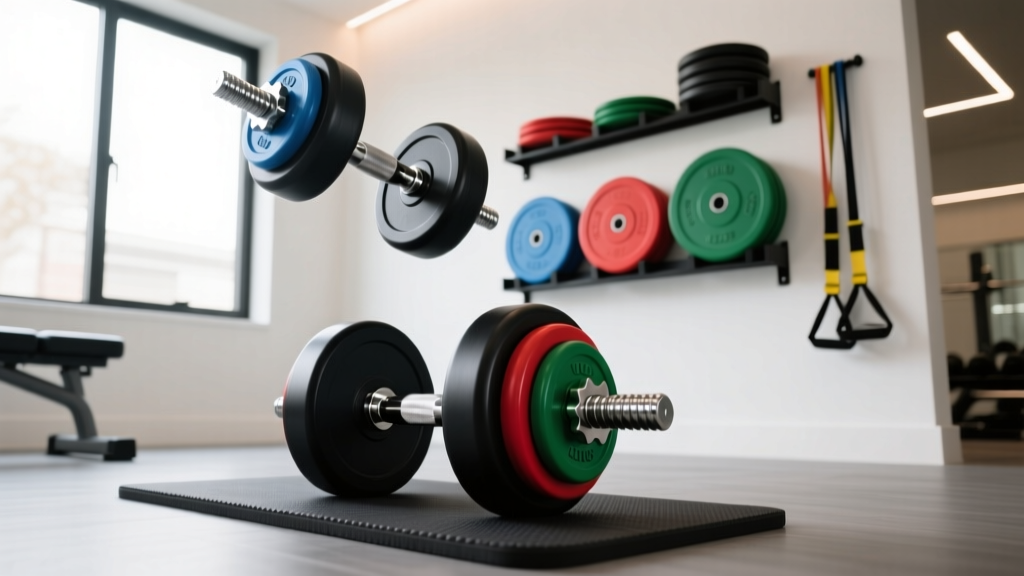
Barbell Collar vs Clamp Setup & Dumbbell Scap Trap Guide
Master your 2026 home gym setup with our barbell collar vs clamp comparison, installation walkthrough, and dumbbell scap trap station guide.

The Physics of Barbell Retention and Sleeve Tolerances
When building a comprehensive free-weight station, the interface between your weight plates and the barbell sleeve is often the most overlooked safety vector. According to NSCA Weight Room Safety guidelines, improper plate retention is a leading cause of asymmetric loading injuries during compound lifts. In 2026, the market has shifted away from rudimentary spring clips toward precision-machined clamping mechanisms designed to handle extreme axial loads and rotational shear.
Olympic barbell sleeves are standardized at 50mm in diameter, but manufacturing tolerances mean a sleeve can range from 49.8mm to 50.2mm. A high-quality collar must account for this variance, applying uniform radial pressure without scoring the zinc or black oxide finish. Understanding the mechanical differences between collars and clamps is the first step in a complete equipment installation walkthrough.
The 2026 Collar and Clamp Comparison Matrix
Not all retention devices are created equal. The choice between a traditional collar and a modern clamp depends entirely on your training modality. Below is a detailed breakdown of the top retention systems available this year, analyzing material composition, clamping force, and ideal use cases.
| Mechanism Type | Top 2026 Model | Material Composition | Avg. Price | Clamping Force | Best Application |
|---|---|---|---|---|---|
| Lever Clamp | Eleiko Olympic Collar | Hardened Steel / Aluminum | $95.00 | ~1200 N | Competitive Weightlifting |
| Screw-Down Billed | Rogue Billed Collars | 6061 Aircraft Aluminum | $45.00 | ~900 N | Heavy Powerlifting |
| Jaw-Lock | Lock-Jaw Pro | Glass-Reinforced Nylon | $35.00 | ~600 N | CrossFit / Dynamic Drops |
| Spring Tension | Standard Spring Collar | Spring Steel | $12.00 | ~150 N | Light Accessory Work |
Step-by-Step Installation Walkthrough
Proper installation of barbell clamps extends the lifespan of your equipment and ensures maximum safety. Follow this precise setup protocol before every heavy session.
- Sleeve Preparation: Wipe the 50mm sleeve with a microfiber cloth and a light application of 3-in-One oil. Remove any chalk dust or metal shavings that could become trapped between the clamp and the sleeve, which causes micro-scratches on black oxide finishes.
- Plate Loading: Load your bumper or steel plates flush against the inner shoulder of the sleeve. Ensure the inner hub of the plate is fully seated.
- Collar Positioning: Slide the clamp onto the sleeve. For screw-down billed collars (like the Rogue Billed Collars), leave exactly a 1mm to 2mm gap between the outer plate and the collar body. This allows the collar to bite inward without bottoming out the threads prematurely.
- Torque and Lock: Tighten the mechanism. If using a lever clamp, push the lever past the 90-degree center point to engage the over-center locking cam. If using a jaw-lock, ensure both nylon teeth click audibly into the secondary safety grooves.
- The Shake Test: Lift the barbell to the hang position and give it a controlled, sharp shake. Zero lateral plate movement should be detectable.
Expanding the Rack: The Dumbbell Scap Trap Setup
A complete free-weight installation walkthrough extends beyond the barbell. In modern hypertrophy programming, the dumbbell scap trap station has emerged as a critical setup for isolating the middle and lower trapezius muscles without overloading the lumbar spine. Setting this up correctly requires precise bench angling and specific dumbbell selections.
Configuring the Incline Station
To execute the chest-supported dumbbell scap trap retraction (often referred to as a scapular shrug or batwing row), you must configure an adjustable FID (Flat/Incline/Decline) bench to exactly 30 degrees. A 45-degree angle shifts too much load onto the upper traps and rear delts, while a 15-degree angle limits the range of motion for the rhomboids.
- Dumbbell Selection: Use urethane-coated hex dumbbells (e.g., Rogue Urethane Dumbbells, $3.50/lb). The hex profile prevents them from rolling off the bench when you set them down mid-set, which is crucial when performing drop sets for trap fatigue.
- Clearance Metrics: Ensure your power rack or bench station has a minimum lateral clearance of 36 inches. When your arms hang perpendicular to the floor with heavy dumbbells (e.g., 70+ lbs per hand), you need adequate space to execute the scapular squeeze without your knuckles striking the uprights of your squat rack.
- Execution Cue: Instead of shrugging 'up' toward the ears (upper trap focus), the setup requires pulling the scapulae 'together and down' into the back pockets, leveraging the 30-degree incline to target the mid-trap fibers.
'The integration of chest-supported dumbbell scap trap work is non-negotiable for lifters dealing with anterior shoulder glide. By stabilizing the thoracic spine on a 30-degree incline, we force the scapular retractors to do 100% of the work, eliminating momentum and lower-back compensation.' — Biomechanics & Hypertrophy Review, 2025
Edge Cases: Rotational Shear and Drop Sets
When programming for high-intensity techniques, your collar choice dictates your safety margins. During Olympic lifts, the barbell spins freely on its needle bearings, but the sleeve itself experiences immense rotational torque when the plates catch in the air. Glass-reinforced nylon clamps (like Lock-Jaw) are superior here because they grip the sleeve without requiring metal-on-metal friction, which can slip if the sleeve is heavily chalked.
Conversely, for heavy powerlifting drop sets, where plates are rapidly added and removed, screw-down aluminum collars offer the fastest operational speed. However, be aware that aluminum collars can gall against stainless steel sleeves if not kept clean. If you are using a premium stainless steel bar (such as the Eleiko or American Barbell Stainless bars), opt for nylon-lined jaw clamps to preserve the sleeve's mirror finish.
Maintenance and Calibration
Collars and clamps require routine maintenance to maintain their rated clamping force in Newtons. Every 90 days, disassemble screw-down collars and apply a dry PTFE lubricant to the threads. Avoid wet greases, which attract gym chalk and form an abrasive paste that will eventually strip the internal threading. For lever clamps, inspect the rubberized inner gasket for dry rot or compression set; if the gasket no longer rebounds when pressed with a thumbnail, the collar must be replaced, as it will no longer provide the necessary 1000+ N of radial force.
Frequently Asked Questions
Can I use the same collar for a standard 1-inch bar and an Olympic 2-inch bar?
No. Standard bars measure 25mm (1 inch) at the sleeves, while Olympic bars measure 50mm (approx. 2 inches). While some cheap spring collars claim universal fitment, they fail to provide adequate tension on 50mm sleeves. Always purchase collars specifically calibrated for 50mm Olympic tolerances.
Do jaw-lock clamps stretch out over time?
Glass-reinforced nylon (GRN) is highly resistant to mechanical creep. However, the internal metal tension springs can fatigue after 3 to 5 years of heavy daily use. If the clamp can be removed without pressing the release tab, the spring has failed.
How does the dumbbell scap trap setup differ from a trap bar shrug?
A trap bar shrug primarily targets the upper trapezius through vertical elevation of the scapula. The chest-supported dumbbell scap trap setup targets the middle and lower trapezius through horizontal retraction and depression, providing a more balanced postural stimulus and reducing cervical spine compression.
More gear to consider
All reviews
Power Rack vs Squat Rack vs Stand for Dumbbell Step-Ups & Lifts

Loadable Dumbbell Maintenance for Safe Dumbbell Lunges

Bumper vs Iron Plates & Biceps Workout with Dumbbells Chart
Rubber Hex vs Urethane: Which Aids Dumbbell Bicep Curl Form Best?

Cast Iron vs Competition Kettlebells & Walking with Dumbbells in Hands