
Power Rack vs Squat Rack vs Stand: Romanian Deadlifts with Dumbbells
Compare power racks, squat racks, and stands. Find the best 2026 setup for heavy squats and romanian deadlifts with dumbbells based on depth and clearance.

The Hinge Clearance Problem: Why Rack Depth Matters
When outfitting a home gym, most buyers focus on weight capacity and footprint. However, if your programming includes posterior chain work—specifically romanian deadlifts with dumbbells—the internal depth of your rack becomes a critical, often overlooked variable. The hip hinge requires significant backward travel of the glutes and forward reach of the torso. When you add the length of heavy dumbbells into the equation, spatial geometry dictates whether you can perform the movement safely and effectively without clipping your equipment.
A standard 50-pound hex dumbbell measures approximately 14.5 inches in length. If a 6-foot-tall lifter is standing inside a 24-inch deep squat rack, the margin for error during the eccentric phase of a dumbbell RDL is practically zero. The dumbbell heads will strike the front uprights, or the lifter's glutes will collide with the rear crossmembers. This guide breaks down the structural differences between power racks, half racks, and squat stands, evaluating them specifically through the lens of heavy hinge movements and overall versatility in 2026.
Equipment Breakdown: Cages, Half Racks, and Stands
1. Power Racks (Full Cages)
Power racks are fully enclosed, four-upright cages. They are the gold standard for safety and versatility. In the current market, you will primarily find two depth options: 24 inches and 30 inches.
- The 30-Inch Advantage: For lifters over 5'8" performing romanian deadlifts with dumbbells, a 30-inch depth (like the Rep Fitness PR-4000) is virtually mandatory if you intend to step inside the cage. The extra 6 inches provides the necessary clearance for hip travel and dumbbell reach without the constant anxiety of scraping the powder coat off your uprights.
- Westside Hole Spacing: Premium 2026 models feature 1-inch spacing through the bench and floor-press zones. This allows you to set safety spotter arms exactly at mid-shin height, providing a perfect fail-safe if your grip gives out at the bottom of a heavy dumbbell or barbell hinge.
- Drawbacks: The footprint is massive. A 30-inch deep rack with attached weight storage can easily consume a 4x8 foot area, and ceiling height restrictions (often 84 to 90 inches) can limit overhead pressing or pull-up clearance.
2. Squat Racks (Half Racks)
Half racks feature two main front uprights and two shorter rear uprights, often connected by a weight storage horn. They offer a middle ground between the enclosure of a cage and the openness of a stand.
- Biomechanical Freedom: Because the rear uprights are set back and lower, you can stand further forward in a half rack. This makes executing romanian deadlifts with dumbbells much more comfortable than in a shallow 24-inch power rack. You get the benefit of front-facing safety spotter arms without feeling claustrophobic.
- Storage Integration: Models like the Rogue S-2 or Titan X-2 come with integrated plate storage on the rear pegs. This not only saves floor space but also acts as a necessary counterweight, anchoring the rack during aggressive racking of heavy barbells.
- Drawbacks: Half racks are generally less stable than fully bolted-down power racks. If you are dropping heavy dumbbells onto the floor inside the rack, the vibration can shift the unit if it isn't properly bolted to a reinforced concrete subfloor.
3. Squat Stands (Open Uprights)
Squat stands consist of two independent uprights (or a single connected base) designed primarily to hold a barbell. They are the most space-efficient and budget-friendly option.
- The Open Floor Concept: With squat stands, you are never truly "inside" the rack. You place the stands behind you as safeties, or in front of you for squats. This means you have infinite depth for hip hinges. You can step as far back as needed to perform deep, unencumbered romanian deadlifts with dumbbells or kettlebell swings.
- Failure Modes & Edge Cases: The primary danger of squat stands is tipping. If a lifter accidentally racks a barbell too far forward, or if heavy dumbbells are stored improperly on the base, the center of gravity shifts. Folding squat stands (like the Titan T-2 Folding) are particularly problematic for hinge movements; the lateral wobble during a heavy dumbbell RDL can cause the spotter arms to shift out of alignment.
- Expert Recommendation: If you choose stands, opt for a flat-footed, heavy-duty model with a wide base (e.g., Rogue SML-2 Monster Lite) and always use them on a high-density rubber mat system to prevent micro-sliding during foot placement adjustments.
Comparison Matrix: Footprint, Clearance, and Hinge Compatibility
| Equipment Type | Standard Depth | Avg. Price (2026) | Dumbbell RDL Clearance | Safety for Hinge Bailing |
|---|---|---|---|---|
| Power Rack (24") | 24 Inches | $900 - $1,300 | Poor (Clipping likely for tall lifters) | Excellent (Enclosed safeties) |
| Power Rack (30") | 30 Inches | $1,300 - $1,800 | Good (Adequate room for hip travel) | Excellent (Enclosed safeties) |
| Half Rack | 24" - 34" | $1,100 - $1,600 | Very Good (Open rear allows step-back) | Very Good (Front spotter arms) |
| Squat Stands | N/A (Open) | $350 - $600 | Perfect (Unrestricted floor space) | Fair (Requires precise arm placement) |
Safety Spotter Arms and Bailing on a Hinge
Unlike a back squat, where you can simply dump the bar backward onto the safeties, bailing on a heavy hinge movement is complex. According to biomechanics experts at the Stronger By Science team, the shear force on the lumbar spine increases exponentially if a lifter loses their neutral spine at the bottom of a Romanian deadlift.
Pro-Tip for Dumbbell RDL Safeties: If you are using a power rack or half rack, set the safety spotter arms at mid-shin height, slightly wider than shoulder width. If your grip fails or your lower back begins to round, do not try to muscle the weight up. Simply bend your knees slightly, dropping the dumbbells directly onto the spotter arms. This requires the arms to be long enough to catch the dumbbell heads (at least 20-inch spotter arms are recommended for this specific maneuver).Weight Storage and Dumbbell Integration
Storing heavy dumbbells (50 lbs to 100 lbs per pair) inside your workout area requires strategic planning. If you are using a 24-inch power rack, storing dumbbells on the floor inside the cage eliminates the already scarce clearance needed for your feet during split-stance RDLs or lunges.
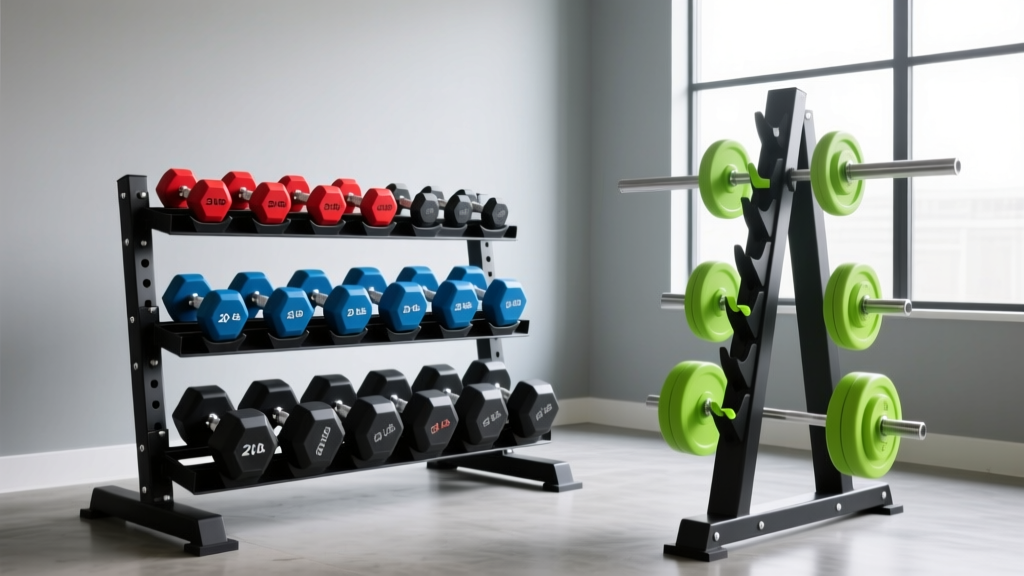
For power racks and half racks, investing in vertical dumbbell storage horns that attach to the exterior of the uprights is highly recommended. This keeps the interior footprint clear for unencumbered movement. For squat stands, you must rely on a separate, dedicated floor rack. Attempting to hang heavy dumbbells from the base pegs of a squat stand will raise the center of gravity and create a severe tipping hazard during dynamic movements.
Final Verdict: Which Setup Fits Your Hinge?
Your choice between a power rack, squat rack, and squat stand should be dictated by your ceiling height, available square footage, and the specific biomechanics of your programming.
- Choose a 30-Inch Power Rack if: You have the space (and an 8-foot+ ceiling), prioritize absolute safety, and want the versatility to perform enclosed squats, bench presses, and unencumbered romanian deadlifts with dumbbells without worrying about spatial constraints.
- Choose a Half Rack if: You want the safety of front-mounted spotter arms but prefer an open-back feel for posterior chain work. It is the ideal compromise for garage gyms with limited depth.
- Choose Squat Stands if: You are on a strict budget, have low ceilings, or train in a small apartment gym. You gain total freedom for hip hinges and dumbbell work, provided you are diligent about leveling the stands and utilizing proper floor mats to prevent shifting.
Ultimately, the best rack is the one that accommodates your body's mechanics. Do not sacrifice the integrity of your hip hinge just to fit inside a shallow cage. Measure your space, test your range of motion, and invest in the steel that supports your long-term strength goals.
More gear to consider
All reviews
Best Adjustable Dumbbells for the Dumbbell Bicep Hammer Curl (2026)

Squat Stand vs Power Rack: Space for Dumbbell Side Plank Hip Lifts

Beyond 200 Pound Dumbbells: Barbell Weight & Knurling Mistakes

Cast Iron vs Competition Kettlebells vs a 75 Pound Dumbbell
2026 Market Trends: Dumbbell Racks for Heavy Chest Fly Dumbbells
