
Inner Thigh Workout Equipment: Horizontal vs 45° Leg Press
Compare horizontal vs 45-degree leg presses as inner thigh workout equipment. Discover 2026 models, biomechanics, pricing, and space requirements.

The Biomechanics of Adductor Activation on a Leg Press
While the leg press is universally recognized for quadriceps and glute development, manipulating foot placement transforms it into elite inner thigh workout equipment. According to kinesiological principles outlined by ExRx, a wide stance with external toe rotation shifts the mechanical advantage toward the adductor complex (adductor magnus, longus, and brevis). However, the machine's angle—horizontal versus 45-degree—drastically alters hip flexion mechanics, pelvic tilt, and ultimately, the stretch-mediated hypertrophy potential of the inner thighs.
For hypertrophy, the adductors require a deep, loaded stretch. In the 2026 fitness equipment market, buyers must choose between the space-efficient horizontal sled and the gravity-assisted 45-degree linear bearing press. This guide breaks down the biomechanics, structural failure modes, and top-tier models for both configurations to help you select the ultimate inner thigh training solution.
Horizontal Leg Press Machines: Mechanics and Market Leaders
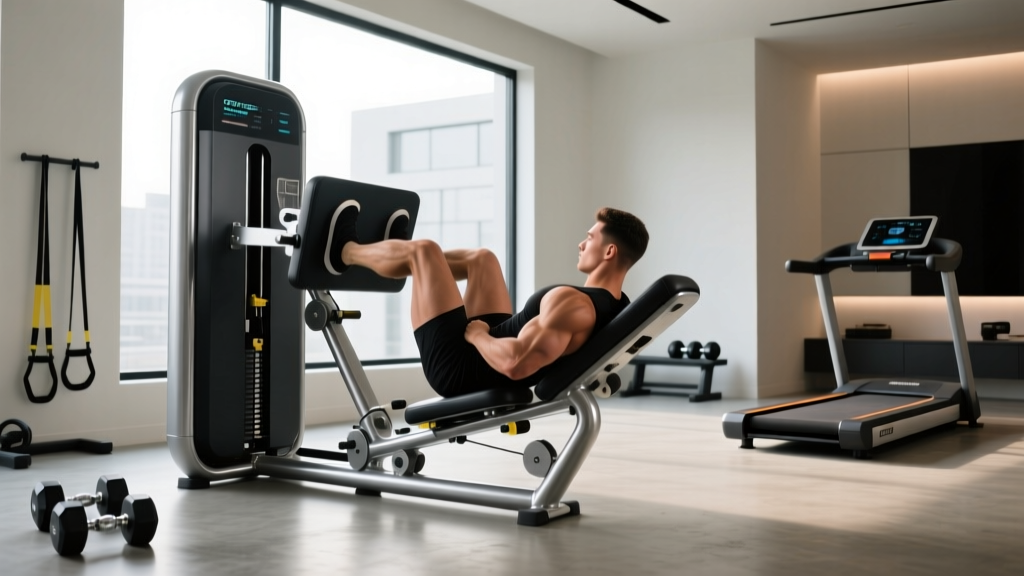
The horizontal leg press positions the user parallel to the floor, pushing the sled directly away from the torso. This setup relies heavily on the user's core stability and hip mobility to maintain a neutral spine at the bottom of the movement.
Top 2026 Models and Pricing
- Powertec Fitness Leverage Workbench (Horizontal Sled): Priced around $1,999, this model utilizes a leverage arm rather than a pure linear sled. It requires a smaller footprint (approx. 60" x 34") but limits maximum loading to 400 lbs, which advanced lifters will outgrow quickly.
- Prime Fitness XP Plate-Loaded Horizontal: A commercial-grade staple retailing between $4,200 and $5,500. It features an 800 lb capacity and dual guide rods with heavy-duty nylon bushings. Its low profile (48" height) makes it ideal for basement gyms with standard 8-foot ceilings.
45-Degree Linear Bearing Presses: The Heavyweight Standard
The 45-degree leg press angles the sled upward. Gravity assists the eccentric (lowering) phase, and the angled hip joint allows the knees to travel down and outward past the torso. This creates a significantly deeper stretch in the adductors without forcing the lumbar spine into flexion, making it biomechanically superior for inner thigh hypertrophy.
Top 2026 Models and Pricing
- Body-Solid Pro Club Line SLP500G: The undisputed king of home and light-commercial gyms, retailing at $2,199. It features a 1,000 lb capacity, an 83" x 34" footprint, and an oversized 11-gauge steel frame. The 45-degree carriage allows for deep adductor stretches while the back pad supports the natural lumbar curve.
- Hammer Strength MTS Linear Leg Press: A premium selectorized option costing upwards of $6,800. It utilizes independent converging/diverging movement arms, allowing unilateral inner thigh work to correct adductor imbalances—a feature highly valued by physical therapists and elite bodybuilders.
Foot Placement Matrix for Inner Thigh Targeting
To maximize the 45-degree press as inner thigh workout equipment, precise foot placement is critical. The National Strength and Conditioning Association (NSCA) emphasizes that joint angle dictates muscle recruitment. Use this matrix to dial in your adductor focus:
| Stance Width | Toe Angle | Platform Height | Primary Target | Stretch Depth |
|---|---|---|---|---|
| 1.5x Shoulder Width | 30° External | Low Platform | Adductor Longus / Gracilis | Moderate |
| 2.0x Shoulder Width | 45° External | Mid Platform | Adductor Magnus (Hip Extension) | Maximum |
| 1.2x Shoulder Width | 15° External | High Platform | Glute Max / Adductor Synergy | Low |
Head-to-Head Comparison Matrix
Choosing between these two machine types requires balancing biomechanical advantages against spatial and financial constraints. Below is a direct comparison of the horizontal and 45-degree configurations for the 2026 buyer.
| Feature | Horizontal Leg Press | 45-Degree Leg Press |
|---|---|---|
| Adductor Stretch Potential | Moderate (Limited by pelvic tilt) | Excellent (Knees clear torso) |
| Lumbar Safety | Lower (Requires high mobility) | Higher (Natural spinal support) |
| Ceiling Height Requirement | Low (48" - 55") | High (75" - 85") |
| Floor Footprint | Compact (approx. 15 sq ft) | Large (approx. 22 sq ft) |
| Weight Capacity (Avg) | 400 - 800 lbs | 800 - 1,200+ lbs |
| Price Range (2026) | $1,500 - $4,500 | $2,200 - $7,000+ |
Maintenance, Failure Modes, and Longevity
Heavy adductor training involves massive lateral forces on the sled carriage, especially when utilizing wide stances that push the knees outward against the machine's tracking system. Understanding failure modes is critical for long-term equipment investments.
Horizontal Sled Failure Modes
Horizontal machines typically rely on nylon or UHMW (Ultra-High-Molecular-Weight) polyethylene bushings gliding over steel guide rods. When users perform wide-stance inner thigh presses, the lateral torque can cause uneven wear on these bushings. Over 3 to 5 years, this results in a "grinding" sensation and sled wobble. Fix: Inspect bushings annually and replace them (usually $30-$50 per set) before they scar the steel guide rods.
45-Degree Linear Bearing Maintenance
High-end 45-degree presses use recirculating ball linear bearings. While smoother and capable of handling heavier loads, they are susceptible to dust and chalk infiltration. If chalk enters the bearing block, the internal ball bearings will seize. Fix: Wipe down the guide rods weekly with a dry microfiber cloth and apply a light coat of PTFE (Teflon) dry lubricant every 90 days. Avoid wet oils or WD-40, which attract abrasive gym dust.
Cable and Pulley Systems (Selectorized Models)
If you opt for a pin-loaded 45-degree machine like the Hammer Strength MTS, the inner thigh drive generates immense tension on the aircraft-grade steel cables. Check the cable tension monthly. If the cable frays near the carriage attachment point, replace it immediately. A snapped cable under a 600 lb load on a 45-degree incline will cause the carriage to free-fall, posing a catastrophic safety risk.
Final Verdict: Which Machine Wins for Inner Thigh Development?
If your primary goal is to utilize the leg press as dedicated inner thigh workout equipment, the 45-degree linear bearing press is the undisputed winner. The angled geometry allows the knees to travel deeply past the torso, providing the loaded, stretch-mediated stimulus that the adductor magnus requires for maximum hypertrophy, all while protecting the lumbar spine from the posterior pelvic tilt inherent in horizontal designs.
However, if you are outfitting a home gym with standard 8-foot ceilings and limited square footage, a high-quality horizontal press like the Prime Fitness XP is a necessary compromise. To mitigate the spinal risks on a horizontal machine, limit your range of motion to just above the point of lumbar flexion, and supplement your inner thigh training with dedicated cable hip adductions or a seated hip adductor machine to ensure complete muscle fiber recruitment without compromising your lower back.
For more detailed biomechanical breakdowns of lower body equipment, consult the ExRx 45-Degree Leg Press directory to verify muscle targeting based on your specific stance variations.
More gear to consider
All reviews
Sled vs Leg Press Machine Muscles Worked: Beginner Guide

Iso Leg Press Machine vs Sled Push Pull: A Beginner's Guide

Best Leg Press Machine for Hamstrings: Horizontal vs 45° (2026)
Beyond the Leg Press Machine Description: Home Gym Head-to-Head 2026

Beyond Machine Leg Presses: Beginner Sled Push Guide
