Standing vs Seated Calf Raises & Leg Press Machine Foot Placement
Troubleshoot stubborn calves with our guide on standing vs seated machines and exact leg press machine foot placement for safe, maximum growth.

The Triceps Surae Dilemma: Why Your Calves Aren't Growing
The calf muscle complex, scientifically known as the triceps surae, is notoriously stubborn. For many lifters, the lower legs remain a weak point despite years of training. The root cause of this stagnation usually boils down to two factors: a fundamental misunderstanding of biomechanics (specifically the difference between standing and seated positions) and poor equipment execution. When dedicated machines are unavailable or overcrowded, lifters often turn to the sled, making leg press machine foot placement a critical variable that is frequently botched, leading to both suboptimal hypertrophy and severe injury risks.
In this troubleshooting guide, we will dissect the biomechanical differences between standing and seated calf raise machines, identify the most common mechanical failures, and provide a masterclass on utilizing the leg press safely and effectively for calf development.
Standing vs. Seated Calf Machines: Biomechanics & Troubleshooting
To troubleshoot your calf training, you must first understand the anatomy. The calf is primarily composed of the gastrocnemius and the soleus. The gastrocnemius crosses both the knee and the ankle joint, meaning it is most active when the leg is straight. The soleus only crosses the ankle joint and becomes the primary mover when the knee is bent.
| Machine Type | Target Muscle | 2026 Benchmark Model | Price Range | Primary Failure Point |
|---|---|---|---|---|
| Standing Calf Raise | Gastrocnemius | Rogue Fitness Standing Calf | $1,450 - $1,600 | Knee flexion during the eccentric phase |
| Seated Calf Raise | Soleus | Hammer Strength HS-4000 Seated | $3,100 - $3,400 | Shallow ROM; failing to pause at the bottom |
| 45-Degree Leg Press | Both (Angle Dependent) | Life Fitness Signature Series | $4,500 - $5,200 | Foot slipping off the sled platform |
Troubleshooting the Standing Machine
The most common mistake on a standing calf raise machine is allowing the knees to bend slightly as the weight gets heavy. According to biomechanical analyses from ExRx.net, even a 15-degree bend in the knee shifts the mechanical advantage away from the gastrocnemius and onto the soleus, defeating the purpose of the standing variation. The Fix: Lock your knees out completely. Engage your quadriceps to keep the leg rigid throughout the entire range of motion.
Troubleshooting the Seated Machine
On a seated machine like the Hammer Strength HS-4000, lifters often use the stretch reflex to bounce the weight up. Because the soleus is highly endurance-oriented (composed of up to 80% slow-twitch muscle fibers), it requires deep, controlled stretches and prolonged time under tension. The Fix: Implement a mandatory 2-second pause at the bottom of the movement to dissipate elastic energy before pressing up.
The Sled Alternative: Mastering Leg Press Machine Foot Placement
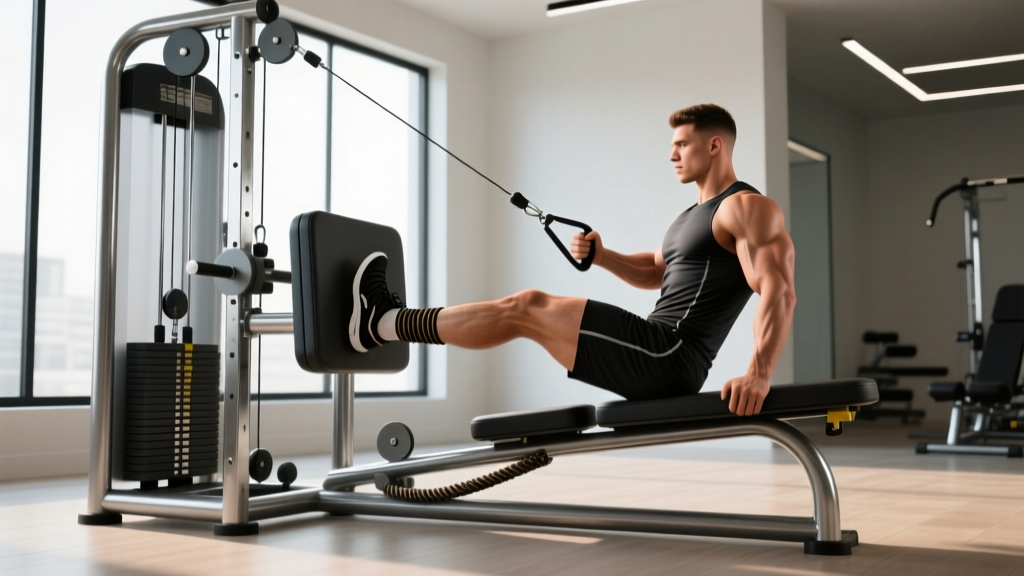
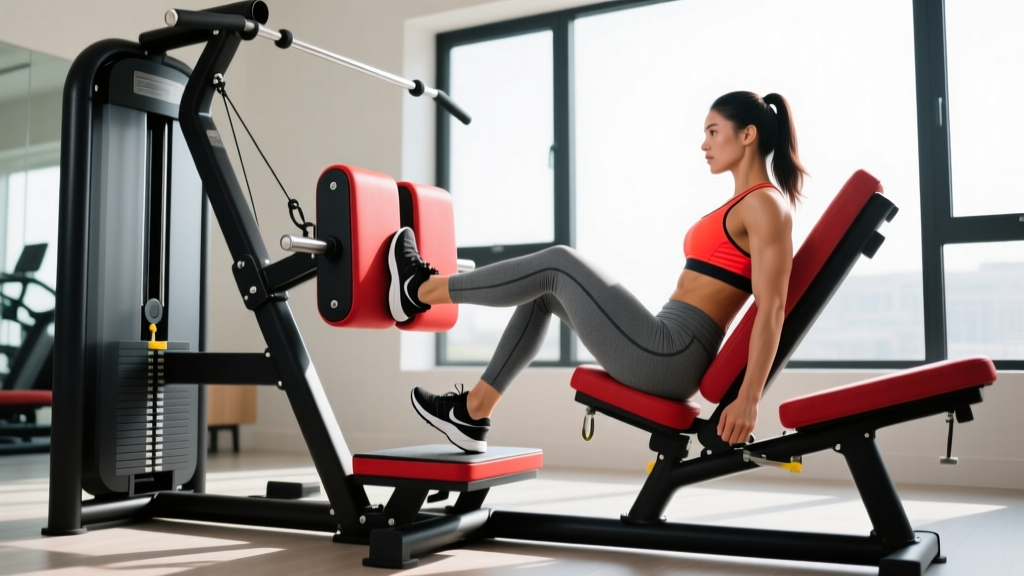
Not every commercial or home gym has a dedicated calf raise station. The 45-degree leg press is the most common alternative, but it introduces a massive safety hazard if executed poorly. Proper leg press machine foot placement for calves is entirely different from foot placement for squats or leg presses.
⚠️ WARNING: The Sled Slip Hazard
Every year, emergency rooms treat lifters for severe Achilles tendon ruptures and crushed toes resulting from the leg press sled slipping off the edge of the foot. The smooth diamond-plate steel of most leg press platforms offers zero traction when wet with sweat. Never perform calf raises on a leg press barefoot or in socks.
Step-by-Step Foot Placement Protocol
To safely and effectively target the calves on the leg press, follow these exact positioning metrics:
- Shoe Selection: Wear flat-soled, high-grip shoes (like Converse Chuck Taylors or dedicated weightlifting shoes with rubber outsoles). Avoid squishy running shoes, which absorb the force and create an unstable base.
- Vertical Placement: Place only the balls of your feet (the metatarsal heads) on the bottom edge of the sled platform. Your heels must hang entirely off the edge.
- Overhang Metric: The edge of the platform should sit exactly 1 to 1.5 inches behind your big toe joint. If the platform is too far forward, you will crush your toes. If it is too far back, the sled will slip off your arch.
- Toe Angle: Point your toes straight ahead or with a very slight 10-to-15-degree outward turnout. Extreme outward or inward angles place dangerous torsional stress on the Achilles tendon and the plantar fascia.
- Hand Positioning: Do not use your hands to push on your knees. Grip the safety handles tightly to brace your torso and prevent your lower back from lifting off the pad.
The Eccentric Drop Measurement
When performing the eccentric (lowering) phase on the leg press, allow your heels to drop below the plane of the metal platform. Aim for a 2.5-inch heel drop. If your ankle mobility restricts you from achieving this depth without your knees bending, you must reduce the weight. As noted by the American Council on Exercise (ACE), full range of motion in the plantarflexion and dorsiflexion planes is non-negotiable for complete motor unit recruitment in the lower leg.
Troubleshooting the 'Bounce': Eliminating the Stretch-Shortening Cycle
The single greatest enemy of calf hypertrophy is the Stretch-Shortening Cycle (SSC). The Achilles tendon is essentially a massive, thick rubber band. When you drop your heels quickly and immediately reverse the motion, the tendon acts like a spring, doing 80% of the work while the actual muscle fibers do very little.
"If you are bouncing out of the bottom position of a calf raise, you are training your Achilles tendon, not your calf muscles. You must kill the momentum to force the muscle to adapt."
— Biomechanics & Hypertrophy Coaching Principles
The Troubleshooting Fix: The Dead-Stop Pause
Whether you are on a seated Hammer Strength machine, a standing Rogue Fitness unit, or utilizing specific leg press machine foot placement on the sled, you must implement a dead-stop pause. Lower the weight slowly over 3 seconds, hold the deep stretch for a full 2 seconds (allowing the elastic energy in the Achilles to dissipate completely), and then explode upward. This 2-second pause will likely force you to drop your working weight by 30% to 40%, but the hypertrophic stimulus to the actual muscle tissue will double.
Edge Cases: Ankle Mobility Restrictions
Some lifters find that when they attempt deep calf raises, they experience a pinching sensation in the front of the ankle or their foot cramps violently. This is often due to poor dorsiflexion mobility or a lack of intrinsic foot strength.
- Foot Cramping: If your toes claw and cramp on the edge of the leg press, your intrinsic foot muscles are weak. Spend 5 minutes a day doing 'towel scrunches' barefoot on the floor to build arch strength.
- Ankle Pinching: If you feel a block in the front of the ankle, perform banded ankle joint mobilizations before your calf workout to clear the joint capsule space.
The 2026 Calf Hypertrophy Framework
To build complete, diamond-shaped calves, you must train both the gastrocnemius and the soleus. Use this troubleshooting framework to structure your weekly lower-body programming:
Session A: Gastrocnemius Focus (Heavy / Low Reps)
- Exercise: Standing Calf Raise Machine (or Leg Press with straight legs).
- Protocol: 4 sets of 6-8 reps.
- Execution: 3-second eccentric, 2-second dead-stop pause at the bottom, explosive concentric, 1-second hard squeeze at the top.
- Rest: 120 seconds between sets.
Session B: Soleus Focus (Metabolic Stress / High Reps)
- Exercise: Seated Calf Raise Machine.
- Protocol: 3 sets of 15-20 reps.
- Execution: Continuous tension. Do not lock out or bounce. Use a 1-second eccentric and a 1-second concentric, focusing purely on the deep burn and cellular swelling.
- Rest: 60 seconds between sets.
Final Thoughts on Equipment Selection
While the leg press is a viable substitute in a pinch, investing in or seeking out a gym with dedicated standing and seated calf machines is highly recommended for long-term joint health and isolated loading. Machines like the Hammer Strength line by Life Fitness provide ergonomic knee pads and specialized footplates with aggressive grip tape that simply cannot be replicated on a standard leg press sled. Master your biomechanics, respect the pause, and prioritize safe foot placement to finally force your lower legs to grow.
More gear to consider
All reviews
Space Layouts: Squat Racks & Different Kinds of Leg Press Machines
Calf Raises Standing vs Seated: Horizontal Leg Press Machines

Squat Rack vs Leg Press Machine for Women: Space Guide

Hack Squat vs Individual Leg Press Machine Setup & Comparison

Leg Press Cable Machine Guide: Horizontal vs 45-Degree 2026