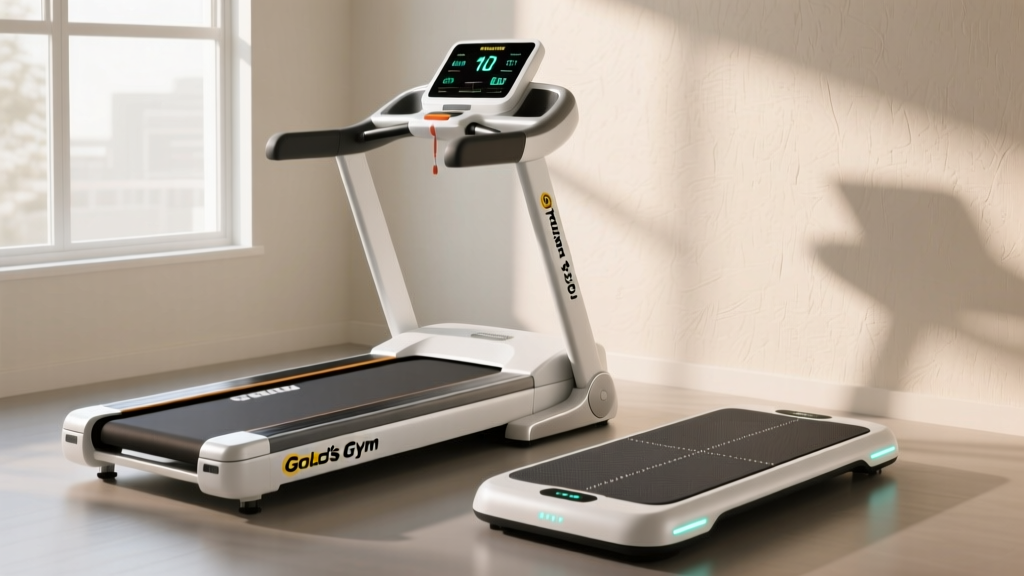
Gold's Gym Trainer 430i Treadmill vs Walking Pads: Beginner Guide
Compare the Gold's Gym Trainer 430i treadmill to modern walking pads. A beginner's step-by-step guide to choosing, setting up, and starting home cardio.

The Home Cardio Dilemma: Traditional Folding vs. Walking Pads
When beginners decide to bring cardio into their living space, they are immediately confronted by two vastly different form factors: the traditional budget folding treadmill and the modern under-desk walking pad. The Gold's Gym Trainer 430i treadmill has long been a staple in the budget fitness aisle, offering a familiar console, handrails, and a folding deck. Conversely, the explosion of remote work has popularized sleek, low-profile walking pads designed to slide under sofas and standing desks. But which one actually delivers better results for a beginner? This guide breaks down the exact specifications, spatial requirements, and real-world performance of the Gold's Gym 430i compared to leading 2026 walking pads, providing a step-by-step roadmap to launching your home walking routine.
Beginner Insight: Motor Ratings Explained (CHP vs. Peak HP)Before comparing models, you must understand motor terminology. The Gold's Gym 430i features a 1.5 Continuous Horsepower (CHP) motor. CHP measures the power the motor can sustain indefinitely without overheating. Most walking pads advertise 2.0 to 2.5 Peak HP. Peak HP only measures the maximum power output in short, unsustainable bursts. In reality, a 1.5 CHP traditional treadmill motor is significantly more durable and capable of handling continuous 60-minute walking sessions than a 2.5 Peak HP walking pad motor, which typically operates at roughly 1.0 CHP under continuous load.
Deep Dive Review: Gold's Gym Trainer 430i Treadmill
The Gold's Gym Trainer 430i remains one of the most accessible entry-level treadmills on the market, typically retailing between $249 and $279. It is engineered specifically for walking and light jogging, not marathon training. The 14-inch by 50-inch belt provides adequate length for walking strides up to 3.5 mph, though taller users (over 6 feet) may find the belt slightly restrictive for running. The fixed handrails offer crucial stability for seniors, physical therapy patients, or beginners lacking balance confidence. Furthermore, the inclusion of a magnetic safety lanyard—a feature entirely absent on 90% of walking pads—ensures the belt stops immediately if you stumble.
- Pros: True 1.5 CHP motor, physical safety lanyard, stable handrails, built-in console with preset programs, higher 250 lb weight capacity.
- Cons: Heavy (105 lbs), requires significant floor space when deployed, manual incline adjustment (no motorized incline), belt width is narrow for running.
Head-to-Head: Gold's Gym 430i vs. Top 2026 Walking Pads
To understand how the traditional 430i stacks up against the walking pad trend, we compared it against two of the most popular walking pads currently on the market: the UREVO Strol 2E (featuring a foldable handlebar) and the WalkingPad R2 (a premium dual-fold model).
| Feature | Gold's Gym 430i | UREVO Strol 2E | WalkingPad R2 |
|---|---|---|---|
| Retail Price | $249 - $279 | $259 - $299 | $399 - $449 |
| Motor Type | 1.5 CHP | 2.25 Peak HP | 2.5 Peak HP |
| Belt Dimensions | 14 x 50 inches | 15 x 43 inches | 17 x 47 inches |
| Max Speed | 10.0 MPH | 7.6 MPH | 7.5 MPH |
| Weight Capacity | 250 lbs | 265 lbs | 240 lbs |
| Safety Lanyard | Yes | No | No |
| Storage Profile | Folds vertically (63x28x10 in) | Flat or handle up | Folds in half (flat) |
Step-by-Step: Setting Up Your Home Walking Station
Improper setup is the leading cause of motor burnout and floor damage in home cardio equipment. Follow this exact protocol to prepare your space, regardless of which machine you choose.
- Spatial Mapping and Clearance: For the Gold's Gym 430i, measure a floor space of 60 inches long by 30 inches wide. Crucially, you must leave at least 24 inches of clearance behind the rear roller. If you fall and the safety lanyard triggers, you need space to slide backward without hitting a wall or furniture. Walking pads require less depth but still need 12 inches of rear clearance.
- Vibration Dampening: Never place a treadmill directly on hardwood or laminate. The 1.5 CHP motor on the 430i generates low-frequency vibrations that can scratch floors and loosen baseboards over time. Purchase a 3/4-inch thick PVC treadmill mat (typically costing $35 to $50). This specific thickness absorbs acoustic shock and prevents dust from being sucked into the motor housing.
- Power Delivery: Plug your machine directly into a wall outlet. Avoid using standard extension cords or power strips shared with high-draw appliances (like space heaters or microwaves), as voltage drops can cause the treadmill's control board to short out or the belt to stutter mid-stride.
- Belt Lubrication Check: Out of the box, budget treadmill belts are often under-lubricated. Before your first walk, lift the edge of the belt. If the deck feels dry, apply exactly 10ml of 100% silicone treadmill lubricant in a zigzag pattern down the center of the deck to reduce friction and extend motor life.
Your First 30 Days: A Beginner's Walking Progression
According to the American Heart Association, adults should aim for at least 150 minutes of moderate-intensity aerobic activity per week. Here is how to safely build up to that benchmark using your new equipment.
Week 1-2: Base Building and Posture Correction
Your goal for the first two weeks is tendon adaptation and establishing a habit, not burning maximum calories. Set the Gold's Gym 430i or your walking pad to 2.5 MPH. Walk for 15 minutes daily. Focus entirely on posture: keep your gaze fixed 10 feet ahead (do not stare down at the console or your phone), roll your shoulders back, and strike the belt with your heel first, rolling through to your toe. As noted by Mayo Clinic, proper walking mechanics engage the core and glutes, preventing the lower back pain often associated with treadmill use.
Week 3-4: Introducing Intervals and Speed
Once your joints have adapted to the daily 15-minute load, increase the duration to 25 minutes and introduce speed intervals to elevate your heart rate into the cardiovascular conditioning zone. Alternate between 3 minutes at a brisk 3.2 MPH and 2 minutes of active recovery at 2.0 MPH. If you are using the Gold's Gym 430i, you can manually adjust the rear feet to add a slight 2% incline during the brisk intervals, which Harvard Health Publishing highlights as an excellent method to increase caloric expenditure and posterior chain engagement without adding the joint impact of running.
Expert Tip: If you opt for a walking pad without handrails (like the base WalkingPad models), do not attempt speed intervals while holding onto a standing desk. Holding on alters your natural gait, reduces core activation, and can lead to asymmetric hip strain. Only use intervals when you can walk completely hands-free.
Final Verdict: Which Machine Belongs in Your Home?
The choice between the Gold's Gym Trainer 430i treadmill and a modern walking pad ultimately depends on your spatial constraints and balance requirements. If you have the floor space, require handrails for stability, value the safety of an emergency stop lanyard, and want a motor built for continuous daily walking, the Gold's Gym 430i is the superior, more durable choice for the price. However, if you live in a small apartment, need to store the machine under a bed or sofa, and plan to walk at slower speeds (under 4.0 MPH) while working at a standing desk, a high-quality walking pad offers unmatched convenience. Whichever you choose, prioritize consistency over intensity, protect your floors with a proper mat, and follow a structured progression plan to build a lifelong walking habit.
More gear to consider
All reviews
Ice Treadmill Motor Guide: Step-by-Step Horsepower Sizing
Knee Pain After Treadmill Running? Feature Buying Guide

NordicTrack EXP 1000 Treadmill Noise vs. Quiet Cardio Alternatives
Treadmill Handle Attachment Safety & Belt Lubrication Maintenance
Sole Treadmill F63 vs F65 or Under-Desk Treadmill? Office Use Review
