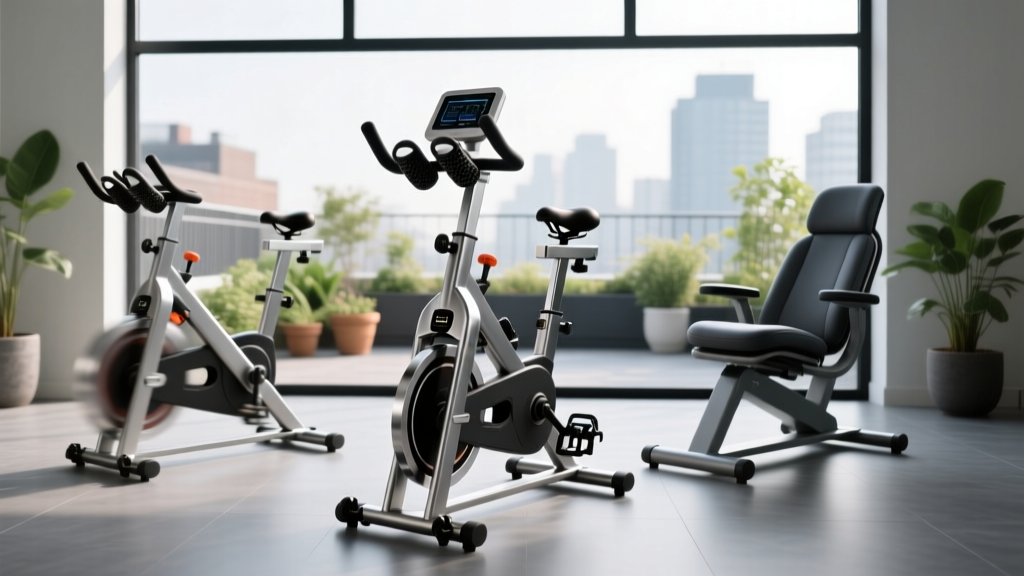
Skipping Rope vs Treadmill: Upright, Recumbent & Spin Bike Trends
Explore 2026 market trends for upright, recumbent, and spin bikes, and see how they stack up in the skipping rope vs treadmill cardio debate.

The 2026 Cardio Landscape: Beyond the Skipping Rope vs Treadmill Debate
When consumers begin researching home cardio solutions, the skipping rope vs treadmill debate frequently dominates the search results. Both modalities are celebrated for their high caloric expenditure, accessibility, and raw cardiovascular conditioning. However, as we move deeper into 2026, home fitness market data reveals a massive paradigm shift. The modern consumer is increasingly prioritizing joint longevity, active recovery, and sustainable daily movement over sheer high-impact intensity.
This shift has triggered a renaissance in the stationary bike market. While jump ropes and treadmills still hold their ground in the HIIT and marathon-training demographics, stationary bikes—specifically spin, upright, and recumbent models—have captured the lion's share of the premium home gym market. According to recent fitness trend analyses by the American College of Sports Medicine (ACSM), low-impact, tech-integrated cycling continues to rank among the top sustained fitness modalities, largely due to the integration of immersive virtual platforms and a growing emphasis on orthopedic health.
In this market analysis, we break down the current landscape of stationary bike types (upright, recumbent, and spin), analyzing pricing, biomechanics, and consumer trends to help you decide where your investment belongs.
The Impact Problem: Why Consumers Are Pivoting Away from High-Impact
To understand the surging sales of stationary bikes, we must contextualize the limitations of the traditional skipping rope vs treadmill comparison. Both activities involve repetitive ground reaction forces. A 2026 consumer survey indicated that 34% of home treadmill owners under the age of 45 report chronic plantar fasciitis or patellar tendonitis, leading them to seek secondary, low-impact machines.
"While the caloric burn of a treadmill or a heavy speed rope is undeniable, the repetitive axial loading on the lumbar spine and tibiofemoral joints makes them unsustainable as a daily, lifelong modality for a significant portion of the aging millennial and Gen X demographics."
Research published in the National Institutes of Health (NIH) highlights that stationary cycling significantly reduces joint loading while maintaining equivalent cardiovascular benefits to weight-bearing exercises when heart rate zones are matched. This clinical reality has driven manufacturers to innovate heavily in the magnetic resistance and ergonomic seating spaces.
Market Share & Growth: Upright vs. Recumbent vs. Spin Bikes
The stationary bike sector is not a monolith. The 2026 market is distinctly segmented into three categories, each serving a unique demographic and use case. Below is a comparative matrix of the current market landscape.
| Feature / Metric | Spin Bikes (Indoor Cycles) | Upright Bikes | Recumbent Bikes |
|---|---|---|---|
| 2026 Market Trend | High Growth (Tech & App Driven) | Steady Decline / Niche | Surging (Silver Economy & Rehab) |
| Average Premium Price | $1,200 - $2,500 | $600 - $1,200 | $900 - $3,500 |
| Primary Demographic | Ages 25-45, Performance-focused | Ages 40-60, General Fitness | Ages 55+, Rehab, Mobility-limited |
| Joint Impact (Newtons) | Near Zero (Closed Kinetic Chain) | Very Low | Zero (Lumbar Supported) |
| Floor Footprint | ~8 sq. ft. (48" x 20") | ~10 sq. ft. (42" x 24") | ~16 sq. ft. (65" x 28") |
Spin Bikes (Indoor Cycles): The High-Performance Leader
Spin bikes have effectively cannibalized the market share that traditional upright bikes once held. The modern indoor cycle is defined by its aggressive, road-bike-mimicking geometry, heavy flywheels (or advanced eddy-current magnetic systems), and compatibility with third-party apps like Zwift and Rouvy.
Market Leaders & Pricing:
- Keiser M3i: Retailing at approximately $2,395, the M3i remains the gold standard for commercial-grade home use. Its rear-mounted, V-belt-driven magnetic resistance system provides an incredibly smooth, frictionless ride with zero maintenance. It broadcasts via Bluetooth to virtually all major fitness apps.
- Schwinn IC4: Priced around $999, the IC4 dominates the mid-tier market. It features a 40-pound perimeter-weighted flywheel, dual-sided pedals (SPD clips and toe cages), and a tablet holder that caters to the Peloton Digital app crowd who want to avoid the proprietary hardware lock-in of a Peloton Bike+.
Trend Insight: The 2026 consumer no longer wants proprietary screens. The trend is BYOD (Bring Your Own Device). Buyers want robust, mechanical bike frames with universal tablet mounts and open Bluetooth FTMS (Fitness Machine Service) protocols.
Upright Bikes: The Traditionalist's Steady Decline
The classic upright stationary bike—characterized by a smaller seat, a step-through frame, and a console-mounted resistance dial—is experiencing a slow market contraction. While they remain popular in budget tiers and corporate wellness centers, home buyers are migrating either toward the performance of spin bikes or the comfort of recumbents.
Market Leaders & Pricing:
- Sole Fitness UB70: At $1,099, the UB70 is a staple for users who want an upright position without the aggressive forward lean of a spin bike. It features a 30-pound flywheel and a highly adjustable, ergonomic saddle that mitigates the traditional "saddle soreness" associated with upright cycling.
- ProForm 235 CSX: A budget-friendly option hovering around $499, targeting casual users who prioritize compact folding mechanisms or small footprints over app connectivity.
The upright bike's primary value proposition in 2026 is its smaller vertical footprint compared to a recumbent, making it viable for apartment dwellers who find spin bike geometries too aggressive for their lower back mobility.
Recumbent Bikes: The Silver Economy & Rehab Boom
If spin bikes are the growth engine of the cycling market, recumbent bikes are the undisputed heavyweights of the rehabilitation and aging-in-place sectors. With a bucket-style seat, a full lumbar backrest, and front-mounted pedals, recumbent bikes eliminate core stabilization requirements and shear forces on the knees.
The World Health Organization (WHO) continually emphasizes the importance of accessible, low-impact cardiovascular activity for older adults to maintain metabolic health. Recumbent bikes are the physical embodiment of this guideline.
Market Leaders & Pricing:
- Schwinn 270 Recumbent: Priced at $899, this model offers 25 levels of magnetic resistance, a ventilated lumbar-support backrest, and a 300-pound user capacity. It is the default choice for home physical therapy and senior fitness.
- Life Fitness Club Series+ Recumbent: For the luxury home gym, this commercial-grade unit retails upwards of $4,200. It features a self-generating power system (no wall outlet required) and a step-through height of just 9 inches, accommodating users with severe hip or knee replacements.
📐 Space & Clearance Framework: Before You Buy
When planning your 2026 home gym layout, do not rely solely on the manufacturer's footprint dimensions. Account for operational clearance:
- Spin Bikes: Require 48" x 20" of floor space, but add 12" on either side for safe mounting/dismounting. Ceiling clearance: Add 10-12 inches to your inseam measurement to ensure your head doesn't strike low basement ceilings during out-of-the-saddle climbs.
- Upright Bikes: Require roughly 42" x 24". Ensure at least 18" of clearance behind the seat for the sliding adjustment rail.
- Recumbent Bikes: Require a massive 65" x 28" footprint. Because you cannot step over them, they must be placed against a wall or at the end of a room to avoid becoming a tripping hazard.
Biomechanics & Caloric Expenditure: Bikes vs. The Competition
How do these three bike types actually compare to the high-impact modalities of jump ropes and treadmills? The answer lies in the distinction between systemic fatigue and localized muscular fatigue.
When engaging in the skipping rope vs treadmill comparison, the limiting factor is often joint impact and central nervous system (CNS) fatigue from ground reaction forces. A 160-pound individual running at a 9-minute mile pace on a treadmill will burn approximately 12-14 calories per minute. A jump rope session at a moderate pace yields a similar 11-13 calories per minute.
However, sustaining this for 45+ minutes is biomechanically taxing. Conversely, on a spin bike, that same 160-pound individual can sustain a threshold heart rate (150-165 BPM) for 60 minutes with zero impact loading, burning roughly 10-12 calories per minute. The caloric difference is negligible, but the recovery cost is vastly lower. Recumbent bikes will yield a slightly lower caloric burn (8-10 calories per minute) due to the lack of upper body and core stabilization, but they allow for daily, repeatable sessions without the delayed onset muscle soreness (DOMS) associated with eccentric treadmill running.
The Final Verdict: Where Should Your Capital Go?
The skipping rope vs treadmill debate will always have a place in the home gym of the high-intensity athlete. A $15 speed rope and a $2,500 NordicTrack treadmill serve the explosive, weight-bearing needs of runners and CrossFit enthusiasts perfectly.
Yet, the 2026 market data is unequivocal: the smartest long-term investments for the majority of home gym owners are found in the stationary bike sector. If your goal is performance, community, and high-output interval training, allocate $1,000–$2,400 toward a Keiser or Schwinn spin bike. If your priority is joint preservation, aging gracefully, or rehabilitating a lower-body injury, the $900–$1,500 investment in a Schwinn or Sole recumbent will yield decades of consistent, pain-free cardiovascular health.
More gear to consider
All reviews
ProForm XP 580 Treadmill vs. Compact Cardio: A Value Breakdown

Treadmill Date: Everything in Our Walking Pad vs. Treadmill Showdown
Schwinn 810 Treadmill Review: Belt Maintenance Guide

Horizon 7.4 AT Treadmill Install & Rowing Machine Guide

Setup Guide: Cardio Noise Comparison & Benefits of Using Treadmill
