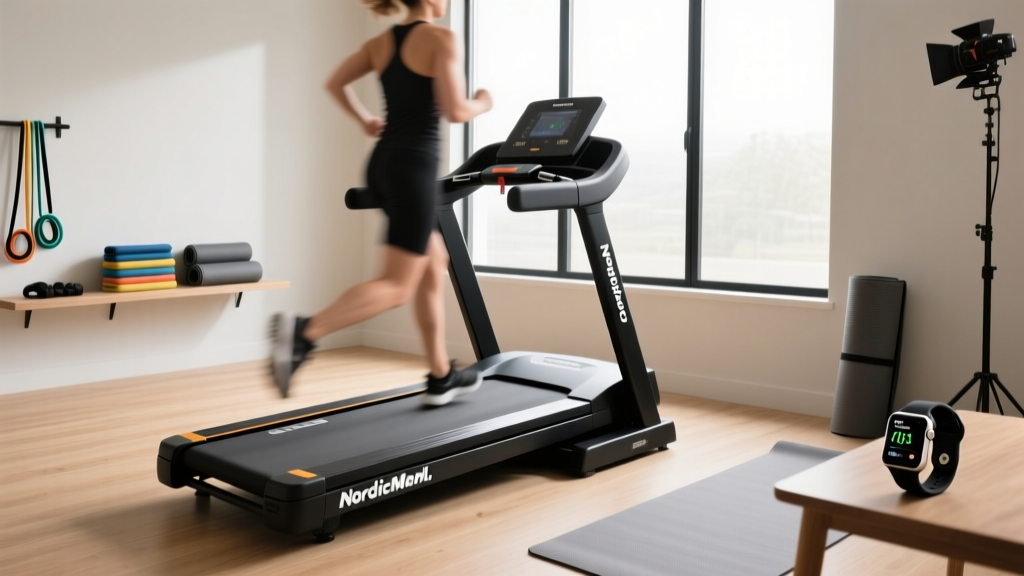
Treadmill Trail Tech: 2026 Folding Treadmill for Small Spaces Review
Discover the top folding treadmills for small spaces in 2026. We analyze market trends, trail simulation tech, and spatial footprints for urban homes.

The 2026 Market Shift: Urban Spaces Meet Treadmill Trail Demands
As urbanization accelerates in 2026, the average square footage of newly built apartments continues to shrink, yet consumer demand for immersive, outdoor-simulated cardio has never been higher. The modern fitness enthusiast no longer settles for flat, monotonous indoor walking. Instead, the market has pivoted heavily toward treadmill trail simulation—utilizing dynamic incline/decline motors, adaptive deck cushioning, and high-definition topographical mapping to replicate the biomechanical demands of hiking and trail running.
However, a critical friction point remains: spatial limitations. Non-folding commercial incline trainers require up to 35 square feet of dedicated floor space, a luxury most urban dwellers simply do not possess. This has forced fitness engineers to develop a new breed of equipment: the high-performance folding treadmill. According to recent fitness industry analyses highlighted by the American College of Sports Medicine (ACSM), space-efficient equipment that does not compromise on biomechanical variability is the fastest-growing segment in home cardio.
📊 2026 Market Insight: Over 64% of home fitness buyers in metropolitan areas now list 'foldability' or 'stowability' as a top-three purchase criterion, while simultaneously demanding a minimum 12% incline grade for trail simulation.In this trend report and product review, we analyze the top folding treadmills that successfully bridge the gap between compact storage and rigorous treadmill trail routing. We evaluate their spatial footprints, motor thermals, and structural integrity.
Top Folding Treadmills for Trail Simulation Reviewed
To replicate a true treadmill trail experience, a machine must offer more than just a steep climb. It requires decline capabilities for downhill eccentric loading, a belt long enough for natural stride variations, and software integration for topographical mapping. Here are the leading contenders for small spaces in 2026.
1. NordicTrack EXP 14i: The Incline-Decline Trail Specialist
The NordicTrack EXP 14i has long been the benchmark for mid-tier folding treadmills, but its 2026 hardware refresh specifically targets the trail-simulation demographic. Unlike standard folding models that cap out at a 10% incline, the EXP 14i offers a -3% to 12% grade range, allowing users to simulate both steep ascents and technical downhill trail segments.
- Motor: 3.25 CHP Mach Z Commercial Plus
- Belt Dimensions: 20" x 60"
- Unfolded Footprint: 76" L x 32" W x 65" H
- Folded Footprint: 34" L x 32" W x 73" H
- Current Pricing: ~$1,199
The Expert Take: The 3.25 CHP motor is highly efficient, but the real star is the Reflex Cushioning deck. When simulating a treadmill trail route with mixed terrain, the deck adjusts its shock absorption, mimicking the slight give of packed dirt versus asphalt. The folding mechanism utilizes a hydraulic drop-fold system, which is safe but requires a vertical clearance of at least 75 inches when stowed.
2. Bowflex Series 8: Premium Immersive Trail Routing
For users who prioritize visual immersion alongside physical exertion, the Bowflex Series 8 pairs a robust folding chassis with a 24-inch pivoting touchscreen designed for JRNY's adaptive trail mapping. The Series 8 excels in eccentric muscle loading, offering a -5% decline to 20% incline—the widest grade range in the folding category.
- Motor: 3.5 CHP
- Belt Dimensions: 22" x 60"
- Unfolded Footprint: 80" L x 35" W x 66" H
- Folded Footprint: 39" L x 31" W x 71" H
- Current Pricing: ~$1,799
The Expert Take: The 22-inch belt width is a massive advantage for trail simulation. When running simulated technical trails, users naturally drift laterally; a 20-inch belt often leads to clipping the side rails. The Bowflex Series 8 accommodates this lateral drift. However, its folded depth of 39 inches makes it slightly more intrusive in narrow hallways compared to the NordicTrack.
3. Horizon 7.4S: The Budget-Friendly FTMS Trail Connector
Horizon takes a different approach with the 7.4S. Instead of locking users into a proprietary ecosystem, it features open Bluetooth FTMS (Fitness Machine Service) connectivity. This allows users to connect their treadmill to third-party trail simulation apps like Zwift or Kinomap, controlling the treadmill's incline automatically based on virtual GPS trail routes.
- Motor: 3.0 CHP
- Belt Dimensions: 22" x 60"
- Unfolded Footprint: 78" L x 34" W x 64" H
- Folded Footprint: 38" L x 32" W x 70" H
- Current Pricing: ~$1,099
The Expert Take: While it lacks a decline motor (capping at 0% to 15% incline), the FTMS integration makes it a powerhouse for tech-savvy runners. The 3.0 CHP motor is adequate for walking and light jogging on trails, but heavy runners attempting sustained 15% incline hikes may push the motor to its thermal limits.
Specification & Footprint Comparison Matrix
| Feature | NordicTrack EXP 14i | Bowflex Series 8 | Horizon 7.4S |
|---|---|---|---|
| Grade Range | -3% to 12% | -5% to 20% | 0% to 15% |
| Folded Depth | 34 inches | 39 inches | 38 inches |
| Belt Width | 20 inches | 22 inches | 22 inches |
| Ecosystem | iFIT (Proprietary) | JRNY (Proprietary) | Open FTMS |
Engineering Realities: Failure Modes in Folding Trail Treadmills
When analyzing equipment from a market and engineering perspective, it is vital to address the mechanical compromises inherent in folding designs. Simulating a rugged treadmill trail places unique stresses on folding chassis components that flat-walking treadmills never encounter.
Thermal Shutoffs in Incline Motors
Simulating a 12% to 20% trail grade requires the incline motor to hold the deck at a steep angle while the drive motor works against gravity. In folding units, the incline motor housing is often compacted to allow the deck to fold flush against the uprights. This reduces thermal mass and airflow. Edge Case: Users weighing over 220 lbs who attempt continuous 45-minute trail climbs at 15%+ incline on 3.0 CHP models (like the Horizon 7.4S) frequently trigger internal thermal shutoffs. For heavy, sustained trail climbing, the 3.5 CHP Bowflex Series 8 is mechanically superior.
Gas Strut Degradation
Most folding treadmills use hydraulic gas struts to assist in lifting and lowering the heavy running deck. Over a 3-to-5-year lifecycle, the pressurized gas inside these struts can slowly leak, reducing their lifting force. A deck that once required 15 lbs of force to lower safely may suddenly drop with 40 lbs of force, posing a severe crush hazard to pets or children. Actionable Advice: Inspect the hydraulic struts annually. If the deck no longer 'floats' downward when the release latch is pulled, replace the struts immediately (typically a $40-$60 aftermarket part).
Spatial Optimization: Measuring for Small Spaces
Marketing materials often highlight the 'folded footprint' but omit the operational clearances required for safety and ergonomics. The Mayo Clinic emphasizes the importance of safe fall zones behind cardio equipment, a factor often ignored in compact apartments.
"Always maintain a minimum clearance of 48 inches behind the treadmill to prevent severe friction burns or impact injuries in the event of a fall, regardless of how compact the room is."
The 'Stow-and-Deploy' Time Metric: In small spaces, the friction of unfolding the machine dictates whether it actually gets used. The NordicTrack EXP 14i features a soft-drop hydraulic hinge that deploys in roughly 12 seconds with minimal physical effort. Conversely, manual pin-lock folding mechanisms found on budget sub-$800 models can take over 60 seconds and require significant lower-back exertion, leading to long-term user abandonment.
Final Verdict: Which Folding Treadmill Trail Rig Wins?
The 2026 landscape of folding treadmills proves that urban dwellers no longer have to sacrifice biomechanical realism for spatial efficiency. Your choice ultimately depends on your specific trail simulation goals and room geometry.
- Best Overall for Spatial Efficiency & Value: The NordicTrack EXP 14i offers the tightest folded profile (34" depth) while still providing crucial 3% decline capabilities for downhill trail simulation, making it the smartest buy for standard apartment layouts.
- Best for Hardcore Trail Runners: The Bowflex Series 8 commands a premium price (~$1,799) and requires more floor space, but its 22-inch belt, 20% max incline, and 3.5 CHP motor make it the only folding unit capable of handling aggressive, high-speed trail routing without thermal throttling.
- Best for App-Agnostic Techies: The Horizon 7.4S wins for users who want to map their own GPS trail routes via third-party FTMS apps without being locked into expensive monthly proprietary subscriptions.
As noted by gear analysts at WIRED, the convergence of open-source software and compact mechanical engineering is redefining home cardio. By selecting a machine that aligns with both your spatial constraints and your desired trail intensity, you can build a world-class training environment in the corner of your living room.
More gear to consider
All reviews
Home Stair Climber Fixes & The Wooden Treadmill Without Electricity
What Size Treadmill Do I Need? Space Layout and Belt Care

Stair Climber Setup Guide: Pairing With a Dumbbell Rowing Machine
Treadmill vs Rower: Curved Manual vs Motorized Treadmill Showdown

NordicTrack 1750 Treadmill Review: Small Space Maintenance Guide