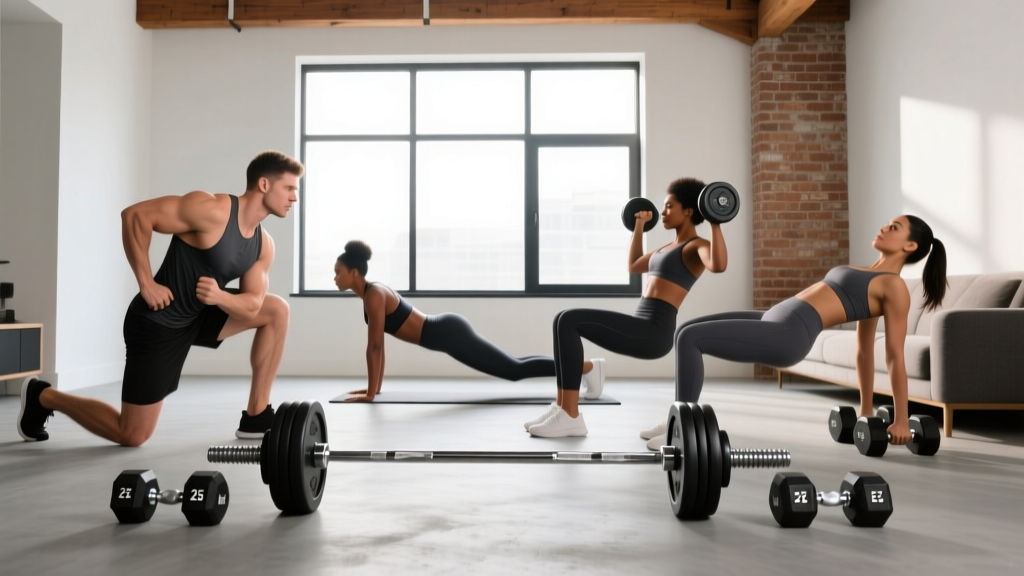
EZ Bar vs Straight Bar & Lower Back Exercises at Home with Dumbbells
Compare the EZ curl bar vs straight bar for arm gains, then master essential lower back exercises at home with dumbbells for a balanced 2026 home gym.

The Upper Body Debate: EZ Curl Bar vs. Straight Bar
When outfitting a home gym, lifters often debate the merits of specialized barbells versus traditional straight bars. The EZ curl bar vs straight bar comparison is a cornerstone of upper-body programming, specifically regarding bicep hypertrophy, forearm development, and joint longevity. However, building a truly resilient physique requires more than just arm isolation; it demands a robust posterior chain. In this comprehensive 2026 guide, we break down the biomechanical differences between these two iconic bars, review the top models on the market, and transition into a critical, often-neglected component of home training: executing effective lower back exercises at home with dumbbells.
Biomechanics and Joint Health: Which Bar Wins?
The primary difference between an EZ curl bar and a straight barbell lies in the grip angle and its subsequent effect on the wrist, elbow, and shoulder joints. According to biomechanical analyses documented by ExRx, a straight bar forces the lifter into full supination (palms facing directly up). While this maximizes the short head of the biceps brachii, it can place severe valgus stress on the elbows and force the wrists into extreme extension, particularly for individuals with a high 'carrying angle' (cubitus valgus).
The EZ curl bar features angled bends that allow for a semi-supinated or neutral grip. This slight rotation aligns the radius and ulna bones more naturally, drastically reducing torque on the medial epicondyle of the elbow and alleviating wrist strain. However, this grip shift places slightly more emphasis on the brachialis and brachioradialis, meaning the biceps peak might not be isolated quite as aggressively as it is on a straight bar.
Expert Callout: The Myth of the 'Inferior' EZ BarMany old-school bodybuilders claim the EZ bar is inferior for bicep peaks. This is a myth. The semi-supinated grip allows most lifters to handle heavier loads with stricter form and zero joint pain, leading to greater overall mechanical tension and, ultimately, more hypertrophy over a training cycle.
2026 Hands-On Barbell Reviews
To help you make an informed purchase, we tested the most popular options currently available in the home fitness market.
1. Rogue Fitness EZ Curl Bar (The Premium Pick)
Rogue’s EZ Curl Bar remains the gold standard for serious home gyms. Weighing in at 35 lbs, it features a medium-depth 'volcano' knurl that grips the skin without tearing calluses. The multi-angle bends are spaced perfectly for both narrow and wide grips. Priced around $245, it utilizes high-quality bronze bushings for smooth sleeve rotation during heavy reverse curls. The 11.5-inch loadable sleeve length easily accommodates up to 450 lbs of standard bumper or iron plates.
2. Titan Fitness 7FT Olympic Bar (The Straight Bar Workhorse)
For straight bar work, the Titan Fitness 7FT Olympic Bar ($159.99) offers incredible value. It boasts a 50,000 PSI tensile strength and a 190,000 PSI yield strength, meaning it will not permanently bend under heavy loads. The dual knurl marks (powerlifting and Olympic) make it versatile for everything from strict bicep curls to heavy barbell rows. Its hard chrome finish resists rust and oxidation, a critical feature for garage gyms where humidity fluctuates.
3. CAP Barbell Super Curl Bar (The Budget Option)
If you are on a strict budget, the CAP Barbell Super Curl Bar ($55 - $70) is a viable entry point. At 15 lbs, it is significantly lighter than the Rogue, making it ideal for beginners or physical therapy. However, the knurling is relatively passive, and the sleeves use basic bushings that can squeak under heavy, unbalanced loads. It is best suited for strict, low-weight isolation work.
Comparison Matrix: EZ Bar vs. Straight Bar
| Feature | EZ Curl Bar | Straight Barbell |
|---|---|---|
| Wrist & Elbow Strain | Low (Semi-supinated grip) | High (Full supination) |
| Primary Muscle Focus | Brachialis, Brachioradialis, Biceps | Biceps Brachii (Short Head focus) |
| Max Load Capacity | Moderate (Sleeve length limits plates) | High (Standard 16.3" sleeves) |
| Best For | Hypertrophy, Joint preservation, Skullcrushers | Heavy compounds, Reverse curls, Strict form |
Crucial Balance: Lower Back Exercises at Home with Dumbbells
While optimizing your arm training is rewarding, neglecting the posterior chain is a recipe for postural dysfunction and injury. When programming lower back exercises at home with dumbbells, the goal is not to load the spine with heavy, compressive forces (like a barbell back squat), but rather to train the spinal erectors, quadratus lumborum, and deep core stabilizers through hip-hinging and anti-rotation movements.
Spine biomechanics expert Dr. Stuart McGill emphasizes the importance of building 'spinal stiffness' and endurance rather than just raw power to prevent injury. According to the protocols outlined on BackFitPro, stabilizing the lumbar spine while the hips and shoulders move is the key to a bulletproof back. Dumbbells are the perfect tool for this, as they allow for unilateral loading and natural movement paths that barbells restrict.
1. Dumbbell Romanian Deadlifts (RDLs)
The RDL is the king of posterior chain development. Unlike a standard deadlift, the RDL starts from the top down, focusing on the eccentric stretch of the hamstrings and the isometric hold of the lower back.
- Setup: Hold a pair of heavy hex dumbbells (e.g., 50-70 lbs each) at arm's length in front of your thighs.
- Execution: Unlock your knees slightly, then push your hips backward as if closing a car door with your glutes. Keep the dumbbells grazing your legs.
- Failure Mode: Rounding the lumbar spine. Stop the descent the exact moment your hips stop moving backward. Do not bend your spine to reach the floor.
- Prescription: 3 sets of 8-10 reps with a 3-second eccentric (lowering) phase.
2. Dumbbell Goblet Good Mornings
This variation shifts the center of mass anteriorly, forcing the thoracic and lumbar erectors to work overtime to maintain a neutral spine.
- Setup: Hold a single dumbbell vertically against your chest in a goblet position. Stand with feet shoulder-width apart.
- Execution: Brace your core as if anticipating a punch. Hinge at the hips, keeping your chest proud and spine neutral, until your torso is nearly parallel to the floor.
- Expert Tip: The ACE Exercise Library notes that maintaining cervical neutrality (looking slightly ahead and down, not up at the mirror) is crucial to prevent upper cross syndrome during hinges.
3. Weighted Bird-Dog (Core & Lumbar Stabilization)
While not a heavy hinge, the weighted Bird-Dog trains the multifidus and erector spinae to resist rotational forces.
- Setup: Get on all fours. Hold a light dumbbell (10-15 lbs) in your right hand.
- Execution: Extend your right arm forward and your left leg backward simultaneously. Hold for 3 seconds, focusing on pulling your ribcage down and preventing your lower back from arching.
- Prescription: 3 sets of 6 reps per side, focusing purely on balance and spinal stiffness.
The Complete Upper/Lower Home Gym Protocol
To integrate your barbell arm work with your dumbbell lower back training, utilize this balanced 4-day split designed for the home gym environment.
- Day 1: Upper Body (Pull & Bicep Focus)
- Straight Bar Reverse Curls: 3 x 10
- EZ Bar Skullcrushers: 3 x 12
- EZ Bar Strict Curls: 4 x 8-10
- Day 2: Lower Body & Posterior Chain
- Dumbbell Goblet Squats: 3 x 12
- Heavy Dumbbell RDLs: 4 x 8
- Dumbbell Goblet Good Mornings: 3 x 15
- Day 3: Active Recovery & Core
- Weighted Bird-Dogs: 3 x 8 per side
- McGill Curl-Ups & Side Planks
- Day 4: Full Body Hypertrophy
- Single-Arm Dumbbell Rows: 4 x 10 (Excellent for lat and lower back integration)
- EZ Bar Close-Grip Bench Press: 3 x 10
- Farmer's Walks with Heavy Dumbbells: 3 x 60 seconds
Frequently Asked Questions
Can I use a straight bar for lower back exercises?
Yes, traditional barbell good mornings and deadlifts are excellent for the lower back. However, when restricted to a home gym with limited plate storage or rack space, lower back exercises at home with dumbbells offer a safer, highly effective alternative that reduces shear force on the lumbar spine while still providing ample muscular stimulus.
Why does my lower back hurt after EZ bar curls?
Lower back pain during standing curls is almost always caused by 'cheat curls'—using lumbar hyperextension (arching backward) to swing the weight up. To fix this, perform your EZ bar curls seated on a bench, or strictly brace your glutes and core while standing to lock your pelvis in a neutral position.
What weight dumbbells should I buy for home RDLs?
For most intermediate lifters, a pair of 50 lb to 70 lb rubber hex dumbbells is the sweet spot for RDLs. Hexagonal shapes prevent the weights from rolling away between sets, and rubber coatings protect your home flooring. Adjustable dumbbells (like PowerBlock or Nuobell) are also excellent space-saving options that allow you to micro-load the exercise as your hamstring flexibility improves.
More gear to consider
All reviews
Olympic Barbell Guide: Weight, Knurling & the Dumbbell Hang Snatch
Bumper vs Iron Plates & Standing Abs Workout with Dumbbells

How to Get Bigger Arms with Dumbbells vs. Olympic Barbells

Barbell Buying Guide: Weight, Knurling & Bent Over Dumbbell Laterals
Close Grip Incline Dumbbell Press: EZ Curl Bar vs Straight Bar
