Power Rack vs Squat Rack vs Stand: Back Exercise Using Dumbbell Routines
Compare power rack vs squat rack vs squat stand. Learn which setup best supports heavy lifting and your favorite back exercise using dumbbell routines.

The 2026 Home Gym Foundation: Why Your Rack Choice Matters
Building a home gym is one of the highest-ROI investments you can make for your long-term health, but the sheer volume of equipment options can paralyze beginners. As of 2026, the market is flooded with variations of squat racks, power cages, and minimalist stands. Choosing the wrong footprint or steel gauge doesn't just waste money—it actively limits your exercise selection and compromises safety.
While most buyers focus entirely on barbell squats and bench presses, a well-chosen rack fundamentally changes how you perform accessory work. For instance, if your program requires a targeted back exercise using dumbbell pairs—like heavy chest-supported incline rows or resisted band rows—the dimensions, interior depth, and attachment ecosystem of your rack will dictate whether the movement is highly effective or biomechanically restricted. This step-by-step guide will break down the structural differences between power racks, squat racks (half-racks), and squat stands, helping you match the right steel to your specific training goals.
Defining the Contenders: Cage, Half-Rack, and Stands
Before diving into programming, we must establish the physical boundaries of the three primary rack categories. Understanding the steel gauge (thickness) and tubing dimensions (usually 2x2 or 3x3 inches) is critical for evaluating stability.
1. The Power Rack (Full Cage)
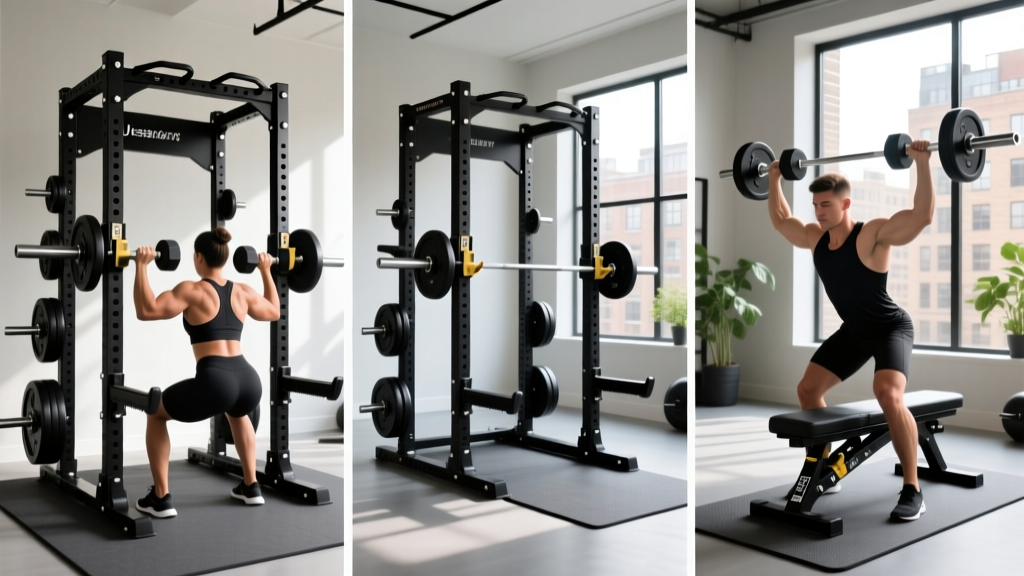
A power rack consists of four main vertical posts connected by horizontal crossmembers, creating an enclosed 'cage.' It features safety spotter bars or straps that catch dropped weights. Because you lift inside the rack, it is the gold standard for solo training. Models like the Rogue RML-390F (3x3 inch tubing, 11-gauge steel) offer immense stability and a massive ecosystem of attachments, from lat pulldowns to monolifts.
2. The Squat Rack (Half-Rack)
Often confused with stands, a true half-rack (like the Titan Fitness T-2 Half Rack) features two main front posts and two shorter rear stabilizing posts. You lift outside the rack, racking the barbell on the front J-cups. This provides more lateral freedom for Olympic lifts or dynamic movements but requires careful weight management, as failing a rep forward can result in the barbell missing the safety catches.
3. The Squat Stand
Squat stands (e.g., Rep Fitness SR-4000) are two independent, freestanding vertical posts with weighted bases. They are highly space-efficient and budget-friendly but offer zero overhead stability and limited attachment options. They are strictly for racking and unracking barbells.
Comparison Matrix: Specs, Pricing, and Footprints
| Feature | Power Rack (Cage) | Squat Rack (Half-Rack) | Squat Stand |
|---|---|---|---|
| Average Footprint | 48" x 30" to 48" x 48" | 48" x 36" | 36" x 24" (per pair) |
| 2026 Avg Price Range | $650 - $1,200+ | $400 - $600 | $250 - $350 |
| Interior Lifting Space | Enclosed (High Safety) | Exterior (Moderate Safety) | Exterior (Low Safety) |
| Attachment Compatibility | Extensive (Cables, Pulleys, Dip Bars) | Moderate (Pull-up bars, Band pegs) | Minimal (J-cups, basic safeties) |
Step-by-Step: Selecting the Right Rack for Your Space and Goals
Follow this sequential framework to eliminate guesswork and align your equipment with your training reality.
- Step 1: Audit Your Ceiling and Floor Space. Standard power racks are 84 to 90 inches tall. If you have a basement gym with a 7-foot ceiling, you must seek out 'short' racks (usually 72 inches) to allow clearance for overhead presses and pull-ups. Ensure you have at least 12 inches of clearance on all sides for loading plates.
- Step 2: Map Your Exercise Selection. Write down your top 10 movements. If your list is heavy on barbell squats, bench presses, and rack pulls, a power rack is non-negotiable. If you prioritize Olympic weightlifting (cleans and snatches), a half-rack provides the necessary bailout space.
- Step 3: Factor in Accessory and Dumbbell Work. This is where many beginners fail. If your hypertrophy blocks rely heavily on supported movements, the rack's interior depth becomes a critical metric.
Optimizing for the Back: Dumbbell Rows and Rack Ergonomics
Let’s address a specific, highly effective training scenario: programming a heavy isolation back exercise using dumbbell equipment, such as the chest-supported incline row. According to biomechanical data cataloged by the ExRx Exercise Directory, chest-supported rows eliminate lower back momentum, forcing the latissimus dorsi and rhomboids into strict isolation.
To perform this movement safely and effectively inside a rack, you must wedge an adjustable FID (Flat/Incline/Decline) bench inside the cage and set it to a 30- or 45-degree incline. Here is where rack dimensions dictate success:
- Interior Depth Matters: A shallow power rack (24-inch interior depth) will cause your elbows to strike the rear crossmembers or safety straps at the bottom of the rowing motion when using large hex dumbbells. You need a rack with at least a 30-inch interior depth (like the Rogue RML-390F) to allow full range of motion without steel interference.
- Band Peg Integration: Advanced lifters often use accommodating resistance for rows. A full power rack allows you to anchor heavy resistance bands to the bottom crossmembers, looping them around the dumbbells to create peak tension at the top of the contraction. Squat stands lack these low-anchor crossmembers entirely.
- Bench Stability: When dragging heavy 80lb dumbbells up your thighs to get into position on an incline bench, the bench can slide. Inside a power rack, you can pin the bench against the J-cups or use rack-mounted bench stabilizers, a luxury not afforded by freestanding squat stands.
Expert Insight: If your primary goal is a specific back exercise using dumbbell pairs and you lack the space for a full cage, consider a 'fold-away' wall-mounted power rack. These units provide the 30-inch depth required for incline bench rows but fold flat against the wall when not in use, solving the footprint issue for garage gyms.
Safety Protocols and Common Failure Modes
According to the CDC Physical Activity Guidelines, muscle-strengthening activities are vital, but injury prevention must remain the priority. When evaluating Rogue Fitness Power Racks or budget alternatives, inspect the following failure points:
Warning: The UHMW Plastic Check
Never buy a rack where the J-cups (the hooks that hold the barbell) are bare metal. Bare metal will chew through the knurling of your barbell and create dangerous slipping hazards. Ensure the J-cups are lined with UHMW (Ultra-High Molecular Weight) polyethylene plastic. This protects your gear and dampens the sound of re-racking heavy loads.
Another common failure mode occurs with squat stands. Because they are freestanding, re-racking a heavy barbell off-center can create a lateral tipping moment. If you opt for squat stands, you must purchase the optional rear crossmember and spotter arm extensions, and ensure the base is loaded with sandbags or heavy plates to lower the center of gravity.
Final Verdict: Which Setup Wins?
There is no universal 'best' rack—only the best rack for your specific spatial constraints and training modalities.
Choose the Power Rack If:
You train alone, prioritize heavy barbell lifts, and want the interior depth required to set up an adjustable bench for a supported back exercise using dumbbell variations safely. It is the ultimate 'buy once, cry once' investment.
Choose the Half-Rack If:
You perform dynamic Olympic lifts, need easy access for plate loading from the sides, and have a dedicated lifting platform where forward bailouts are safe.
Choose the Squat Stand If:
You are on a strict sub-$300 budget, have a very small footprint, and primarily use dumbbells and kettlebells for accessory work outside the rack.
By mapping your exact exercise selection—including your preferred dumbbell back movements—to the physical dimensions of the rack, you will build a home gym that serves your strength journey safely and effectively for decades to come.
More gear to consider
All reviews
Single Arm Dumbbell Floor Press: Olympic vs Standard Plate Mistakes

Space Layouts: Cable Cross With Dumbbells and Kettlebell Guides

How to Use Dumbbells: Beginner Guide & 2026 Adjustable Review

Setup Guide: Neoprene Dumbbell Workout to Tone Arms at Home

Rubber Hex vs Urethane: Space Layouts & Rear Delt Workout Dumbbell