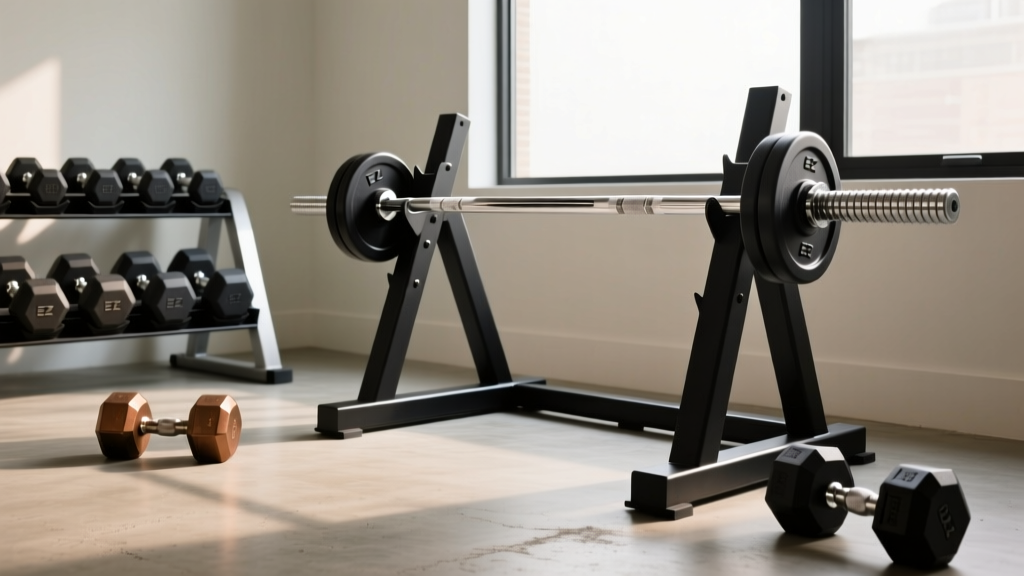
EZ vs Straight Bar Care: Longevity and the Dumbbell Isometric Hold
Compare EZ curl bar vs straight bar maintenance, longevity, and tensile strength. Learn how static loading and the dumbbell isometric hold impact bar care.

The Intersection of Static Loading and Barbell Longevity
When building a comprehensive arm and grip training arsenal in 2026, the debate between the EZ curl bar and the straight barbell usually centers on muscle activation and wrist ergonomics. However, from an equipment maintenance and longevity perspective, these two tools require vastly different care protocols—especially when subjected to high-tension static loading. Many strength athletes utilize the dumbbell isometric hold to build tendon resilience and grip endurance, often transitioning immediately to barbell curls. Understanding how the biomechanics of static holds interact with the structural integrity of EZ versus straight bars is critical for preventing permanent shaft deformation, sleeve seizure, and knurling degradation.
According to Rogue Fitness barbell specifications, the tensile strength and yield points of Olympic bars dictate their lifespan under heavy, sustained loads. While a straight bar distributes static tension evenly across a linear shaft, an EZ bar concentrates shear stress at its angled bends. This article breaks down the exact maintenance routines, structural vulnerabilities, and cleaning protocols required to maximize the lifespan of both bars in a modern home or commercial gym.
Knurling Maintenance: Linear Shafts vs. Angled Bends
The most immediate maintenance difference between a straight bar and an EZ curl bar lies in the knurling geometry. A standard straight barbell features continuous, uniform knurling (often with a smooth center ring) that is relatively easy to brush and wipe down. An EZ bar, however, features segmented knurling interrupted by smooth, angled bends designed to reduce wrist supination strain.
The Chalk Trap in EZ Bar Bends
During heavy bicep training, lifters frequently use chalk to maintain grip. On an EZ bar, the inner angles of the 30-degree and 45-degree bends act as natural traps for magnesium carbonate, dead skin cells, and sweat. If left uncleaned, this mixture absorbs ambient moisture and accelerates oxidation, particularly on older zinc or bare steel finishes.
Expert Maintenance Tip: Never use a wire brass brush on modern Cerakote or high-quality black zinc EZ bars, as it will strip the protective coating. Instead, use a stiff nylon brush and a few drops of 3-in-One oil to loosen impacted chalk from the angled bends, wiping away the residue with a microfiber cloth.For straight bars, a standard nylon brush followed by a light application of synthetic barbell oil is sufficient. For deeper insights on removing stubborn oxidation without damaging the knurl peaks, BarBend's comprehensive guide on barbell cleaning recommends using a 50/50 mix of white vinegar and water for spot treatments on severe rust patches, followed by immediate neutralization with a baking soda paste.
Tensile Strength and the Dumbbell Isometric Hold Transition
To understand why barbell longevity is tied to your training style, we must look at tensile strength, measured in Pounds per Square Inch (PSI). A high-quality Olympic straight bar typically boasts a tensile strength between 190,000 and 215,000 PSI. In contrast, many standard EZ curl bars—especially those in the $100 to $180 price bracket—range from 130,000 to 160,000 PSI. Premium EZ bars can reach 190,000 PSI, but their shorter overall length and bent geometry inherently alter their yield point.
Consider the dumbbell isometric hold. A lifter might hold a pair of 60 lb dumbbells at a 90-degree elbow flexion for 45 seconds to condition the brachialis and bicep tendons. This generates massive static tension. When the lifter transitions to a barbell equivalent—say, holding a 120 lb straight bar in the same isometric position—the linear shaft of the straight bar handles the continuous shear stress effortlessly.
Warning: EZ Bar Deformation RiskIf you attempt heavy, static barbell holds on a lower-PSI EZ curl bar, the continuous downward force combined with the torque applied at the angled grips can exceed the bar's yield strength. Over time, this causes the bends to permanently warp outward, ruining the ergonomic profile of the bar and causing uneven sleeve rotation.
Load Limits for Static Holds
- Straight Bar (190k+ PSI): Safe for heavy isometric holds up to the lifter's 1-rep max curl capacity.
- Premium EZ Bar (190k PSI): Safe for moderate static holds, but avoid dropping the bar from the top of a curl, as the bends are vulnerable to impact shock.
- Standard EZ Bar (130k-150k PSI): Restrict static holds to 50% of your max curl. Use the dumbbell isometric hold for heavy static tensioning instead to preserve the EZ bar's structural integrity.
Sleeve Bushings vs. Bearings Under Rotational Stress
The sleeve construction of your barbell dictates how it handles rotational force. When you finish a dumbbell isometric hold and move into rapid barbell curls, the barbell sleeves must spin to accommodate the natural rotation of your wrists and forearms.
| Feature | Straight Olympic Bar | EZ Curl Bar |
|---|---|---|
| Sleeve Mechanism | Needle Bearings or Composite Bushings | Brass or Bronze Bushings (Rarely Bearings) |
| Lubrication Need | Low (Sealed bearings require minimal oiling) | High (Bushings require regular synthetic oil) |
| Failure Mode | Bearing cage shattering from axial drops | Sleeve seizure from chalk/dust ingress |
| 2026 Avg. Replacement Cost | $85 - $120 per sleeve assembly | $45 - $75 per sleeve assembly |
Because EZ bars almost exclusively use bushings, they are highly susceptible to 'sleeve seizure' if fine chalk dust bypasses the snap rings and mixes with old oil, creating an abrasive paste. To maintain an EZ bar's sleeve spin, apply 2-3 drops of synthetic sleeve oil (or a high-grade 3-in-One oil) to the seam where the sleeve meets the shaft every 60 days. Rotate the sleeve manually to work the oil into the brass bushing.
Step-by-Step Deep Cleaning Protocol
Whether you are maintaining a straight bar or an EZ bar, a monthly deep clean is non-negotiable for equipment longevity. Follow this protocol to ensure your bars survive years of heavy isometric and dynamic loading.
- Dry Brush the Knurling: Use a stiff nylon brush to aggressively scrub the shaft. For EZ bars, pay special attention to the valleys of the bends where skin cells accumulate.
- Apply Solvent (If Needed): For stubborn grime, spray a mild degreaser or a 50/50 isopropyl alcohol and water mix onto the shaft. Let it sit for 60 seconds.
- Wipe Down: Use a clean, dry microfiber cloth to wipe away the dissolved chalk and oils. Never use paper towels, as they leave micro-lint in the knurling grooves.
- Re-Oil the Shaft: Apply a very light coat of barbell-specific oil or mineral oil to a cloth and wipe the shaft. This displaces ambient moisture and prevents flash rusting.
- Lubricate the Sleeves: Stand the bar vertically. Apply 3 drops of synthetic oil to the sleeve gap. Spin the sleeve for 15 seconds to distribute the lubricant evenly across the bushings.
Frequently Asked Questions
Can I use a straight bar for all my isometric hold exercises?
Yes, a high-PSI straight bar is structurally superior for heavy static holds. However, if you experience medial epicondylitis (golfer's elbow) or wrist pain during straight bar static holds, you must use an EZ bar. To protect the EZ bar, keep the static load moderate and rely on the dumbbell isometric hold for your heaviest, maximum-effort grip conditioning sets.
How often should I oil my EZ curl bar compared to my straight bar?
In a climate-controlled gym, oil your straight bar's shaft every 3 to 4 months. An EZ bar, due to its complex geometry and reliance on brass bushings, should have its shaft lightly oiled every 2 months, and its sleeves lubricated every 6 to 8 weeks to prevent chalk-induced seizure.
Does dropping an EZ bar damage it faster than a straight bar?
Absolutely. Straight bars are engineered to absorb the shock of being dropped from overhead or the rack. EZ bars are not. Dropping a loaded EZ bar, especially on the angled bends, can cause micro-fractures in lower-PSI steel and misalign the internal bushings, leading to a gritty, uneven sleeve spin.
More gear to consider
All reviews
Best Adjustable Dumbbells for the Dumbbell Press Exercise (2026)

Double Arm Dumbbell Row: Complete Home Setup & Form Guide

Best Neoprene Incline Chest Press Dumbbells for Home Use

Close Grip Press with Dumbbells: Loadable Set Value Guide
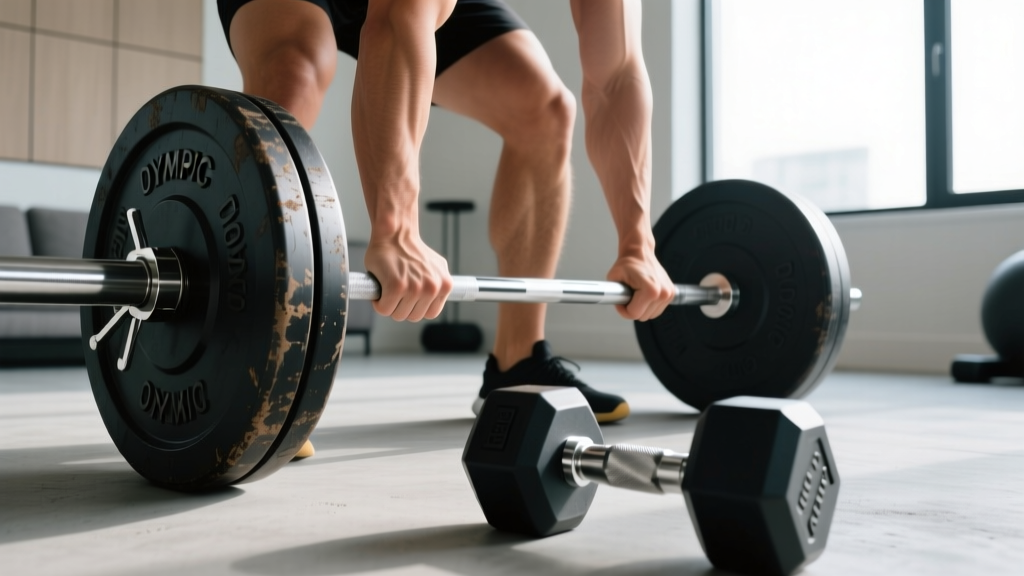
Dumbbell Bicep Curl GIF vs Barbell: Troubleshooting Knurling Errors
