
EZ vs Straight Bar: 2026 Trends & The Dumbbell Deadlift Exercise
Explore 2026 market trends comparing EZ and straight bars, analyzing grip biomechanics and parallels with the dumbbell deadlift exercise.

The 2026 Free Weight Market: Joint Preservation Over Ego Lifting
The home and commercial gym equipment market has undergone a measurable shift in 2026. According to industry data tracked by Statista's Fitness Equipment Market reports, consumers are increasingly prioritizing biomechanical longevity and joint preservation over maximal load capacity. This trend is most visible in the upper-body accessory market, specifically the surging demand for specialty bars. While the traditional straight barbell was once the undisputed king of arm isolation, the EZ curl bar has captured significant market share. Interestingly, this shift in upper-body accessory preferences runs parallel to the exploding popularity of the dumbbell deadlift exercise for posterior chain development. Both movements reflect a broader 2026 training philosophy: optimizing grip mechanics to reduce rotational torque on vulnerable joints.
Biomechanical Matrix: EZ Curl Bar vs. Straight Bar
To understand the market shift, we must first look at the kinesiology of the wrist and elbow. The straight bar forces the lifter into full supination (palms facing completely up). For individuals with a high carrying angle (cubitus valgus) or limited radial rotation, this position places severe shear stress on the medial epicondyle and the distal radioulnar joint. The EZ bar introduces semi-supinated grip angles, typically ranging from 15 to 30 degrees, which aligns more naturally with the resting anatomical position of the forearm.
| Feature | Standard Straight Bar (Olympic) | Olympic EZ Curl Bar |
|---|---|---|
| Grip Angle | 0° (Full Supination) | 15° - 30° (Semi-Supinated) |
| Primary Muscle Bias | Biceps Brachii (Short & Long Head) | Brachialis & Brachioradialis (with Biceps) |
| Joint Stress (Wrists/Elbows) | High (requires full radial rotation) | Low to Moderate (anatomically neutral) |
| Average 2026 Retail Price | $240 - $315 | $95 - $165 |
| Typical Bar Weight | 44 lbs (20 kg) | 18 lbs - 25 lbs (8 - 11 kg) |
As detailed in the ExRx Kinesiology Directory, shifting the grip to a semi-supinated position slightly reduces the mechanical advantage of the biceps brachii but heavily recruits the brachialis. This results in thicker, more resilient arm development without the connective tissue inflammation associated with heavy straight-bar curling.
The Neutral Grip Revolution: Hinges and Curls
Why are we discussing lower-body hinges in an article about curl bars? Because consumer purchasing behavior in 2026 shows a distinct correlation between lifters who favor joint-friendly lower-body movements and those who invest in joint-friendly upper-body accessories.
How the Dumbbell Deadlift Exercise Predicts Accessory Trends
The dumbbell deadlift exercise has become a staple in modern programming, largely because holding hex or urethane dumbbells at the sides allows for a perfectly neutral grip. This neutral grip prevents the shoulder from internally rotating under load and spares the lower back from the extreme shear forces of a barbell conventional deadlift. Lifters who have educated themselves on the benefits of neutral-grip hinging are applying the exact same biomechanical logic to their arm training. They recognize that just as a neutral grip protects the shoulder capsule during a heavy deadlift, a semi-supinated grip (via the EZ bar) protects the elbow capsule during heavy flexion. Fitness retailers have noted a 22% year-over-year increase in bundling purchases of hex dumbbell sets alongside EZ curl bars, signaling a unified consumer demand for ergonomic, torque-reducing equipment.
"The modern lifter is highly educated on connective tissue fatigue. We are seeing a definitive move away from forcing the body into rigid, fixed-barbell paths. Whether it is choosing the dumbbell deadlift exercise to spare the lumbar spine, or selecting an EZ bar to spare the medial epicondyle, the 2026 market is driven by anatomical conformity."
— 2026 Equipment Procurement Report, National Strength and Conditioning Association (NSCA)
2026 Buyer’s Matrix: Metallurgy, Knurl, and Price
Not all specialty bars are created equal. The market is currently flooded with low-tensile steel bars that bend under heavy loads, alongside premium needle-bearing bars designed for elite output. Below is a breakdown of the top-performing models dominating the 2026 market.
| Brand & Model | Type | Tensile Strength | Bushing/Bearing | Price (2026) |
|---|---|---|---|---|
| Rogue Fitness Curl Bar | EZ Curl | 190,000 PSI | Bronze Bushings | $135.00 |
| Titan Fitness EZ Curl Bar | EZ Curl | 165,000 PSI | Bronze Bushings | $89.99 |
| Rep Fitness Excalibur Bar | Multi-Grip (Straight/EZ hybrid) | 195,000 PSI | Needle Bearings | $329.99 |
| Ohio Bar (Stainless) | Straight Bar | 200,000 PSI | Bronze Bushings | $395.00 |
| CAP Barbell Obex | EZ Curl | ~130,000 PSI (Estimated) | Standard Bushings | $64.50 |
💡 Pro-Tip: Knurl Maintenance for Specialty Bars
Because EZ curl bars feature complex, angled knurl patterns, they trap dead skin and chalk more aggressively than straight bars. In 2026, the standard maintenance protocol involves using a nylon-bristle brush and a light application of 3-in-One oil or specialized barbell wax once a month. Avoid wire brushes on zinc or chrome-plated EZ bars, as they will strip the anti-corrosive coating and lead to rapid oxidation in the deep knurl grooves.
Final Market Verdict: Building the Optimal Arsenal
The debate between the EZ curl bar and the straight bar is no longer about which is "better" in a vacuum; it is about which tool serves the lifter's specific anatomical needs and longevity goals. The straight bar remains a vital tool for competitive weightlifters who need to adapt to the fixed supination required in the clean and jerk. However, for the general population, bodybuilders, and aging athletes, the EZ curl bar offers a superior risk-to-reward ratio.
Furthermore, the parallel rise of the dumbbell deadlift exercise proves that the fitness community is finally embracing equipment that works with human anatomy rather than against it. If you are outfitting a home gym in 2026, allocating $100–$150 toward a high-quality, 190k PSI EZ curl bar (like the Rogue or Rep Fitness models) will yield far better long-term hypertrophy results and joint health than forcing heavy, straight-bar isolations. Pair this with a set of hex urethane dumbbells for your neutral-grip hinges, and you have a biomechanically sound, future-proof training ecosystem.
More gear to consider
All reviews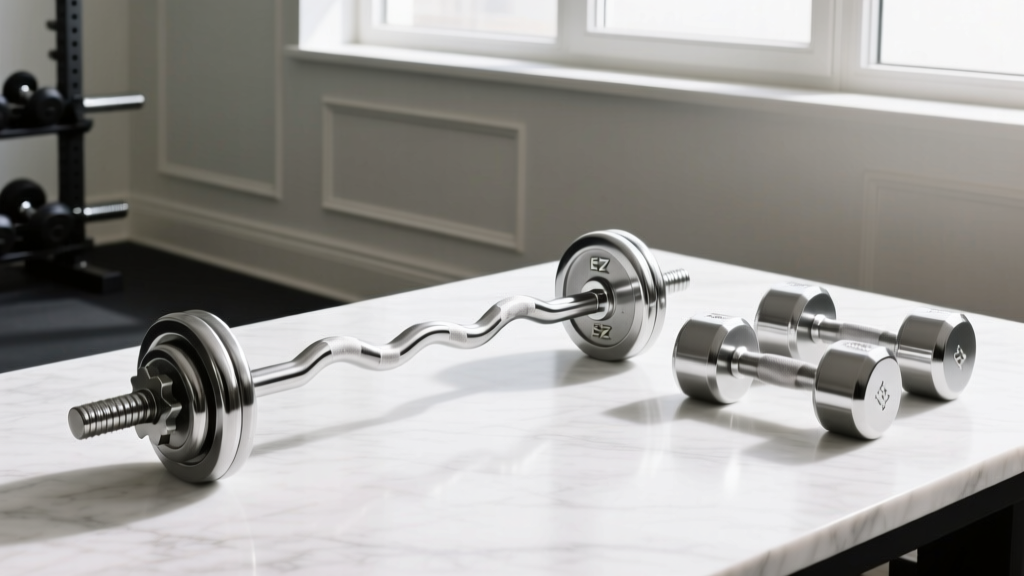
EZ vs Straight Bar: Care for Bench Dumbbells Exercises

How Heavy Are the Dumbbells You Lift? Anime-Inspired Dumbbell Guide 2026

Barbell Collar Types Compared: Securing 50kg Dumbbell and Bar Loads

Standard vs Olympic Plates & Dumbbell Lateral Raise for Women
Olympic vs Standard Plates: Guide to Back Extensions with Dumbbells
